



IL-1R1 Protein, Rat (HEK293, His)
Based on 1 Customer Validation
IL-1R1 (CD121a) belongs to IL-1 receptor, and binds to IL-1α, IL-1β, IL-1Ra and IL-38 with comparable affinities (Kd: 0.1-1 nM). IL-1R1 regulates the transcription of multiple proinflammatory cytokines and mediates immune and inflammatory responses, including the activation of NF-κB, MAPK pathways . IL-1R1 Protein, Rat (HEK293, His) is a recombinant rat extracellular region of IL-1R1 (M1-K352) with a C terminal His tag, which is produced in HEK293 cells.
- Species: Rat
- Source: HEK293
-
Storage:Stored at -20°C for 2 years from date of receipt. After reconstitution, it is stable at 4°C for 1 week or -20°C for longer (with carrier protein). It is recommended to freeze aliquots at -20°C or -80°C for extended storage.


To place orders, for customer services and technical support, please contact: MedChemExpress USA
Tel: 609-228-6898 E-mail: [email protected] [email protected]


-
 Biological Activity
-
Technical Parameters
-
Product Properties
- Documentation
- References
- Help & FAQs




Biological Activity
Description
IL-1R1 (CD121a) belongs to IL-1 receptor, and binds to IL-1α, IL-1β, IL-1Ra and IL-38 with comparable affinities (Kd: 0.1-1 nM). IL-1R1 regulates the transcription of multiple proinflammatory cytokines and mediates immune and inflammatory responses, including the activation of NF-κB, MAPK pathways [1]. IL-1R1 Protein, Rat (HEK293, His) is a recombinant rat extracellular region of IL-1R1 (M1-K352) with a C terminal His tag, which is produced in HEK293 cells.
Background
IL-1R1 (CD121a), a member of IL-1 receptor, is a receptor for IL-1α, IL-1β, IL-1Ra and IL-38, thereby mediating IL-1-dependent activation[1]. IL-1R1 is mainly expressed in endothelial cells and astrocytes. The neuronal distribution of IL-1R1 is limited in the rat forebrain, and is expressed in the hippocampus, basolateral amygdala and ARH. [2].
The sequence of amino acids in IL-1R1 differs in different species. Rats IL-1R1 shares 85.59% aa sequence identity with mouse, and shares <70% aa sequence identity with Human IL-1R1.
IL-1R1 interacts with IL-1α and IL-1β, thereby promoting signal transduction together with IL-1R3 (IL-1RAcP)[3]. IL-1R1 is important in necrosome formation. IL-1R1 interacts with p-MLKL to trigger neuronal necroptosis after tGCI (global cerebral ischemia)[4].
IL-1R1 mediates necrosome formation, and immune and inflammatory responses including the activation of NF-κB, MAPK and other pathways.
In Vitro
IL-1R1 (murine, .5 μg/mL) prevents the loss of cell-surface IL-1R1 in Il1rn−/− blood cells[6].
Verified Bioactivity
Measured by its binding ability in a functional ELISA. Immobilized Rat IL-1R1 at 10 μg/ml (100 μl/well) can bind Human IL-1RN. The ED50 for this effect is 2.163 ng/mL.
MCE Validation Data
-
Purity - SDS-PAGE
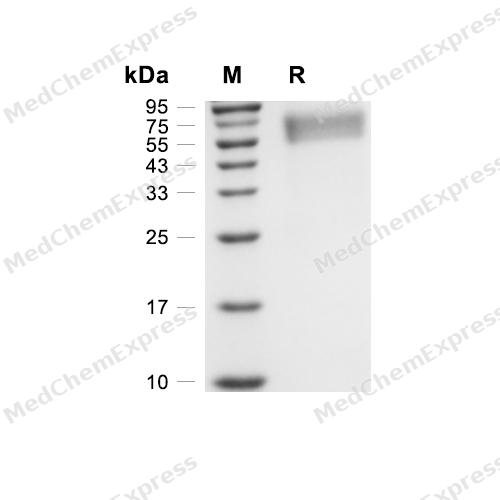
Purity - SDS-PAGE
-
Bioactivity - ELISA
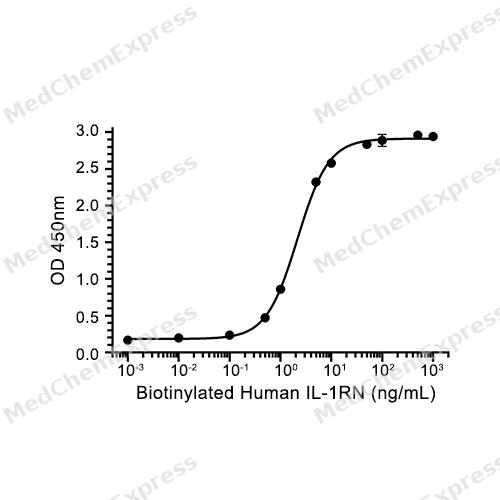
Bioactivity - ELISA


Technical Parameters
-
Species Rat
-
Source HEK293
-
Tag C-His
-
Accession
NP_037255.3 (L34-K352)
-
Molecular Construction
-
N-term
-
IL-1R1 (L34-K352)
Accession # NP_037255.3 -
His
-
C-term
-
-
Protein Length
Partial
-
Synonyms
IL1R1; IL-1R-Alpha; Prev. IL1RA; Interleukin 1 Receptor Alpha, Type I; Prev. IL1R; Interleukin-1 Receptor, Type I; CD121 Antigen-Like Family Member A; Interleukin 1 Receptor, Type I; Interleukin-1 Receptor Type 1; CD121a Antigen; Interleukin-1 Receptor Ty
-
AA Sequence
LETDKCTEYPNEVISFSSVNEIDIRSCPLTPNEMHGGTIIWYKNDSKTPISADKDSRIHQQNEHLWFVPAKMEDSGYYYCIMRNSTYCLKTKITMSVLENDPGLCYNTQASFIQRLHVAGDGSLVCPYLDFFKDENNELPKVQWYKNCKPLPLDDGNFFGFKNKLMVMNVAEEHRGNYTCRTSYTYQGKQYPVTRVITFITIDDSKRDRPVIMSPRNETMEADPGSTIQLICNVTGQFTDLVYWKWNGSEIEWDDPILAEDYQFLEHPSAKRKYTLITTLNVSEVKSQFYRYPFICFVKNTHILETAHVRLVYPVPDFK
-
Molecular Weight
Approximately 50-60 kDa, based on SDS-PAGE under reducing conditions, due to the glycosylation.
-
Purity
≥ 95%, as determined by reducing SDS-PAGE.


Product Properties
Lyophilized powder.
Lyophilized from a 0.22 μm filtered solution of PBS, pH 7.4.
<1 EU/μg, determined by LAL method.
It is not recommended to reconstitute to a concentration less than 100 μg/mL in ddH2O. For long term storage it is recommended to add a carrier protein (0.1% BSA, 5% HSA, 10% FBS or 5% Trehalose).
Stored at -20°C for 2 years from date of receipt. After reconstitution, it is stable at 4°C for 1 week or -20°C for longer (with carrier protein). It is recommended to freeze aliquots at -20°C or -80°C for extended storage.
Room temperature in continental US; may vary elsewhere.


Documentation
-
Data Sheet (265 KB)
-
SDS (254 KB)
- English - EN (254 KB)
- Français - FR (254 KB)
- Deutsch - DE (254 KB)
- Norwegian - NO (254 KB)
- Español - ES (254 KB)
- Swedish - SV (254 KB)
- Italian - IT (254 KB)
- Korean - KR (254 KB)
- Portuguese - PT (254 KB)
-
Handling Instructions (2659 KB)


References
[1]. Diana Boraschi, et al. The family of the interleukin-1 receptors. Immunol Rev. 2018 Jan;281(1):197-235. [Content Brief]
[2]. Léa Chaskiel, et al. Interleukin-1 reduces food intake and body weight in rat by acting in the arcuate hypothalamus. Brain Behav Immun. 2019 Oct;81:560-573. [Content Brief]
[3]. Naoe Kaneko, et al. The role of interleukin-1 in general pathology. Inflamm Regen. 2019 Jun 6;39:15. [Content Brief]
[4]. Xiang Chu, et al. Coupling Between Interleukin-1R1 and Necrosome Complex Involves in Hemin-Induced Neuronal Necroptosis After Intracranial Hemorrhage. Stroke. 2018 Oct;49(10):2473-2482. [Content Brief]
[5]. Siri Tahtinen, et al. IL-1 and IL-1ra are key regulators of the inflammatory response to RNA vaccines. Nat Immunol. 2022 Apr;23(4):532-542. [Content Brief]

Calculators
Concentration (start) × Volume (start) = Concentration (final) × Volume (final)


 Powered by Bioz

