



IL-2R beta/CD122 Protein, Rat (HEK293, His)

Based on 1 Customer Validation
IL-2R beta (CD122), a type Ⅰ cytokine receptor expressed on T lymphocytes, is a receptor for IL-2 (Kd: 1 nM approximately). IL-2R beta mediates T cell immune responses, such as stimulating T cell proliferation and activating lymphokine-activated killer cells. IL-2R beta/CD122 Protein, Rat (HEK293, His) is a recombinant rat IL-2R beta (M1-E239) with a C-Terminal His tag, which is produced in HEK293 cells.
- Species: Rat
- Source: HEK293
-
Storage:Stored at -20°C for 2 years from date of receipt. After reconstitution, it is stable at 4°C for 1 week or -20°C for longer (with carrier protein). It is recommended to freeze aliquots at -20°C or -80°C for extended storage.


To place orders, for customer services and technical support, please contact: MedChemExpress USA
Tel: 609-228-6898 E-mail: [email protected] [email protected]


-
 Biological Activity
-
Technical Parameters
-
Product Properties
- Documentation
- References
- Help & FAQs




Biological Activity
Description
IL-2R beta (CD122), a type Ⅰ cytokine receptor expressed on T lymphocytes, is a receptor for IL-2 (Kd: 1 nM approximately)[1]. IL-2R beta mediates T cell immune responses, such as stimulating T cell proliferation and activating lymphokine-activated killer cells[2]. IL-2R beta/CD122 Protein, Rat (HEK293, His) is a recombinant rat IL-2R beta (M1-E239) with a C-Terminal His tag, which is produced in HEK293 cells.
Background
IL-2R beta (CD122) is a type I cytokine receptor, and belongs to Type 4 subfamily. IL-2R beta is also a key component of the IL-15 receptor. IL-2R beta is broadly expressed in spleen, blood, and lymph node, such as B and T lymphocytes[1][3].
The sequence of amino acids in IL-2R beta differs in different species. Rats IL-2R beta shares 81.01% aa sequence identity with mouse. Human IL-2R beta shares <60% aa sequence identity with mouse and rats.
IL-2R beta cytoplasmic domain heterodimerizes with IL-2 and leads to the activation of signaling pathways: phosphoinositol 3-kinase (PI3-K)/AKT, Ras-MAP kinase, and the JAK-STAT pathways[4]. IL-2R beta binds IL-2 with intermediate affinity. IL-2R beta mediates IL-2 internalization and signal transduction, such as cell proliferation or differentiation[5]. IL-2R beta interacts with IL-2 and increases the proportion of CD4+ T lymphocytes[1]. IL-2R stimulates T cell proliferation and activating lymphokine-activated killer cells[2].
IL-2R beta mediates T cell immune responses, and also mediates endocytosis, as well as transducing the mitogenic signals of IL-2.
Verified Bioactivity
Measured by its ability to inhibit the IL-15-dependent proliferation of MO7e human megakaryocytic leukemic cells. The ED50 for this effect is 7.957 µg/mL in the presence of 4.0 ng/mL of recombinant human IL-15, corresponding to a specific activity is 6.094×10⁵ units/mg.
MCE Validation Data
-
Purity - SDS-PAGE
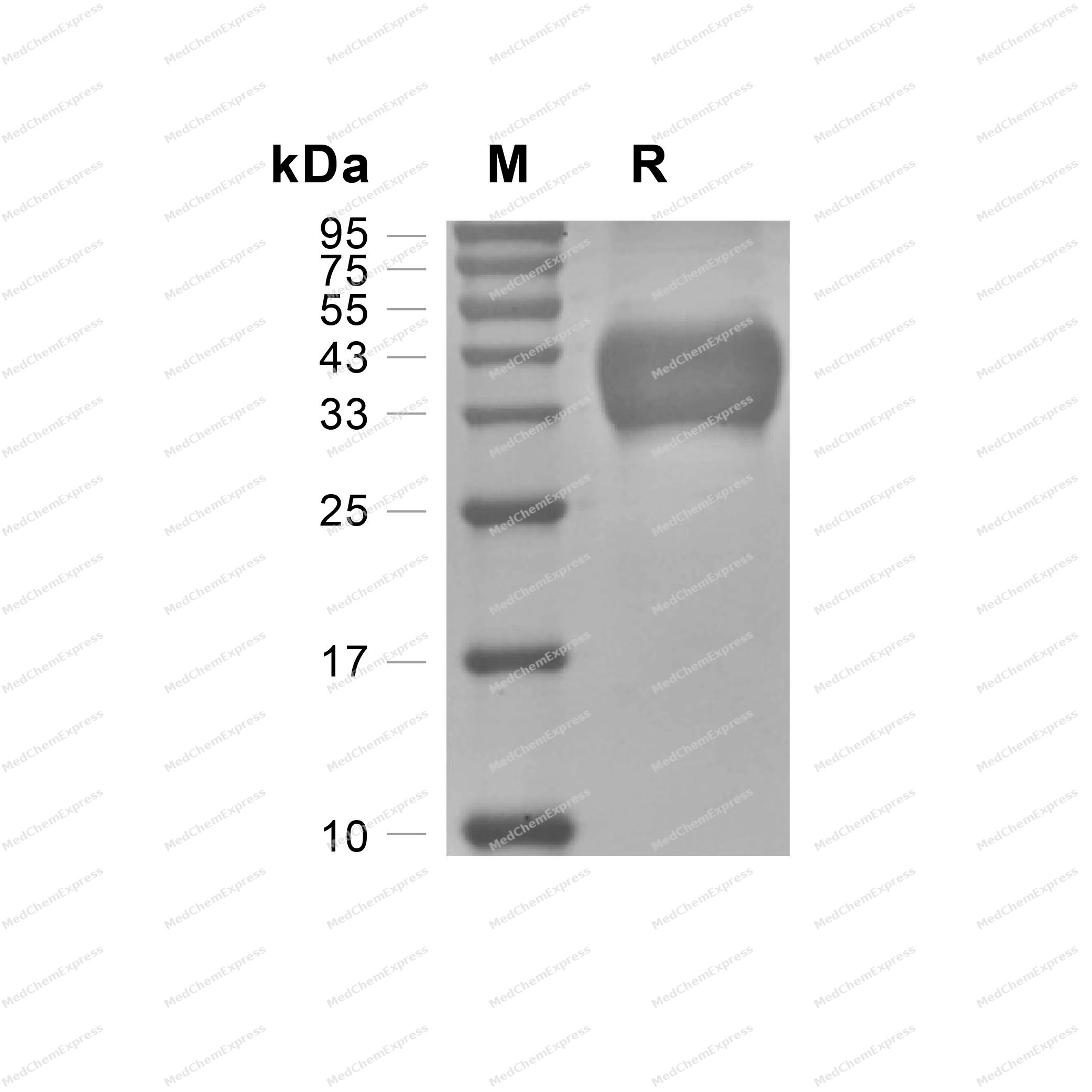
Purity - SDS-PAGE
-
Bioactivity - Cell-Based Assay
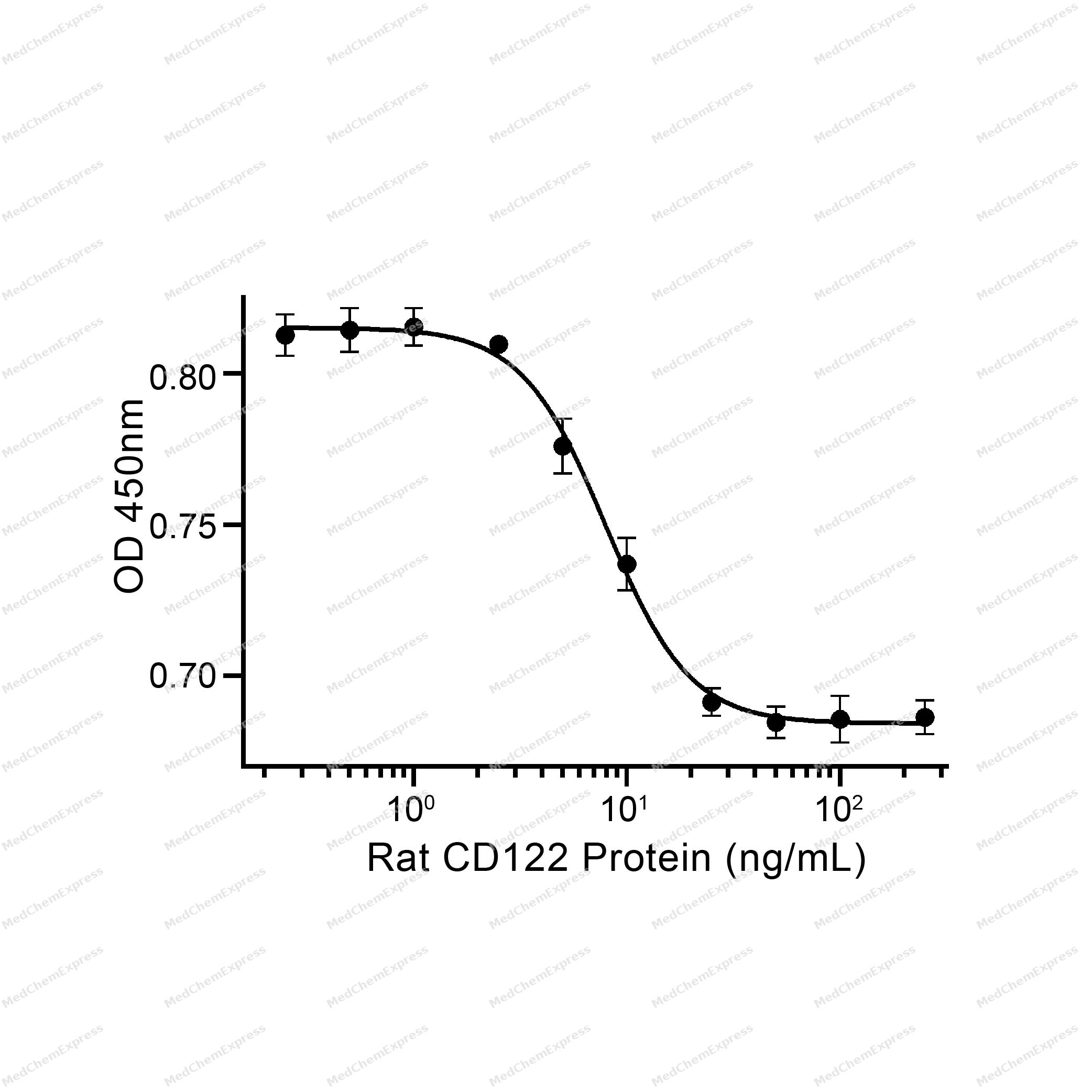
Bioactivity - Cell-Based Assay


Technical Parameters
-
Species Rat
-
Source HEK293
-
Tag C-His
-
Accession
NP_037327 (A27-E239)
-
Molecular Construction
-
N-term
-
IL-2Rβ (A27-E239)
Accession # NP_037327 -
His
-
C-term
-
-
Protein Length
Extracellular Domain
-
Synonyms
IL2RB; Interleukin 2 Receptor, Beta; Prev. IL15RB; IL-2R Subunit Beta; High Affinity IL-2 Receptor Subunit Beta; CD122 Antigen; Interleukin-2 Receptor Subunit Beta; IL-2RB; P70-75; P75; CD122; High Affinity IL-2 Receptor Beta Subunit; Interleukin-15 Recep
-
AA Sequence
AVNDCSHLKCFYNSRANVSCMWSPEEALNVTSCHIHAKSDMRHWNKTCELTPVRQASWACNLILGPLPDSQSLTSVDLLSLSVVCWEEKGWRRVKTCNFHPFDNLRLIAPHSLQVLHIETRRCNISWEVSQVSHYVNPYLEFEARRRLLDRSWEDASVFSLKQRQQWIFLETLTPDTSYELQVRVIAQRGKTRTWSPWSQPVAFRTRPADPKE
-
Molecular Weight
Approximately 30-49 kDa.
-
Purity
≥ 95%, as determined by reducing SDS-PAGE.


Product Properties
Lyophilized powder
Lyophilized from a 0.2 μm filtered solution of PBS, pH 7.4.
<1 EU/μg, determined by LAL method.
It is not recommended to reconstitute to a concentration less than 100 μg/mL in ddH2O. For long term storage it is recommended to add a carrier protein (0.1% BSA, 5% HSA, 10% FBS or 5% Trehalose).
Stored at -20°C for 2 years from date of receipt. After reconstitution, it is stable at 4°C for 1 week or -20°C for longer (with carrier protein). It is recommended to freeze aliquots at -20°C or -80°C for extended storage.
Room temperature in continental US; may vary elsewhere.


Documentation
-
Data Sheet (265 KB)
-
SDS (251 KB)
- English - EN (251 KB)
- Français - FR (251 KB)
- Deutsch - DE (251 KB)
- Norwegian - NO (251 KB)
- Español - ES (251 KB)
- Swedish - SV (251 KB)
- Italian - IT (251 KB)
- Korean - KR (251 KB)
- Portuguese - PT (251 KB)
-
Handling Instructions (2659 KB)


References
[1]. Xiujuan Zhou, et al. Interleukin-2 (IL-2) Interacts With IL-2 Receptor Beta (IL-2Rβ): Its Potential to Enhance the Proliferation of CD4+ T Lymphocytes in Flounder ( Paralichthys olivaceus). Front Immunol. 2020 Sep 9;11:531793. [Content Brief]
[2]. R N Bamfordm, et al. The interleukin (IL) 2 receptor beta chain is shared by IL-2 and a cytokine, provisionally designated IL-T, that stimulates T-cell proliferation and the induction of lymphokine-activated killer cells. Proc Natl Acad Sci U S A.1999 May [Content Brief]
[3]. Xiujuan Zhou, et al. Immunological characteristics of Interleukin-2 receptor subunit beta (IL-2Rβ) in flounder (Paralichtlys olivaceus): Implication for IL-2R function. Fish Shellfish Immunol. 2019 Oct;93:641-656. [Content Brief]
[4]. Akira Sakai, et al. The role of tumor-associated macrophages on serum soluble IL-2R levels in B-cell lymphomas. J Clin Exp Hematop. 2014;54(1):49-62. [Content Brief]
[5]. M Allouche, et al. Interleukin 2 receptors. Leuk Res. 1990;14(8):699-708. [Content Brief]

Calculators
Concentration (start) × Volume (start) = Concentration (final) × Volume (final)


 Powered by Bioz

