



PLA2G2D Protein, Human (His-SUMO)

Based on 1 Customer Validation
PLA2G2D protein is a secreted calcium-dependent phospholipase A2 that targets extracellular lipids and has anti-inflammatory and immunosuppressive functions.It hydrolyzes the fatty acyl group at the sn-2 position, preferentially hydrolyzing phosphatidylethanolamine and phosphatidylglycerol.PLA2G2D Protein, Human (His-SUMO) is the recombinant human-derived PLA2G2D protein, expressed by E.coli , with N-His, N-SUMO labeled tag.
- Species: Human
- Source: E. coli
-
Storage:Stored at -20°C for 2 years from date of receipt. After reconstitution, it is stable at 4°C for 1 week or -20°C for longer (with carrier protein). It is recommended to freeze aliquots at -20°C or -80°C for extended storage.


To place orders, for customer services and technical support, please contact: MedChemExpress USA
Tel: 609-228-6898 E-mail: [email protected] [email protected]


-
 Biological Activity
-
Technical Parameters
-
Product Properties
- Documentation
- Help & FAQs




Biological Activity
Description
PLA2G2D protein is a secreted calcium-dependent phospholipase A2 that targets extracellular lipids and has anti-inflammatory and immunosuppressive functions.It hydrolyzes the fatty acyl group at the sn-2 position, preferentially hydrolyzing phosphatidylethanolamine and phosphatidylglycerol.PLA2G2D Protein, Human (His-SUMO) is the recombinant human-derived PLA2G2D protein, expressed by E.coli , with N-His, N-SUMO labeled tag.
Background
PLA2G2D is a secretory calcium-dependent phospholipase A2 with a primary focus on extracellular lipids, showcasing anti-inflammatory and immunosuppressive functions. This protein hydrolyzes the ester bond of the fatty acyl group at the sn-2 position of phospholipids, displaying a preference for phosphatidylethanolamines and phosphatidylglycerols over phosphatidylcholines. Particularly in draining lymph nodes, it selectively hydrolyzes diacyl and alkenyl forms of phosphatidylethanolamines, releasing omega-3 polyunsaturated fatty acids like eicosapentaenoate and docosahexaenoate. These compounds act as precursors for the synthesis of anti-inflammatory lipid mediators known as resolvins. During the resolution phase of acute inflammation, PLA2G2D drives the synthesis of resolvin D1 derived from docosahexaenoate, suppressing dendritic cell activation and the T-helper 1 immune response. Beyond its catalytic activity, PLA2G2D, via mechanisms independent of its enzymatic functions, promotes the differentiation of regulatory T cells (Tregs) and contributes to maintaining immune tolerance. Additionally, it may play a role in lipid remodeling of cellular membranes and participate in the generation of lipid mediators crucial for pathogen clearance, exhibiting bactericidal activity against Gram-positive bacteria by directly hydrolyzing phospholipids in the bacterial membrane.
Verified Bioactivity
Measured by its ability to hydrolyze 20 μΜ 1-Hexadecanoyl-2-(1-pyrene-decanoyl)-sn-glycero-3-phosphocholine. The specific activity is >5 pmol/min/μg that at room temperature in kinetic mode for 5 minutes.
MCE Validation Data
-
Purity - SDS-PAGE
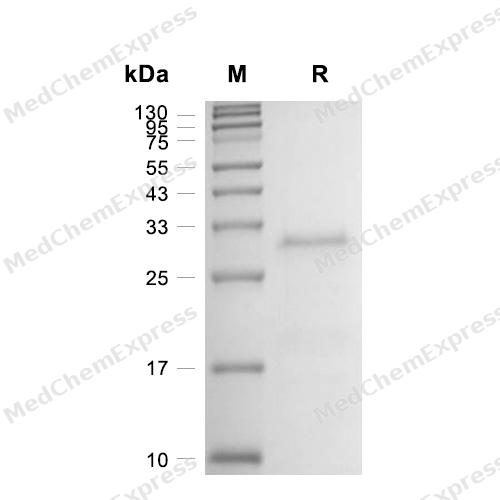
Purity - SDS-PAGE


Technical Parameters
-
Species Human
-
Source E. coli
-
Tag N-SUMO;N-6*His
-
Accession
Q9UNK4 (I22-C145)
-
Molecular Construction
-
N-term
-
6*His-SUMO
-
PLA2G2D (22I-145C)
Accession # Q9UNK4 -
C-term
-
-
Protein Length
Full Length of Group IID secretory phospholipase A2 Chain
-
Synonyms
PLA2G2D; GIID SPLA2; Phospholipase A2 Group IID; SPLA2-IID; SPLA2S; PLA2IID; Secretory-Type PLA, Stroma-Associated Homolog; SPLASH; Phosphatidylcholine 2-Acylhydrolase 2D; Phospholipase A2, Group IID; Group IID Secretory Phospholipase A2; Secretory Phosph
-
AA Sequence
ILNLNKMVKQVTGKMPILSYWPYGCHCGLGGRGQPKDATDWCCQTHDCCYDHLKTQGCSIYKDYYRYNFSQGNIHCSDKGSWCEQQLCACDKEVAFCLKRNLDTYQKRLRFYWRPHCRGQTPGC
-
Molecular Weight
Approximately 30 kDa, based on SDS-PAGE under reducing conditions.
-
Purity
≥ 90%, as determined by reducing SDS-PAGE.


Product Properties
Lyophilized powder
Lyophilized from a 0.22 μm filtered solution of 20 mM HEPES, 150 mM NaCl, pH 8.2, 0.2% CHAPS, 8% trehalose.
<1 EU/μg, determined by LAL method.
It is not recommended to reconstitute to a concentration less than 100 μg/mL in ddH2O.
Stored at -20°C for 2 years from date of receipt. After reconstitution, it is stable at 4°C for 1 week or -20°C for longer (with carrier protein). It is recommended to freeze aliquots at -20°C or -80°C for extended storage.
Room temperature in continental US; may vary elsewhere.


Documentation
-
Data Sheet (236 KB)
-
SDS (252 KB)
- English - EN (252 KB)
- Français - FR (252 KB)
- Deutsch - DE (252 KB)
- Norwegian - NO (252 KB)
- Español - ES (252 KB)
- Swedish - SV (252 KB)
- Italian - IT (252 KB)
- Korean - KR (252 KB)
- Portuguese - PT (252 KB)
-
Handling Instructions (2659 KB)

Calculators
Concentration (start) × Volume (start) = Concentration (final) × Volume (final)


 Powered by Bioz

