



S100A8-S100A9 Heterodimer Protein, Human (His, solution)
Based on 2 publication(s) in Google Scholar
S100A8 consists of calcium and zinc bound S100A8, which plays a critical regulatory role in inflammation and immune responses. As calprotectin, it contributes to leukocyte function, regulates the cytoskeleton, and activates intracellular NADPH oxidase. S100A8-S100A9 Heterodimer Protein, Human (His, solution) is a recombinant protein dimer complex containing human-derived S100A8-S100A9 Heterodimer protein, expressed by E. coli , with C-6*His labeled tag.
- Species: Human
- Source: E. coli
-
Storage:Stored at -80°C for 1 year from date of receipt. It is stable at -20°C for 3 months after opening. It is recommended to freeze aliquots at -80°C for extended storage. Avoid repeated freeze-thaw cycles.


To place orders, for customer services and technical support, please contact: MedChemExpress USA
Tel: 609-228-6898 E-mail: [email protected] [email protected]


-
 Biological Activity
-
Technical Parameters
-
Product Properties
- Documentation
- Help & FAQs




Biological Activity
Description
S100A8 consists of calcium and zinc bound S100A8, which plays a critical regulatory role in inflammation and immune responses. As calprotectin, it contributes to leukocyte function, regulates the cytoskeleton, and activates intracellular NADPH oxidase. S100A8-S100A9 Heterodimer Protein, Human (His, solution) is a recombinant protein dimer complex containing human-derived S100A8-S100A9 Heterodimer protein, expressed by E. coli , with C-6*His labeled tag.
Background
The S100A8, consisting of calcium- and zinc-binding S100A8, plays a crucial role in regulating inflammatory processes and immune responses. Often found as calprotectin (S100A8/A9), it serves diverse intracellular functions, including facilitating leukocyte arachidonic acid trafficking and metabolism, modulating the tubulin-dependent cytoskeleton during phagocyte migration, and activating the neutrophilic NADPH-oxidase. In particular, it activates NADPH-oxidase by aiding in the assembly of the enzyme complex at the cell membrane, transferring arachidonic acid, and directly binding to NCF2/P67PHOX. Extracellularly, it exhibits pro-inflammatory, antimicrobial, oxidant-scavenging, and apoptosis-inducing activities. Acting as an alarmin or danger-associated molecular pattern (DAMP) molecule, S100A8 stimulates innate immune cells through binding to pattern recognition receptors such as Toll-like receptor 4 (TLR4) and receptor for advanced glycation endproducts (AGER), activating MAP-kinase and NF-kappa-B signaling pathways and amplifying the pro-inflammatory cascade. With antimicrobial activity against bacteria and fungi, it likely exerts this effect through Zn(2+) chelation essential for microbial growth. Additionally, S100A8/A9 induces cell death via autophagy and apoptosis, regulates neutrophil number and apoptosis, and acts as an oxidant scavenger to prevent tissue damage. Its role as an amplifier of inflammation in autoimmunity and cancer development is notable, and in microbial infection, such as by SARS-CoV-2, it may induce expansion of aberrant immature neutrophils in a TLR4-dependent manner.
Verified Bioactivity
1.Measured by its ability to induce IL-6 secretion by A375 human melanoma cells. The ED50 for this effect is 1.0-10.0 μg/mL.
2.Immobilized Recombinant Human S100A8/A9 Heterodimer (C 6His) at 2 μg/mL (100 μl/well) can bind Anti-Human S100A9 Antibody. The ED50 of Anti-Human S100A9 Antibody is 9.91 ng/mL.
MCE Validation Data
-
Purity - SDS-PAGE
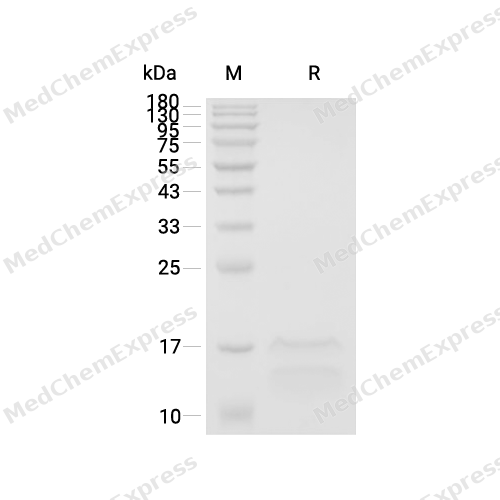
Purity - SDS-PAGE
-
Bioactivity - Cell-Based Assay
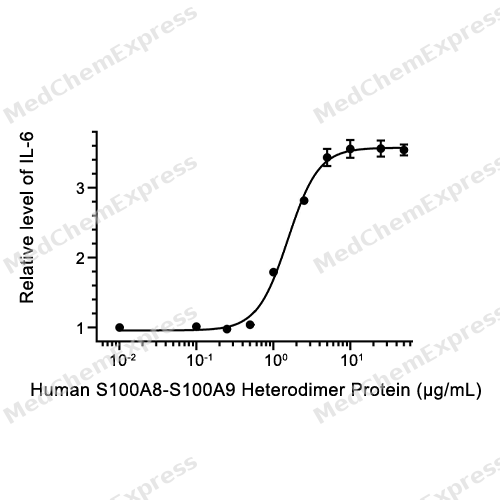
Bioactivity - Cell-Based Assay


Publications (2)
-
Journal Impact Factor
-
Most Recent
-
-
Respir Res
2023 Nov 17;24(1):288. PMID: 37978525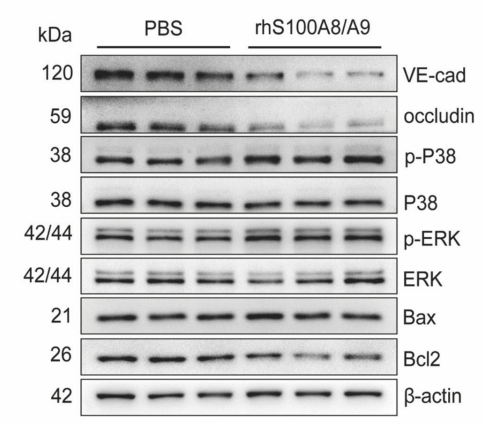
S100A8-S100A9 Heterodimer Protein, Human (His, solution) purchased from MedChemExpress. Usage Cited in: Respir Res. 2023 Nov 17;24(1):288. [Abstract]
S100A8-S100A9 Heterodimer Protein, Human (His, solution) (rhS100A8/A9, 2.0 µg/mL; 2 h) induced endothelial barrier dysfunction in human umbilical vein endothelial cells (HUVEC). Following rhS100A8/A9 treatment, the expression levels of occludin and VE‑cadherin were significantly reduced, while the protein levels of phosphorylated ERK (p‑ERK) and phosphorylated p38 (p‑p38) were markedly elevated. Meanwhile, the expression of the anti‑apoptotic protein Bcl2 was obviously decreased, whereas no statistically significant change was detected in the expression of the pro‑apoptotic protein Bax (n=6).


Technical Parameters
-
Species Human
-
Source E. coli
-
Tag C-6*His
-
Molecular Construction
-
N-term
-
S100A8 (M1-E93)
Accession # P05109 -
6*His
-
C-term
-
N-term
-
S100A9 (T2-P114)
Accession # P06702 -
6*His
-
C-term
-
-
Synonyms
S100A8; MRP-8; Prev. CAGA; Urinary Stone Protein Band A; Prev. CFAG; Protein S100-A8; MRP8; Calgranulin A; P8; S100 Calcium-Binding Protein A8; Migration Inhibitory Factor-Related Protein 8; Calgranulin-A; Leukocyte L1 Complex Light Chain; CP-10; Calprotectin L1L Subunit; MA387; Cystic Fibrosis Antigen; L1Ag; S100-A8; NIF; 60B8AG; S100 Calcium Binding Protein A8; CGLA; S100A9; 60B8AG; Prev. CAGB; CGLB; Prev. CFAG; MIF; MRP-14; NIF; MRP14; Protein S100-A9; P14; Calgranulin B; Migration Inhibitory Factor-Related Protein 14; S100 Calcium-Binding Protein A9 (Calgranulin B); Leukocyte L1 Complex Heavy Chain; S100 Calcium-Binding Protein A9; Calprotectin L1H Subunit; Calgranulin-B; S100-A9; L1AG; MAC387; S100 Calcium Binding Protein A9; LIAG
-
AA Sequence
A1:
MLTELEKALNSIIDVYHKYSLIKGNFHAVYRDDLKKLLETECPQYIRKKGADVWFKELDINTDGAVNFQEFLILVIKMGVAAHKKSHEESHKE
A2:
TCKMSQLERNIETIINTFHQYSVKLGHPDTLNQGEFKELVRKDLQNFLKKENKNEKVIEHIMEDLDTNADKQLSFEEFIMLMARLTWASHEKMHEGDEGPGHHHKPGLGEGTP -
Molecular Weight
Approximately 13 kDa & 15 kDa, based on SDS-PAGE under reducing conditions.
-
Purity
≥ 95%, as determined by reducing SDS-PAGE.


Product Properties
Solution
1.Supplied as a 0.22 μm filtered solution of 20 mM HEPES, 10% Glycerol, 150 mM NaCl, 2.5 mM EDTA, pH 7.4.
2.Supplied as a 0.22 μm filtered solution of 50 mM HEPES, 300 mM NaCl, 200 mM Arginine, pH 7.5.
3.Supplied as a 0.22 μm filtered solution of PBS, 2 mM DTT, pH 8.0.
4.Supplied as a 0.22 μm filtered solution of PBS, 5 mM TCEP, pH 8.0.
Please refer to the lot-specific COA for specific buffer information.
<1 EU/μg, determined by LAL method.
Stored at -80°C for 1 year from date of receipt. It is stable at -20°C for 3 months after opening. It is recommended to freeze aliquots at -80°C for extended storage. Avoid repeated freeze-thaw cycles.
Shipping with dry ice.


Documentation
-
Data Sheet (238 KB)
-
SDS (252 KB)
- English - EN (252 KB)
- Français - FR (252 KB)
- Deutsch - DE (252 KB)
- Norwegian - NO (252 KB)
- Español - ES (252 KB)
- Swedish - SV (252 KB)
- Italian - IT (252 KB)
- Korean - KR (252 KB)
- Portuguese - PT (252 KB)
-
Handling Instructions (2659 KB)

Calculators
Concentration (start) × Volume (start) = Concentration (final) × Volume (final)


 Powered by Bioz

