



SLPI Protein, Human (sf9, His)
Based on 2 publication(s) in Google Scholar
The SLPI protein is an acid-stable protease inhibitor that has shown strong affinity for trypsin, chymotrypsin, elastase, and cathepsin G in multiple studies. It plays a critical regulatory role in inflammatory and immune responses following bacterial infection and Listeria monocytogenes infection. SLPI Protein, Human (sf9, His) is the recombinant human-derived SLPI protein, expressed by sf9 insect cells , with C-His labeled tag.
- Species: Human
- Source: Sf9 insect cells
-
Storage:Stored at -20°C for 2 years from date of receipt. After reconstitution, it is stable at 4°C for 1 week or -20°C for longer (with carrier protein). It is recommended to freeze aliquots at -20°C or -80°C for extended storage.


To place orders, for customer services and technical support, please contact: MedChemExpress USA
Tel: 609-228-6898 E-mail: [email protected] [email protected]


-
 Biological Activity
-
Technical Parameters
-
Product Properties
- Documentation
- Help & FAQs




Biological Activity
Description
The SLPI protein is an acid-stable protease inhibitor that has shown strong affinity for trypsin, chymotrypsin, elastase, and cathepsin G in multiple studies. It plays a critical regulatory role in inflammatory and immune responses following bacterial infection and Listeria monocytogenes infection. SLPI Protein, Human (sf9, His) is the recombinant human-derived SLPI protein, expressed by sf9 insect cells , with C-His labeled tag.
Background
SLPI, an acid-stable proteinase inhibitor, exhibits robust affinities for trypsin, chymotrypsin, elastase, and cathepsin G, as demonstrated in various studies. It plays a crucial role in modulating inflammatory and immune responses following bacterial infection, as well as infection by the intracellular parasite L.major. Additionally, SLPI contributes to down-regulating responses to bacterial lipopolysaccharide (LPS) (By similarity) and is involved in regulating the activation of NF-kappa-B, thereby influencing inflammatory responses. Notably, SLPI exhibits antimicrobial activity against mycobacteria but not against salmonella, contributing to normal resistance against infection by M.tuberculosis. It is also essential for normal resistance to infection by L.major and plays a critical role in wound healing, likely by preventing tissue damage through the regulation of protease activity (By similarity). Furthermore, in collaboration with ELANE, SLPI is required for the normal differentiation and proliferation of bone marrow myeloid cells, and it interacts with GRN, protecting progranulin from proteolysis.
Verified Bioactivity
Measured by its ability to inhibit trypsin cleavage of a fluorogenic peptide substrate Mca-RPKPVE-Nval-WRK (Dnp)-NH2 and the IC50 value is ≤2.55 nM.
MCE Validation Data
-
Purity - SDS-PAGE
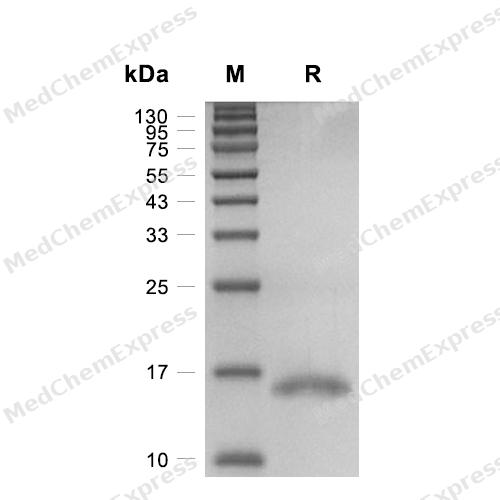
Purity - SDS-PAGE


Publications (2)
-
Journal Impact Factor
-
Most Recent
-
Cell
Comprehensive human proteome profiles across a 50-year lifespan reveal aging trajectories and signatures. [Abstract]2025 Oct 2;188(20):5763-5784.e26. PMID: 40713952 -
MedScience
Secretory leukocyte peptidase inhibitor as a dynamic radiotherapy response biomarker in esophageal squamous cell carcinoma. [Abstract]2026 Apr 20. PMID: 42008079


Technical Parameters
-
Species Human
-
Source Sf9 insect cells
-
Tag C-His
-
Accession
P03973 (S26-A132)
-
Molecular Construction
-
N-term
-
SLPI (S26-A132)
Accession # P03973 -
His
-
C-term
-
-
Protein Length
Full Length of Mature Protein
-
Synonyms
SLPI; Secretory Leukocyte Protease Inhibitor (Antileukoproteinase); Secretory Leukocyte Peptidase Inhibitor; WAP Four-Disulfide Core Domain Protein 4; WFDC4; Seminal Proteinase Inhibitor; BLPI; Mucus Proteinase Inhibitor; WAP4; Protease Inhibitor WAP4; AL
-
AA Sequence
SGKSFKAGVCPPKKSAQCLRYKKPECQSDWQCPGKKRCCPDTCGIKCLDPVDTPNPTRRKPGKCPVTYGQCLMLNPPNFCEMDGQCKRDLKCCMGMCGKSCVSPVKA
-
Molecular Weight
Approximately 15 kDa, based on SDS-PAGE under reducing conditions, due to the glycosylation.
-
Purity
≥ 90%, as determined by reducing SDS-PAGE.


Product Properties
Lyophilized powder.
1.Lyophilized from a 0.22 μm filtered solution of 20 mM Tris, 500 mM NaCl, 10% glycerol, pH 7.5, 5% trehalose, 5% mannitol, 0.01% Tween 80.
2.Lyophilized from a 0.22 μm filtered solution of 20 mM Tris, 500 mM NaCl, 10% gly, pH 7.4.
3.Lyophilized from a 0.22 μm filtered solution of 20 mM Tris-HCl, 500 mM NaCl, pH 7.4, 10% glycerol.
Please refer to the lot-specific COA for specific buffer information.
Note: For SPR assay, please replace the buffer. Primary amine components (e.g., Tris, imidazole) can affect protein-coupled chips.
<1 EU/μg, determined by LAL method.
It is not recommended to reconstitute to a concentration less than 100 μg/mL in ddH2O. For long term storage it is recommended to add a carrier protein (0.1% BSA, 5% HSA, 10% FBS or 5% Trehalose).
Stored at -20°C for 2 years from date of receipt. After reconstitution, it is stable at 4°C for 1 week or -20°C for longer (with carrier protein). It is recommended to freeze aliquots at -20°C or -80°C for extended storage.
Room temperature in continental US; may vary elsewhere.


Documentation
-
Data Sheet (236 KB)
-
SDS (252 KB)
- English - EN (252 KB)
- Français - FR (252 KB)
- Deutsch - DE (252 KB)
- Norwegian - NO (252 KB)
- Español - ES (252 KB)
- Swedish - SV (252 KB)
- Italian - IT (252 KB)
- Korean - KR (252 KB)
- Portuguese - PT (252 KB)
-
Handling Instructions (2659 KB)

Calculators
Concentration (start) × Volume (start) = Concentration (final) × Volume (final)


 Powered by Bioz

