



SMAD3 Protein, Human/Mouse/Rat (Flag-His)
Based on 5 publication(s) in Google Scholar
The SMAD3 protein acts as a receptor-regulated SMAD (R-SMAD), transducing signals from TGF-β and activin type 1 receptor kinase. After being activated by antigen-presenting cells, SMAD3 binds to the TRE element in the gene promoter and forms a complex with SMAD4 to activate transcription. SMAD3 Protein, Human/Mouse/Rat (Flag-His) is the recombinant human-derived SMAD3 protein, expressed by E. coli , with N-6*His, N-Flag labeled tag.
- Species: Human
- Source: E. coli
-
Storage:Stored at -80°C for 1 year from date of receipt. It is stable at -20°C for 3 months after opening. It is recommended to freeze aliquots at -80°C for extended storage. Avoid repeated freeze-thaw cycles.


To place orders, for customer services and technical support, please contact: MedChemExpress USA
Tel: 609-228-6898 E-mail: [email protected] [email protected]


-
 Biological Activity
-
Technical Parameters
-
Product Properties
- Documentation
- Help & FAQs




Biological Activity
Description
The SMAD3 protein acts as a receptor-regulated SMAD (R-SMAD), transducing signals from TGF-β and activin type 1 receptor kinase. After being activated by antigen-presenting cells, SMAD3 binds to the TRE element in the gene promoter and forms a complex with SMAD4 to activate transcription. SMAD3 Protein, Human/Mouse/Rat (Flag-His) is the recombinant human-derived SMAD3 protein, expressed by E. coli , with N-6*His, N-Flag labeled tag.
Background
SMAD3 protein functions as a receptor-regulated SMAD (R-SMAD), serving as an intracellular signal transducer and transcriptional modulator activated by TGF-beta and activin type 1 receptor kinases. Upon activation by antigen-presenting cells, SMAD3 binds the TRE element in gene promoters regulated by TGF-beta and, in conjunction with SMAD4, forms a complex that activates transcription. Additionally, it can assemble a SMAD3/SMAD4/JUN/FOS complex at the AP-1/SMAD site to regulate TGF-beta-mediated transcription. SMAD3 exhibits an inhibitory effect on wound healing, potentially by modulating the growth and migration of primary keratinocytes and altering TGF-mediated monocyte chemotaxis, and this effect appears to be hormone-sensitive. Moreover, SMAD3 serves as a regulator of chondrogenesis and osteogenesis and inhibits early healing of bone fractures. It positively regulates PDPK1 kinase activity by dissociating it from the 14-3-3 protein YWHAQ, acting as a negative regulator. In the absence of TGF-beta, SMAD3 exists as a monomer, whereas in the presence of TGF-beta, it forms homooligomers or heterotrimers, contributing to the versatility of its functions. SMAD3 engages in a complex interaction network with various proteins, including but not limited to MAGI2/ARIP1, ACVR2A, ACVR1B, JUN, FOS, RAN, XPO4, NEDD9, ITCH/AIP4, NEDD9/HEF1, ZNF451, PPM1A, ZMIZ1, RNF111, RANBP3, EP300, TGFBR1, TGFB1I1, PRDM16, SNW1, ZFYVE9, HDAC1, TGIF2, SKOR1, SKOR2, DACH1, RBPMS, MECOM, WWTR1, SKI, MEN1, IL1F7, CSNK1G2, PDPK1, DAB2, USP15, PPP5C, LDLRAD4, PMEPA1, ZNF451, ZFHX3, ZNF8, STUB1, HSPA1A, HSPA1B, HSP90AA1, HSP90AB1, YAP1, CITED2, HGS, WWP1, TTRAP, FOXL2, PML, NEDD4L, ZC3H3, TGIF, CREBBP, ATF2, NEDD9, and more, highlighting its central role in diverse cellular processes and signaling pathways.
Verified Bioactivity
Measured by its binding ability in a functional ELISA. Immobilized Human/Mouse/Rat SMAD3 at 1 μg/mL (100 μL/well) can bind SMAD3 Polyclonal antibody, the ED50 for this effect is 0.2-0.6 μg/mL.
MCE Validation Data
-
Purity - SDS-PAGE
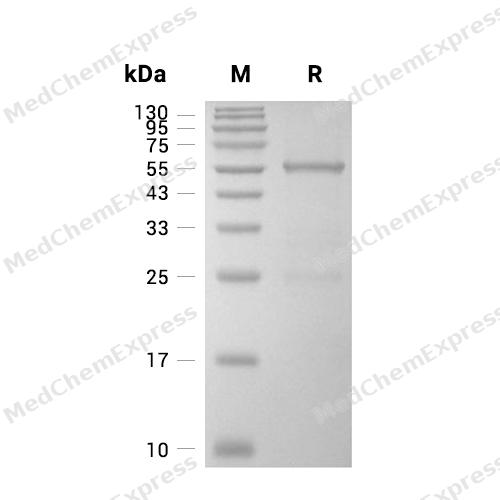
Purity - SDS-PAGE
-
Bioactivity - ELISA
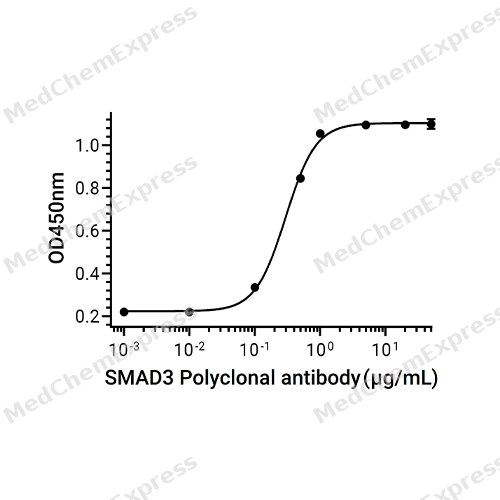
Bioactivity - ELISA


Publications (5)
-
Journal Impact Factor
-
Most Recent
-
Cell
2025 Sep 4;188(18):4950-4967.e22. PMID: 40651473 -
Cell Discov
2025 Mar 11;11(1):22. PMID: 40064862 -
Cell Biosci
VHL-recruiting PROTAC attenuates renal fibrosis and preserves renal function via simultaneous degradation of Smad3 and stabilization of HIF-2α. [Abstract]2022 Dec 19;12(1):203. PMID: 36536448 -
Life Sci
Galectin-9 in human trophoblast cells: Implications for maternal-fetal immune balance and pregnancy complications. [Abstract]2026 Mar 1:388:124173. PMID: 41544754 -
Cell Signal
Novel microRNA seq-14465_x69 promotes scarless wound healing by targeting TGF-β/SMADs pathway in keratinocytes. [Abstract]2025 Nov:135:112060. PMID: 40789493


Technical Parameters
-
Species Human
-
Source E. coli
-
Tag N-6*His;N-Flag
-
Accession
P84022-1/Q8BUN5/P84025 (S2-S425)
-
Molecular Construction
-
N-term
-
6*His-Flag
-
SMAD3 (S2-S425)
Accession # P84022-1 -
C-term
-
-
Protein Length
Full Length
-
Synonyms
SMAD3; MAD, Mothers Against Decapentaplegic Homolog 3; Prev. MADH3; SMAD, Mothers Against DPP Homolog 3; JV15-2; SMA- And MAD-Related Protein 3; HsT17436; Mothers Against DPP Homolog; Mothers Against Decapentaplegic Homolog 3; Mad Protein Homolog; Mothers Against DPP Homolog 3; Mad Homolog JV15-2; MAD Homolog 3; SMAD Family Member; HMAD-3; MAD Homolog; HSMAD3; HSPC193; Mad3; SMAD 3; MAD, Mothers Against Decapentaplegic Homolog 3 (Drosophila); LDS1C; SMAD, Mothers Against DPP Homolog 3 (Drosophila); LDS3; SMAD Family Member 3; Mothers Against Decapentaplegic Homolog
-
AA Sequence
SSILPFTPPIVKRLLGWKKGEQNGQEEKWCEKAVKSLVKKLKKTGQLDELEKAITTQNVNTKCITIPRSLDGRLQVSHRKGLPHVIYCRLWRWPDLHSHHELRAMELCEFAFNMKKDEVCVNPYHYQRVETPVLPPVLVPRHTEIPAEFPPLDDYSHSIPENTNFPAGIEPQSNIPETPPPGYLSEDGETSDHQMNHSMDAGSPNLSPNPMSPAHNNLDLQPVTYCEPAFWCSISYYELNQRVGETFHASQPSMTVDGFTDPSNSERFCLGLLSNVNRNAAVELTRRHIGRGVRLYYIGGEVFAECLSDSAIFVQSPNCNQRYGWHPATVCKIPPGCNLKIFNNQEFAALLAQSVNQGFEAVYQLTRMCTIRMSFVKGWGAEYRRQTVTSTPCWIELHLNGPLQWLDKVLTQMGSPSIRCSSVS
-
Predicted Molecular Mass
50 kDa
-
Molecular Weight
Approximately 50-60 kDa, based on SDS-PAGE under reducing conditions.
-
Purity
≥ 90%, as determined by reducing SDS-PAGE.


Product Properties
Solution
Supplied as a 0.22 μm filtered solution of 20 mM Tris-HCl, 500 mM NaCl, 10% Glycerol, 2 mM EDTA, pH 8.0.
Note: For SPR assay, please replace the buffer. Primary amine components (e.g., Tris, imidazole) can affect protein-coupled chips.
<1 EU/μg, determined by LAL method.
Stored at -80°C for 1 year from date of receipt. It is stable at -20°C for 3 months after opening. It is recommended to freeze aliquots at -80°C for extended storage. Avoid repeated freeze-thaw cycles.
Shipping with dry ice.


Documentation
-
Data Sheet (239 KB)
-
SDS (252 KB)
- English - EN (252 KB)
- Français - FR (252 KB)
- Deutsch - DE (252 KB)
- Norwegian - NO (252 KB)
- Español - ES (252 KB)
- Swedish - SV (252 KB)
- Italian - IT (252 KB)
- Korean - KR (252 KB)
- Portuguese - PT (252 KB)
-
Handling Instructions (2659 KB)

Calculators
Concentration (start) × Volume (start) = Concentration (final) × Volume (final)


 Powered by Bioz

