



SULT2A1 Protein, Human (His)

Based on 1 Customer Validation
The SULT2A1 protein utilizes PAPS for critical sulfonation of steroids and bile acids in the liver and adrenal glands. Its multifunctional activity extends to a variety of compounds, enhancing its water solubility to facilitate renal excretion. SULT2A1 Protein, Human (His) is the recombinant human-derived SULT2A1 protein, expressed by E. coli , with N-6*His labeled tag.
- Species: Human
- Source: E. coli
-
Storage:Stored at -80°C for 1 year from date of receipt. It is stable at -20°C for 3 months after opening. It is recommended to freeze aliquots at -80°C for extended storage. Avoid repeated freeze-thaw cycles.


To place orders, for customer services and technical support, please contact: MedChemExpress USA
Tel: 609-228-6898 E-mail: [email protected] [email protected]


-
 Biological Activity
-
Technical Parameters
-
Product Properties
- Documentation
- Help & FAQs




Biological Activity
Description
The SULT2A1 protein utilizes PAPS for critical sulfonation of steroids and bile acids in the liver and adrenal glands. Its multifunctional activity extends to a variety of compounds, enhancing its water solubility to facilitate renal excretion. SULT2A1 Protein, Human (His) is the recombinant human-derived SULT2A1 protein, expressed by E. coli , with N-6*His labeled tag.
Background
SULT2A1 protein, a sulfotransferase utilizing 3'-phospho-5'-adenylyl sulfate (PAPS) as its sulfonate donor, serves as a crucial mediator in the sulfonation of steroids and bile acids within the liver and adrenal glands. Demonstrating versatile enzymatic activity, SULT2A1 facilitates the sulfation of an extensive array of steroids and sterols, including pregnenolone, androsterone, DHEA, bile acids, cholesterol, and numerous xenobiotics featuring alcohol and phenol functional groups. This sulfonation process enhances the water solubility of these compounds, facilitating their renal excretion; however, it also has the potential to lead to bioactivation, forming active metabolites. SULT2A1's multifaceted roles extend to maintaining steroid and lipid homeostasis, playing a pivotal role in bile acid metabolism, and catalyzing the metabolic activation of potent carcinogenic polycyclic arylmethanols. The diverse substrate specificity of SULT2A1 underscores its significance in regulating essential physiological processes and its potential involvement in the metabolic activation of compounds with carcinogenic properties.
Verified Bioactivity
Measured by its ability to transfer sulfate from PAPS to t-Dehydroandrosterone (DHEA). The specific activity is 26.156 pmol/min/μg.
MCE Validation Data
-
Purity - SDS-PAGE
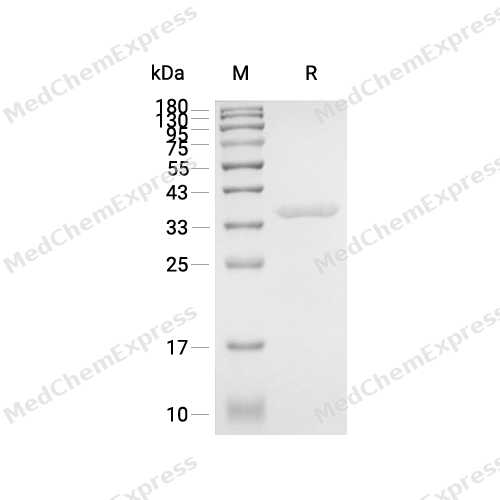
Purity - SDS-PAGE


Technical Parameters
-
Species Human
-
Source E. coli
-
Tag N-6*His
-
Accession
Q06520 (S2-E285)
-
Molecular Construction
-
N-term
-
6*His
-
SULT2A1 (S2-E285)
Accession # Q06520 -
C-term
-
-
Protein Length
Full Length
-
Synonyms
SULT2A1; ST2; Prev. STD; Dehydroepiandrosterone Sulfotransferase; DHEA-ST; Bile-Salt Sulfotranasferase 2A1; Sulfotransferase Family, Cytosolic, 2A, Dehydroepiandrosterone (DHEA)-Preferring, Member 1; Hydroxysteroid Sulfotransferase; Sulfotransferase 2A1;
-
AA Sequence
SDDFLWFEGIAFPTMGFRSETLRKVRDEFVIRDEDVIILTYPKSGTNWLAEILCLMHSKGDAKWIQSVPIWERSPWVESEIGYTALSETESPRLFSSHLPIQLFPKSFFSSKAKVIYLMRNPRDVLVSGYFFWKNMKFIKKPKSWEEYFEWFCQGTVLYGSWFDHIHGWMPMREEKNFLLLSYEELKQDTGRTIEKICQFLGKTLEPEELNLILKNSSFQSMKENKMSNYSLLSVDYVVDKAQLLRKGVSGDWKNHFTVAQAEDFDKLFQEKMADLPRELFPWE
-
Predicted Molecular Mass
35.2 kDa
-
Molecular Weight
Approximately 34-38 kDa, based on SDS-PAGE under reducing conditions.
-
Purity
≥ 95%, as determined by reducing SDS-PAGE.


Product Properties
Solution
Supplied as a 0.22 μm filtered solution of 20 mM Tris-HCl, 100 mM NaCl, pH 8.0.
Note: For SPR assay, please replace the buffer. Primary amine components (e.g., Tris, imidazole) can affect protein-coupled chips.
<1 EU/μg, determined by LAL method.
Stored at -80°C for 1 year from date of receipt. It is stable at -20°C for 3 months after opening. It is recommended to freeze aliquots at -80°C for extended storage. Avoid repeated freeze-thaw cycles.
Shipping with dry ice.


Documentation
-
Data Sheet (237 KB)
-
SDS (252 KB)
- English - EN (252 KB)
- Français - FR (252 KB)
- Deutsch - DE (252 KB)
- Norwegian - NO (252 KB)
- Español - ES (252 KB)
- Swedish - SV (252 KB)
- Italian - IT (252 KB)
- Korean - KR (252 KB)
- Portuguese - PT (252 KB)
-
Handling Instructions (2659 KB)

Calculators
Concentration (start) × Volume (start) = Concentration (final) × Volume (final)


 Powered by Bioz

