



TREM-2 Protein, Human (HEK293, His)

Based on 1 Customer Validation
TREM-2 Protein is a receptor for amyloid beta protein 42, lipoprotein particles, and apolipoprotein. TREM-2 Protein is involved in cell proliferation and apoptosis through Wnt/β, MTOR, PI3K and NF-kappa-B signaling pathways. TREM-2 Protein is expressed by macrophages, immature monocyte-derived dendritic cells, osteoclasts, and microglia to activate the immune response. TREM-2 Protein, Human (HEK293, His) is the recombinant human-derived TREM-2 protein, expressed by HEK293 , with C-6*His labeled tag.
- Species: Human
- Source: HEK293
-
Storage:Stored at -20°C for 2 years from date of receipt. After reconstitution, it is stable at 4°C for 1 week or -20°C for longer (with carrier protein). It is recommended to freeze aliquots at -20°C or -80°C for extended storage.


To place orders, for customer services and technical support, please contact: MedChemExpress USA
Tel: 609-228-6898 E-mail: [email protected] [email protected]


-
 Biological Activity
-
Technical Parameters
-
Product Properties
- Documentation
- Help & FAQs




Biological Activity
Description
TREM-2 Protein is a receptor for amyloid beta protein 42, lipoprotein particles, and apolipoprotein. TREM-2 Protein is involved in cell proliferation and apoptosis through Wnt/β, MTOR, PI3K and NF-kappa-B signaling pathways. TREM-2 Protein is expressed by macrophages, immature monocyte-derived dendritic cells, osteoclasts, and microglia to activate the immune response. TREM-2 Protein, Human (HEK293, His) is the recombinant human-derived TREM-2 protein, expressed by HEK293 , with C-6*His labeled tag.
Background
Triggering receptor expressed on myeloid cells 2 (TREM-2) can form a receptor signaling complex with TYROBP, mediating signaling and cell activation after ligand binding. TREM-2 is a receptor for amyloid beta protein 42 and mediates its uptake and degradation by microglia. Binding to amyloid-β42 mediates microglia activation, proliferation, migration, apoptosis and the expression of pro-inflammatory cytokines such as IL6R, CCL3 and anti-inflammatory cytokine ARG1. TREM-2 is a receptor for lipoprotein particles (such as LDL, VLDL, and HDL) and apolipoproteins (such as APOA1, APOA2, APOB, APOE, APOE2, APOE3, APOE4, and CLU) and enhances their uptake in microglia. TREM-2 acts as an upstream regulator of the Wnt/ beta-catenin signaling cascade to regulate microglial cell proliferation. TREM-2 acts on the metabolism of microglia by activating MTOR. TREM-2 inhibited the response of PI3K and NF-kappa-B signals to lipopolysaccharide. It can promote phagocytosis, inhibit the production of proinflammatory cytokines and nitric oxide, inhibit cell apoptosis, and increase the expression of IL10 and TGFB. During oxidative stress, it promotes anti-apoptotic NF-kappa-B signaling and ERK signaling. TREM-2 can trigger immune response activation of macrophages and dendritic cells mediating cytokine-induced fusion of macrophages to form multinucleated giant cells, and in dendritic cells mediating upregulation of chemokine receptor CCR7 and maturation and survival of dendritic cells[1][2][3][4][5][6].
Verified Bioactivity
Immobilized Human TREM-2, at 1 μg/mL (100 μL/well) can bind Anti-TREM2 Antibody. The ED50 is 10-35 ng/mL.
MCE Validation Data
-
Purity - SDS-PAGE
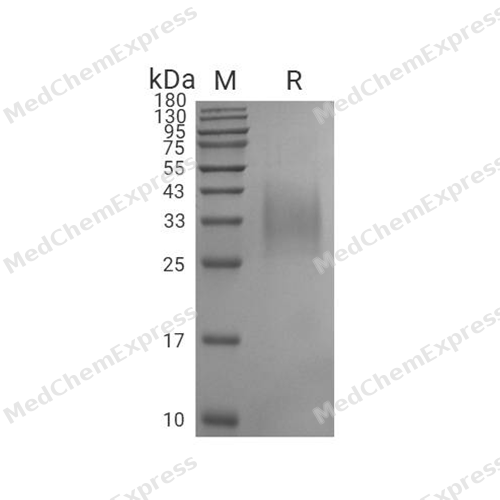
Purity - SDS-PAGE
-
Bioactivity - ELISA
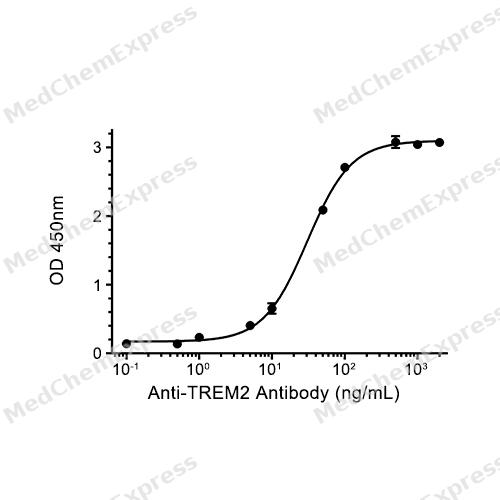
Bioactivity - ELISA


Technical Parameters
-
Species Human
-
Source HEK293
-
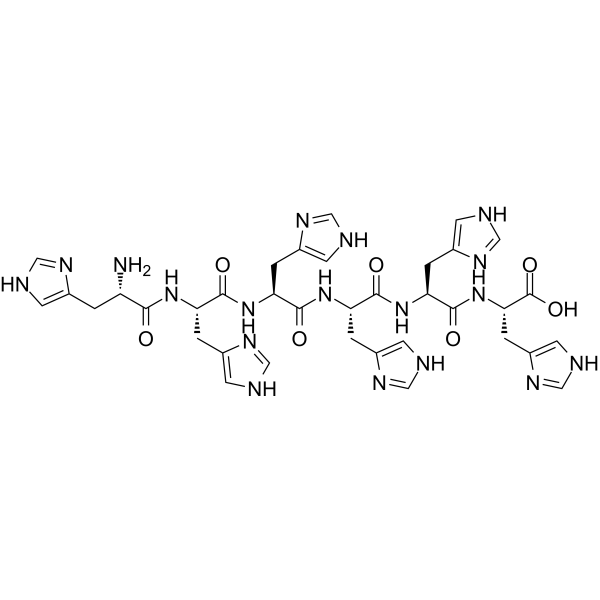
Tag C-6*His
-
Accession
Q9NZC2-1 (H19-S174)
-
Molecular Construction
-
N-term
-
TREM-2 (H19-S174)
Accession # Q9NZC2-1 -
6*His
-
C-term
-
-
Protein Length
Extracellular Domain
-
Synonyms
TREM2; Trem2b; Triggering Receptor Expressed On Myeloid Cells 2; Trem2c; TREM-2; Triggering Receptor Expressed On Myeloid Cells 2a; Triggering Receptor Expressed On Monocytes 2; PLOSL2; Trem2a; AD17
-
AA Sequence
HNTTVFQGVAGQSLQVSCPYDSMKHWGRRKAWCRQLGEKGPCQRVVSTHNLWLLSFLRRWNGSTAITDDTLGGTLTITLRNLQPHDAGLYQCQSLHGSEADTLRKVLVEVLADPLDHRDAGDLWFPGESESFEDAHVEHSISRSLLEGEIPFPPTS
-
Predicted Molecular Mass
18.3 kDa
-
Molecular Weight
Approximately 22-40 kDa, based on SDS-PAGE under reducing conditions, due to the glycosylation.
-
Glycosylation
Yes
-
Purity
≥ 95%, as determined by reducing SDS-PAGE.


Product Properties
Lyophilized powder
1.Lyophilized from a 0.22 μm filtered solution of PBS, pH 7.4.
2.Lyophilized from a 0.22 μm filtered solution of 20 mM PB, 150 mM NaCl, pH 7.4.
Please refer to the lot-specific COA for specific buffer information.
<1 EU/μg, determined by LAL method.
It is not recommended to reconstitute to a concentration less than 100 μg/mL in ddH2O. For long term storage it is recommended to add a carrier protein (0.1% BSA, 5% HSA, 10% FBS or 5% Trehalose).
Stored at -20°C for 2 years from date of receipt. After reconstitution, it is stable at 4°C for 1 week or -20°C for longer (with carrier protein). It is recommended to freeze aliquots at -20°C or -80°C for extended storage.
Room temperature in continental US; may vary elsewhere.


Documentation
-
Data Sheet (237 KB)
-
SDS (252 KB)
- English - EN (252 KB)
- Français - FR (252 KB)
- Deutsch - DE (252 KB)
- Norwegian - NO (252 KB)
- Español - ES (252 KB)
- Swedish - SV (252 KB)
- Italian - IT (252 KB)
- Korean - KR (252 KB)
- Portuguese - PT (252 KB)
-
Handling Instructions (2659 KB)

Calculators
Concentration (start) × Volume (start) = Concentration (final) × Volume (final)


 Powered by Bioz

