



apoB
Apolipoprotein B (apoB) is the principal structural apolipoprotein of atherogenic lipoproteins, including chylomicrons, very-low-density lipoproteins (VLDL), intermediate-density lipoproteins (IDL), low-density lipoproteins (LDL), and lipoprotein(a), and is essential for lipoprotein assembly and lipid transport throughout the circulation[1][2]. ApoB-containing lipoproteins drive lipid trafficking through pathways that coordinate intestinal dietary fat absorption and hepatic lipoprotein secretion, thereby linking systemic lipid metabolism with cholesterol delivery and clearance mechanisms[1][3]. Mechanistically, apoB100 functions as the primary ligand for LDL receptor-mediated uptake of LDL particles, enabling receptor-dependent lipoprotein catabolism and regulating the persistence of circulating atherogenic particles[1][4]. In cardiovascular disease, retention and accumulation of apoB-containing lipoproteins within the arterial wall represent key initiating events in atherosclerotic plaque formation, and elevated apoB particle burden is strongly associated with atherosclerotic cardiovascular risk[1][2][5]. Compared with related isoforms, apoB100 is synthesized in the liver and is present in VLDL, IDL, LDL, and lipoprotein(a), whereas apoB48 is generated in the intestine through APOB mRNA editing and functions primarily in chylomicron formation and dietary lipid transport[1][4][6]. Importantly, apoB48 lacks the LDL receptor-binding domain present in apoB100, resulting in distinct roles in lipoprotein metabolism despite their common genetic origin[3][4]. For experimental applications, apoB and its isoforms are widely used to investigate lipoprotein assembly, remnant metabolism, atherosclerosis mechanisms, and cardiovascular risk assessment in both clinical and preclinical models[1][2][5].
References:
- [1]. Behbodikhah J, et al. Apolipoprotein B and Cardiovascular Disease: Biomarker and Potential Therapeutic Target. Metabolites. 2021 Oct 8;11(10):690. [Content Brief]
- [2]. Kounatidis D, et al. ApoB100 and Atherosclerosis: What's New in the 21st Century? Metabolites. 2024 Feb 12;14(2):123. [Content Brief]
- [3]. Olofsson SO, et al. Apolipoprotein B: a clinically important apolipoprotein which assembles atherogenic lipoproteins and promotes the development of atherosclerosis. J Intern Med. 2005 Nov;258(5):395-410. [Content Brief]
- [4]. Devaraj S, et al. Biochemistry, Apolipoprotein B. 2023 May 14. In: StatPearls [Internet]. Treasure Island (FL): StatPearls Publishing; 2026 Jan–.
- [5]. Lo CC, et al. ApoB48 as an Efficient Regulator of Intestinal Lipid Transport. Front Physiol. 2020 Jul 8;11:796. [Content Brief]
- [6]. Welty FK, et al. Human apolipoprotein (Apo) B-48 and ApoB-100 kinetics with stable isotopes. Arterioscler Thromb Vasc Biol. 1999 Dec;19(12):2966-74. [Content Brief]
All Product Categories
-
apoB Related Products (6)
Related Products (6)

-
Mipomersen sodium
 0 ImagesCat. No.: HY-108764CAS No.: 629167-92-6Synonyms: ISIS 301012Mipomersen sodium (ISIS 301012) is an antisense oligonucleotide inhibitor of apolipoprotein B (apoB). Mipomersen has anti-HCV effect and reduces the infectivity of the HCV. Mipomersen sodium can be used for the research of homozygous familial hypercholesterolemia (HoFH).
-
Muvalaplin
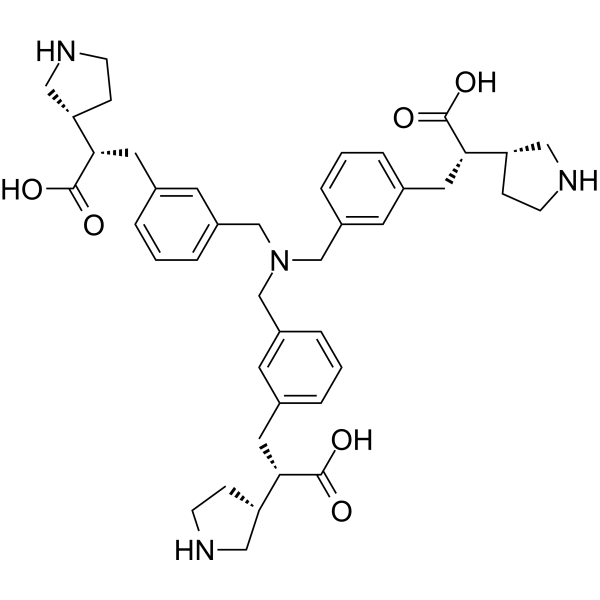 0 ImagesSynonyms: LY3473329Muvalaplin (LY3473329) is an orally active small molecule apolipoprotein a (apolipoprotein a) inhibitor that binds to the KIV8 domain (Kd = 22 nM) and kringle IV domains 7 and 8, blocks the non-covalent interaction between apo (a) and apoB-100, and prevents Lp (a) assembly, thereby lowering circulating Lp (a) levels. Muvalaplin can be used in research on atherosclerotic cardiovascular disease.
-
Obicetrapib
 0 ImagesSynonyms: TA-8995; DEZ-001; AMG-899Obicetrapib (TA-8995; DEZ-001) is an orally active cholesteryl ester transfer protein (CETP) inhibitor. Obicetrapib potently reduces atherogenic lipoproteins (such as LDL-C, ApoB, Lp (a)) and increases HDL-C. Obicetrapib can be used for the research of dyslipidemia and atherosclerotic cardiovascular disease (ASCVD).
-
Mipomersen
 0 ImagesCat. No.: HY-148647CAS No.: 1000120-98-8Synonyms: ISIS 301012 free baseMipomersen (ISIS 301012 free base) is an antisense oligonucleotide inhibitor of apolipoprotein B (apoB). Mipomersen has anti-HCV effect and reduces the infectivity of the HCV. Mipomersen can be used for the research of homozygous familial hypercholesterolemia (HoFH).
-
Muvalaplin tetrahydrochloride
 0 ImagesSynonyms: LY3473329 tetrahydrochlorideMuvalaplin tetrahydrochloride (LY3473329 tetrahydrochloride) is an orally active small molecule apolipoprotein a (apolipoprotein a) inhibitor that binds to the KIV8 domain (Kd = 22 nM) and kringle IV domains 7 and 8, blocks the non-covalent interaction between apo (a) and apoB-100, and prevents Lp (a) assembly, thereby lowering circulating Lp (a) levels. Muvalaplin tetrahydrochloride can be used in research on atherosclerotic cardiovascular disease.
-
PLTP-IN-1
 0 ImagesCat. No.: HY-179364CAS No.: 1224565-08-5PLTP-IN-1 (cpd B) is a selective phospholipid transfer protein (PLTP) inhibitor with an IC50 of 1.6 μM. PLTP-IN-1 can block the phospholipid transfer mediated by PLTP and reduce the secretion of apolipoprotein B. PLTP-IN-1 has no effect on the level of triglycerides. PLTP-IN-1 can be used for the research of metabolic disease, such as hyperlipidemia.



