1. Search Result
Search Result
Results for "

RNA polymerase II C-terminal domain

" in MedChemExpress (MCE) Product Catalog:

8

Inhibitors & Agonists

1

Recombinant Proteins

Cat. No. Product Name Target Research Areas Chemical Structure
  • HY-175238

    ATP Synthase DNA/RNA Synthesis Neurological Disease Cancer
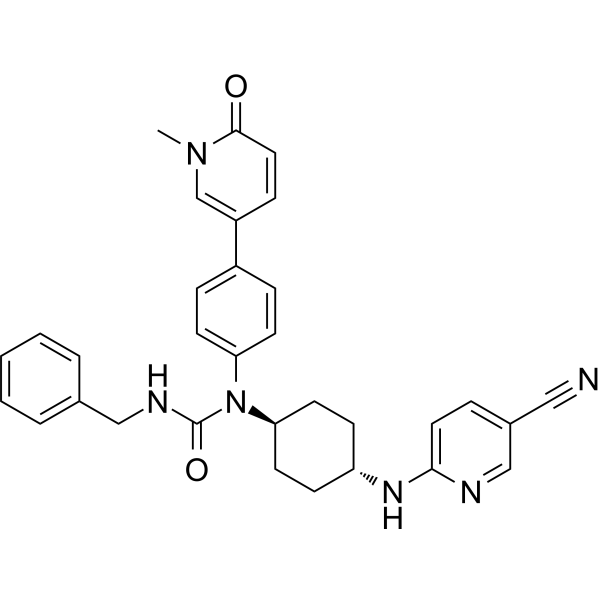
    KI-DX-014 is a DDX21 inhibitor with high RNA-binding inhibitory activity (IC50 of 3.31 μM). KI-DX-014 targets DDX21’s intrinsically disordered C-terminal domain, inhibits DDX21-structured RNA interaction, modulates DDX21’s RNA-dependent ATPase activity, and disrupts DDX21 biomolecular condensate formation. KI-DX-014 attenuates in vitro P-TEFb release from the 7SK snRNP complex, suppresses P-TEFb-dependent RNA polymerase II CTD phosphorylation, and induces developmental defects in zebrafish embryos. KI-DX-014 acts as a chemical probe for dissecting DDX21 functions in normal physiology and disease states. KI-DX-014 can be used for cancers and neurodegenerative disorders research .
    KI-DX-014
  • HY-112626
    CDK12-IN-2
    1 Publications Verification

    CDK Cancer
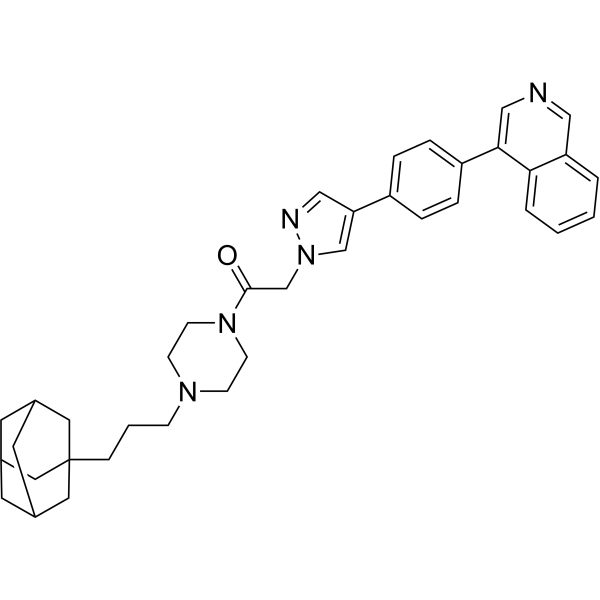
    CDK12-IN-2 is a potent, selective and nanomolar CDK12 inhibitor (IC50=52 nM) with good physicochemical properties. CDK12-IN-2 is also a strong CDK13 inhibitor due to CDK13 is the closest homologue of CDK12. CDK12-IN-2 shows excellent kinase selectivity for CDK12 over CDK2, 9, 8, and 7. CDK12-IN-2 inhibits the phosphorylation of Ser2 in the C-terminal domain of RNA polymerase II. CDK12-IN-2 can be used an excellent chemical probe for functional studies of CDK12 .
    CDK12-IN-2
  • HY-163944

    DNA/RNA Synthesis Molecular Glues CDK Apoptosis RAD51 ATM/ATR PARP Cancer
    LL-K12-18 is a CDK12 kinase inhibitor and a dual-site molecular glue. LL-K12-18 inhibits human CDK12 with an IC50 value of 283.9 nM, and selectively degrades cyclin K via the ubiquitin-proteasome system by stabilizing the CDK12-DDB1 complex. LL-K12-18 downregulates DNA damage response genes, reduces the phosphorylation level of CTD Ser2 in RNA polymerase II, and modulates biomarkers such as ATM, RAD51, γ-H2AX and cleaved PARP, thereby effectively inducing apoptosis and inhibiting proliferation of breast cancer cells. LL-K12-18 exhibits high target selectivity and serves as a research tool for studies on triple-negative breast cancer .
    LL-K12-18
  • HY-153244
    MFH290
    1 Publications Verification

    CDK Cancer
    MFH290 is a potent and highly selective cyclin-dependent kinase 12/13 (CDK12/13) covalent inhibitor. MFH290 forms a covalent bond with Cys-1039 of CDK12 and exhibits excellent kinome selectivity and inhibits the phosphorylation of serine-2 in the C-terminal domain (CTD) of RNA-polymerase II (Pol II). MFH290 is used for cancer research .
    MFH290
  • HY-E70660

    CDK Cancer
    CDK13/CycK Recombinant Human Active Protein Kinase is a RNA polymerase II C-terminal domain kinases. CDK13 interacts with the splicing factor SRSF1 and to regulate alternative splicing of HIV .
    CDK13/CycK Recombinant Human Active Protein Kinase
  • HY-E70659

    CDK Cancer
    CDK12/CycK Recombinant Human Active Protein Kinase is a cyclin-dependent kinase that phosphorylates the C-terminal domain (CTD) of RNA polymerase II (Pol II), thereby regulating different phases of the transcription cycle from transcription initiation to elongation and termination .
    CDK12/CycK Recombinant Human Active Protein Kinase
  • HY-171786

    CDK Cancer
    CDK12-IN-8 (Compound Cpd143) is an orally active and highly selective inhibitor of cyclin-dependent kinase 12 (CDK12). CDK12-IN-8 inhibits CDK12-mediated phosphorylation of the C-terminal domain (CTD) serine 2 of RNA polymerase II, interfering with gene transcription elongation and DNA damage repair pathways. CDK12-IN-8 is promising for research of cancers with high CDK12 expression such as small cell lung cancer and triple-negative breast cancer .
    CDK12-IN-8
  • HY-182312

    CDK Apoptosis Cancer
    CTX-439 is an orally active, ATP-competitive small-molecule inhibitor of CDK12 and CDK13, with an IC50 of 3.1 nM and a Kd of 0.38 nM against CDK12, and an IC50 of 9.2 nM against CDK13. CTX-439 induces DNA damage and apoptosis in tumor cells. CTX-439 is applicable for the research of breast cancer and ovarian cancer .
    CTX-439

Inquiry Online

Your information is safe with us. * Required Fields.

Salutation


Country or Region *

Applicant Name *


Organization Name *

Department *


Email Address *


Product Name *

Cat. No.


Requested quantity *

Phone Number *


Remarks

Inquiry Online

Inquiry Information

Product Name:
Cat. No.:
Quantity:
MCE Japan Authorized Agent:

