



MFH290
Based on 1 publication(s) in Google Scholar
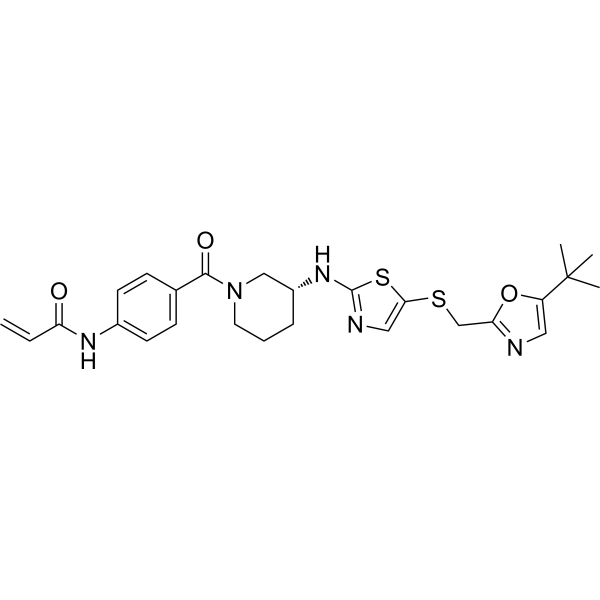
MFH290 is an orally active, selective covalent CDK12/CDK13 inhibitor, with an IC50 of 25 nM against human CDK12 and 49 nM against human CDK13. MFH290 reduces the phosphorylation level of CTD-RNAPII-Ser2, downregulates genes related to DNA damage response (DDR), and inhibits transcription factors regulated by super-enhancers. MFH290 can be used in research related to various cancers including leukemia.
연구목적의 판매만을 진행합니다. 환자를 대상으로 한 판매는 하지 않습니다.
- Purity : 98.29%
- CAS No.: 2088715-91-5
- 화학식: C26H31N5O3S2
- 분자량:525.69
-
보관:Powder -20°C, 3 years ; In solvent -80°C, 6 months , -20°C, 1 month

To place orders, for customer services and technical support, please contact: MedChemExpress USA
Tel: 609-228-6898 E-mail: [email protected] [email protected]


-
 Biological Activity
-
Chemical Information
-
용액&용해도
- Protocol
- 순도&문서
- References
-
 Help & FAQs


Publications Citing Use of MedChemExpress (MCE) MFH290
More

Biological Activity
제품 설명
IC50 & Target
[1]|
CDK12 25 nM (IC50) |
CDK13 49 nM (IC50) |
Cellular Effect
|
Cell Line

|
Type | Value | Description | References |
|---|---|---|---|---|
| HAP1 | IC50 |
10.15 nM
Compound: 1d; MFH290
|
Antiproliferative activity against human HAP1 cells measured after 72 hrs by Celltiter glo assay
Antiproliferative activity against human HAP1 cells measured after 72 hrs by Celltiter glo assay
|
[PMID: 32502343] |
| HAP1 | IC50 |
115.7 nM
Compound: 1d; MFH290
|
Antiproliferative activity against human HAP1 cells harboring CDK12 C1039S mutant measured after 72 hrs by Celltiter glo assay
Antiproliferative activity against human HAP1 cells harboring CDK12 C1039S mutant measured after 72 hrs by Celltiter glo assay
|
[PMID: 32502343] |
| HAP1 | IC50 |
246.5 nM
Compound: 1d; MFH290
|
Antiproliferative activity against human HAP1 cells harboring CDK12 C1039S/CDK13 C1017S double mutant measured after 72 hrs by Celltiter glo assay
Antiproliferative activity against human HAP1 cells harboring CDK12 C1039S/CDK13 C1017S double mutant measured after 72 hrs by Celltiter glo assay
|
[PMID: 32502343] |
| HAP1 | IC50 |
8.414 nM
Compound: 1d; MFH290
|
Antiproliferative activity against human HAP1 cells harboring CDK13 C1017S mutant measured after 72 hrs by Celltiter glo assay
Antiproliferative activity against human HAP1 cells harboring CDK13 C1017S mutant measured after 72 hrs by Celltiter glo assay
|
[PMID: 32502343] |
| Sf9 | IC50 |
120 nM
Compound: 1d; MFH290
|
Inhibition of recombinant human full-length N-terminal GST-tagged CDK2/cyclinA1 expressed in baculovirus infected Sf9 insect cells using FRET-labeled Ser/Thr 12 as substrate measured after 1 hr by Z'-lyte assay
Inhibition of recombinant human full-length N-terminal GST-tagged CDK2/cyclinA1 expressed in baculovirus infected Sf9 insect cells using FRET-labeled Ser/Thr 12 as substrate measured after 1 hr by Z'-lyte assay
|
[PMID: 32502343] |
| Sf9 | IC50 |
3130 nM
Compound: 1d; MFH290
|
Inhibition of kinase tracer 236 binding to recombinant human N-terminal GST-tagged full-length CDK14/Cyclin Y (2 to end residues) expressed in baculovirus infected Sf9 insect cells measured after 1 hr by LanthaScreen Eu Kinase Binding Assay
Inhibition of kinase tracer 236 binding to recombinant human N-terminal GST-tagged full-length CDK14/Cyclin Y (2 to end residues) expressed in baculovirus infected Sf9 insect cells measured after 1 hr by LanthaScreen Eu Kinase Binding Assay
|
[PMID: 32502343] |
| Sf9 | IC50 |
3830 nM
Compound: 1d; MFH290
|
Inhibition of kinase tracer 236 binding to recombinant human N-terminal GST-tagged human CDK16 (107 to end residues)/Cyclin Y (2 to end residues) expressed in baculovirus infected Sf9 insect cells measured after 1 hr by LanthaScreen Eu Kinase Binding Assa
Inhibition of kinase tracer 236 binding to recombinant human N-terminal GST-tagged human CDK16 (107 to end residues)/Cyclin Y (2 to end residues) expressed in baculovirus infected Sf9 insect cells measured after 1 hr by LanthaScreen Eu Kinase Binding Assa
|
[PMID: 32502343] |
In Vitro
MFH290 potently inhibits purified CDK12 (IC50 = 25 nM) and CDK13 (IC50 = 49 nM), exhibits 5-fold selectivity over CDK2 and CDK9, and shows broad selectivity against other human kinases[1].
MFH290 covalently binds to CDK12/13 in Jurkat T-ALL and HAP1 CML cells[2].
MFH290 (incubated for 72 h) exhibits nanomolar antiproliferative activity in wild-type HAP1 cells (IC50 = 10.15 nM), while reduced sensitivity is observed in CDK12 C1039S mutant cells and CDK12/CDK13 double mutant cells, indicating that CDK12 is the primary target mediating its antiproliferative effect[2].
MFH290 (40-200 nM; 6 h) reduces the phosphorylation levels of total Pol II and Pol II CTD at Ser2, Ser5 and Ser7 residues in wild-type HAP1 cells, and this effect is mainly dependent on the inhibition of CDK12[2].
MFH290 (40-200 nM; 6-24 h) reduces the expression of DDR genes (BRCA2, RAD51, RAD51C) at both RNA and protein levels in wild-type HAP1 cells, and this effect is mainly dependent on the inhibition of CDK12[2].
MFH290 (1.56-100 nM; 8 days) acts synergistically with the PARP inhibitor Olaparib (HY-10162) to inhibit the proliferation of WT HAP1 cells[2].
MedChemExpress (MCE) has not independently confirmed the accuracy of these methods. They are for reference only. Further protocols information, click here.
-
Cell Line:WT HAP1 cells, CDK12 C1039S HAP1 cells, CDK13 C1017S HAP1 cells, CDK12 C1039S/CDK13 C1017S double mutant HAP1 cells
-
Concentration:40, 200 nM
-
Incubation Time:6 h
-
Result:Reduced levels of total Pol II and phosphorylated Ser2, Ser5, and Ser7 in WT HAP1 cells.
Greatly restored total and phosphorylated Pol II levels to near WT levels in CDK12 mutant cells.
Showed minimal rescue of total and phosphorylated Pol II levels in CDK13 mutant cells.
Resulted in complete rescue of total and phosphorylated Pol II levels in double mutant cells.
-
Cell Line:WT HAP1 cells
-
Concentration:1.56, 6.25, 25, 100 nM MFH290; 44, 133, 400, 1200, 3600 nM Olaparib
-
Incubation Time:8 days
-
Result:Exhibited synergistic antiproliferative effects with Olaparib, with maximum synergy observed at 25 nM MFH290 and 1.2 μM olaparib, resulting in an excess over Bliss score of 0.75.
Parmacokinetics
In Vivo
MedChemExpress (MCE) has not independently confirmed the accuracy of these methods. They are for reference only.


Chemical Information
-
CAS No. 2088715-91-5
-
Appearance Solid
-
분자량 525.69
-
화학식 C26H31N5O3S2
-
Color White to off-white
-
SMILES
O=C(C1=CC=C(C=C1)NC(C=C)=O)N2C[C@@H](CCC2)NC3=NC=C(SCC4=NC=C(C(C)(C)C)O4)S3
-
선적
Room temperature in continental US; may vary elsewhere.
-
보관
Powder -20°C 3 years In solvent -80°C 6 months -20°C 1 month


Publications (1)
-
Journal Impact Factor
-
Most Recent
-
bioRxiv
2025 May 10:2025.05.06.651696. PMID: 40568108


용액&용해도
In Vitro:
DMSO : ≥ 100 mg/mL (190.23 mM; Hygroscopic DMSO has a significant impact on the solubility of product, please use newly opened DMSO)
* "≥" means soluble, but saturation unknown.
Please refer to the solubility information to select the appropriate solvent. Once prepared, please aliquot and store the solution to prevent product inactivation from repeated freeze-thaw cycles.
Storage method and period of stock solution: -80°C, 6 months; -20°C, 1 month. When stored at -80°C, please use it within 6 months. When stored at -20°C, please use it within 1 month.
Please refer to the solubility information to select the appropriate solvent. Once prepared, please aliquot and store the solution to prevent product inactivation from repeated freeze-thaw cycles.
Storage method and period of stock solution: -80°C, 6 months; -20°C, 1 month. When stored at -80°C, please use it within 6 months. When stored at -20°C, please use it within 1 month.
Concentration (start) × Volume (start) = Concentration (final) × Volume (final)
In Vivo:
Select the appropriate dissolution method based on your experimental animal and administration route.
- For the following dissolution methods, please ensure to first prepare a clear stock solution using an In Vitro approach and then sequentially add co-solvents:
- To ensure reliable experimental results, the clarified stock solution can be appropriately stored based on storage conditions. As for the working solution for In Vivo experiments, it is recommended to prepare freshly and use it on the same day.
- The percentages shown for the solvents indicate their volumetric ratio in the final prepared solution. If precipitation or phase separation occurs during preparation, heat and/or sonication can be used to aid dissolution.
Add each solvent one by one: 10% DMSO 40% PEG300 5% Tween-80 45% Saline
Solubility: ≥ 2.5 mg/mL (4.76 mM); Clear solution
This protocol yields a clear solution of ≥ 2.5 mg/mL (saturation unknown).
Taking 1 mL working solution as an example, add 100 μL DMSO stock solution (25.0 mg/mL) to 400 μL PEG300, and mix evenly; then add 50 μL Tween-80 and mix evenly; then add 450 μL Saline to adjust the volume to 1 mL.
Preparation of Saline: Dissolve 0.9 g sodium chloride in ddH₂O and dilute to 100 mL to obtain a clear Saline solution.
Add each solvent one by one: 10% DMSO 90% (20% SBE-β-CD in Saline)
Solubility: ≥ 2.5 mg/mL (4.76 mM); Clear solution
This protocol yields a clear solution of ≥ 2.5 mg/mL (saturation unknown).
Taking 1 mL working solution as an example, add 100 μL DMSO stock solution (25.0 mg/mL) to 900 μL 20% SBE-β-CD in Saline, and mix evenly.
Preparation of 20% SBE-β-CD in Saline (4°C, storage for one week): 2 g SBE-β-CD powder is dissolved in 10 mL Saline, completely dissolve until clear.
In Vivo Dissolution Calculator
Please enter the basic information of animal experiments:
-
-
-
-
Recommended: Prepare an additional quantity of animals to account for potential losses during experiments.
Please enter your animal formula composition:
-
%DMSO +
Recommended: Keep the proportion of DMSO in working solution below 2% if your animal is weak.
-
%+
-
+%Tween-80 + +
-
%Saline +
The co-solvents required include: DMSO, . All of co-solvents are available by MedChemExpress (MCE). , Tween 80. All of co-solvents are available by MedChemExpress (MCE).
Working solution concentration: 0.22 mg/mL
Method for preparing stock solution: mg drug dissolved in μL DMSO. Stock solution concentration: mg/mL.
1. Take μL DMSO stock solution;
2. Add μL .
μL , mix evenly;
3. Then add μL Tween 80, mix evenly;
4. Then add μL
Please ensure that the stock solution in the first step is dissolved to a clear state, and add co-solvents in sequence. You can use ultrasonic heating (ultrasonic cleaner, recommended frequency 20-40 kHz), vortexing, etc. to assist dissolution.

Protocol
-
Kinase activity and phosphorylation assays
Kinase activity assays measure the ability of kinases to transfer phosphate groups from ATP to specific substrates, while phosphorylation assays detect the presence and levels of phosphorylated proteins. Common methods include radiolabeled ATP incorporation (e. g. ,), ADP release detection via bioluminescence (e. g. ,[3]), enzyme-linked immunosorbent assays (ELISA) for phospho-specific epitopes (e. g. ,[6]), and microtiter-based formats for high-throughput screening (e. g. ,[8]). The ADP-Glo assay quantifies kinase activity by measuring ADP produced during phosphorylation using a luciferase-based system. Radiometric assays involve autoradiography or scintillation counting after incorporation of 32P-labeled ATP into substrate proteins. ELISA-based approaches rely on phospho-specific antibodies to detect activated kinases in cell lysates or purified samples.
-
Western Blot
Western blotting (WB) is a commonly used experimental method in molecular biology, biochemistry, and immunogenetics for identifying and quantifying target proteins. It combines gel electrophoresis with immunoassay, enabling researchers to analyze protein expression, post-translational modifications, and molecular weight.
-
Protocol for Kinase activity and phosphorylation assays
Kinase activity assays measure transfer of phosphate from ATP to a protein or peptide substrate, generating phosphorylated substrate, ADP, or incorporated radiolabeled phosphate as the readout; phosphorylation assays measure site-specific phosphorylation in cells or tissues as a proxy for kinase-pathway activation, inhibition, or substrate regulation. Phosphorylation can be detected by phospho-specific Western blot, immunoprecipitation kinase assay, phospho-immunofluorescence, phospho-flow cytometry, luminescent ADP detection, radiolabeled ATP incorporation, or reporter-based pathway assays, and these readouts can be applied to cancer cells, primary neurons, mouse tumors, organoids, inflammatory macrophages, ferroptosis studies, and mitophagy studies when the kinase target is biologically relevant.
-
Genotoxicity/Mutagenicity Study
The bacterial reverse mutation assay detects point mutations that restore amino-acid prototrophy in auxotrophic Salmonella typhimurium or Escherichia coli tester strains; after exposure to a test article, mutagenic activity is read out as an increased number of revertant colonies on minimal agar compared with the vehicle control. The assay uses tester strains with different mutation targets so that base-substitution and frameshift mutagens can be detected, and testing is performed with and without exogenous mammalian metabolic activation because some chemicals require biotransformation to become mutagenic.


순도&문서
-
Data Sheet (282 KB)
-
SDS (252 KB)
- English - EN (252 KB)
- Français - FR (252 KB)
- Deutsch - DE (252 KB)
- Norwegian - NO (252 KB)
- Español - ES (252 KB)
- Swedish - SV (252 KB)
- Italian - IT (252 KB)
- Korean - KR (252 KB)
- Portuguese - PT (252 KB)
-
Handling Instructions (2659 KB)
References
[1]. Tadesse S, et al. The promise and current status of CDK12/13 inhibition for the treatment of cancer. Future medicinal chemistry. 2021 Jan;13(2):117-141. [Content Brief]
[2]. Liu Y, et al. Discovery of MFH290: A Potent and Highly Selective Covalent Inhibitor for Cyclin-Dependent Kinase 12/13. Journal of medicinal chemistry. 2020 Jul 09;63(13):6708-6726. [Content Brief]


Complete Stock Solution Preparation Table
Please refer to the solubility information to select the appropriate solvent. Once prepared, please aliquot and store the solution to prevent product inactivation from repeated freeze-thaw cycles.
Storage method and period of stock solution: -80°C, 6 months; -20°C, 1 month. When stored at -80°C, please use it within 6 months. When stored at -20°C, please use it within 1 month.
| Optional Solvent | Concentration Solvent Mass | 1 mg | 5 mg | 10 mg | 25 mg |
|---|---|---|---|---|---|
| DMSO | 1 mM | 1.9023 mL | 9.5113 mL | 19.0226 mL | 47.5565 mL |
| 5 mM | 0.3805 mL | 1.9023 mL | 3.8045 mL | 9.5113 mL | |
| 10 mM | 0.1902 mL | 0.9511 mL | 1.9023 mL | 4.7557 mL | |
| 15 mM | 0.1268 mL | 0.6341 mL | 1.2682 mL | 3.1704 mL | |
| 20 mM | 0.0951 mL | 0.4756 mL | 0.9511 mL | 2.3778 mL | |
| 25 mM | 0.0761 mL | 0.3805 mL | 0.7609 mL | 1.9023 mL | |
| 30 mM | 0.0634 mL | 0.3170 mL | 0.6341 mL | 1.5852 mL | |
| 40 mM | 0.0476 mL | 0.2378 mL | 0.4756 mL | 1.1889 mL | |
| 50 mM | 0.0380 mL | 0.1902 mL | 0.3805 mL | 0.9511 mL | |
| 60 mM | 0.0317 mL | 0.1585 mL | 0.3170 mL | 0.7926 mL | |
| 80 mM | 0.0238 mL | 0.1189 mL | 0.2378 mL | 0.5945 mL | |
| 100 mM | 0.0190 mL | 0.0951 mL | 0.1902 mL | 0.4756 mL |


MFH290 Related Classifications
HY-153244 Related Classifications
 Powered by Bioz