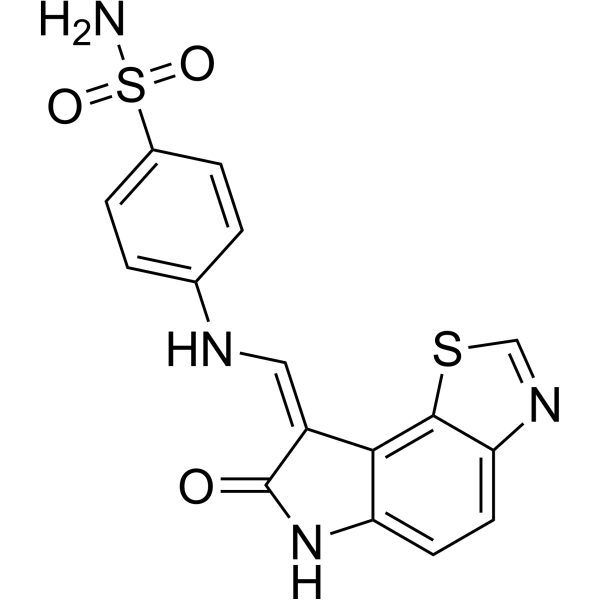
Pho85
Pho85 is a multifunctional cyclin-dependent kinase (CDK) in Saccharomyces cerevisiae that integrates nutrient sensing, metabolic regulation, and cell-cycle control through association with multiple cyclin partners (Pcls)[1]. Unlike the essential cell-cycle CDK Cdc28, Pho85 operates through at least ten cyclins that direct substrate specificity across distinct biological processes, including phosphate homeostasis, glycogen metabolism, polarized growth, and G1/S transition regulation[1][2]. Mechanistically, the Pho80-Pho85 complex phosphorylates the transcription factor Pho4 under phosphate-replete conditions, thereby repressing PHO pathway gene expression and maintaining phosphate homeostasis[3]. Pho85-dependent signaling also interfaces with broader nutrient-responsive networks; Pho85 promotes TORC1-Sch9 signaling by regulating Sch9 recruitment and priming phosphorylation, linking phosphate availability to cellular growth control[4]. In experimental models, Pho85 has become an important system for studying noncanonical CDK functions because its regulatory architecture differs from classical cell-cycle CDKs and allows environmental signals to be coupled directly to transcriptional and metabolic responses[2]. Compared with related CDKs, Pho85 exhibits unusually broad functional diversity through cyclin-dependent substrate targeting, making cyclin composition a major determinant of pathway specificity[1][5]. For research applications, chemical inhibition of Pho85 has been used to dissect stress-response pathways and nutrient-regulated transcriptional programs, providing a useful experimental framework for investigating CDK-mediated environmental adaptation[6].
References:
- [1]. Huang D, et al. Pho85, a multifunctional cyclin-dependent protein kinase in budding yeast. Mol Microbiol. 2007 Oct;66(2):303-14. [Content Brief]
- [2]. Deprez MA, et al. The nutrient-responsive CDK Pho85 primes the Sch9 kinase for its activation by TORC1. PLoS Genet. 2023 Feb 15;19(2):e1010641. [Content Brief]
All Product Categories
-
Pho85 Related Products (1)
Related Products (1)