14 Results for "

active pocket residues

" in MedChemExpress (MCE) Product Catalog:
Products (14)

14 Results for "active pocket residues" in MCE Product Catalog:

Cat. No.: HY-168046
CAS No.: 2542029-03-6
Research Areas:  

Metabolic Disease

ALG-055009 is a selective and orally active Thyroid Hormone Receptor Beta (THR-β) agonist with an EC50 of 0.063 μM. ALG-055009 binds to the T3 hormone pocket of human THR-β, forming polar interactions with protein residues. ALG-055009 can lower total cholesterol levels in rats on a high-fat diet. ALG-055009 exhibits high metabolic stability, good permeability, a long in vivo half-life, and limited drug-drug interaction liability. ALG-055009 can be used in studies related to metabolic dysfunction-associated fatty liver disease .
loading...
    loading...
Cat. No.: HY-176892
CAS No.: 574-77-6
Research Areas:  

Neurological Disease

Papaveroline is a Fyn tyrosine kinase inhibitor, Na +,K +-ATPase inhibitor with an IC50 of 0.20 mM, Mg 2+-ATPase inhibitor, K +-activated pNPPase inhibitor with an IC50 of 1.51 mM, and apoptosis inducer . Papaveroline binds to the active site of Fyn tyrosine kinase and forms stable interactions with pocket amino acid residues . Papaveroline induces cell apoptosis, produces pycnotic and fragmented cell nuclei, and does not reduce intracellular ATP levels . Papaveroline is a dopamine-derived neurotoxin candidate associated with the pathogenesis of Parkinson's disease . Papaveroline can be used in the research of Alzheimer's disease and Parkinson's disease .
loading...
    loading...
Cat. No.: HY-175249
CAS No.: 3082627-31-1
Research Areas:  

Others

TKL-IN-2 is a herbicide and SvTKL inhibitor with an IC50 of 0.11 mg/L. TKL-IN-2 binds to the SvTKL active site, interacts with key pocket residues, and inhibits enzyme activity. TKL-IN-2 can be used for the research of weed control in maize, wheat, soybean, and cotton fields .
loading...
    loading...
Cat. No.: HY-170322
TDO2-IN-1 is a selective TDO2 inhibitor. TDO2-IN-1 binds to the active pocket, heme-binding pocket and substrate-binding pocket of apo-TDO2, interacts with key residues, competitively inhibits heme insertion, and suppresses intracellular TDO2 activity. TDO2-IN-1 can be used in research related to cancer, metabolism and other fields .
loading...
    loading...
Cat. No.: HY-152158
CAS No.: 2870693-28-8
Purity:  99.13%
Target:  

Glycosidase

Research Areas:  

Metabolic Disease

α-Glucosidase-IN-22 (Compound 7i) is a α-glucosidase inhibitor with an IC50 value of 0.64 μM. α-Glucosidase-IN-22 can be used for the research of type 2 diabetes .
loading...
    loading...
Cat. No.: HY-124308
CAS No.: 1221964-50-6
Target:  

PKC

Research Areas:  

Cancer

PS315, a derivative of PS48 (HY-15967), is an allosteric PKC inhibitor by binding to the PIF-pocket of aPKC and inducing a displacement of the active site residue Lys111. PS315 inhibits the full-length and catalytic domain constructs of PKCζ (IC50=10 μM) and PKCη (IC50=30 μM). PS315 has anti-cancer activity .
loading...
    loading...
Cat. No.: HY-187383
Target:  

Carbonic Anhydrase

Research Areas:  

Others

Carbonic anhydrase-IN-40 is a human carbonic anhydrase I/II inhibitor, with an IC50 of 16.900 nM against hCA I and an IC50 of 4.682 nM against hCA II. Carbonic anhydrase-IN-40 binds to the active site of the enzyme, coordinates with the catalytic zinc ion, forms π-π stacking interactions with active site residues, and makes hydrophobic contacts with the hydrophobic pocket. Carbonic anhydrase-IN-40 can serve as a lead compound for studies related to carbonic anhydrase inhibitors .
loading...
    loading...
Cat. No.: HY-189127
CAS No.: 668468-75-5
Target:  

Bacterial Fungal

Research Areas:  

Infection

Antibacterial agent 373 is a broad-spectrum antibacterial agent. Antibacterial agent 373 exhibits antibacterial activity against Gram-negative/Gram-positive bacteria and some fungi, with MIC values ranging from 11.25 to 22.5 mg/mL. Antibacterial agent 373 is predicted to target Staphylococcus aureus topoisomerase IV, occupy the novobiocin binding pocket, and form hydrogen bonds with the active site residues Asn49 and Glu53. Antibacterial agent 373 can be used in studies related to bacterial and Candida infections .
loading...
    loading...
Cat. No.: HY-189207
Target:  

DNA/RNA Synthesis

Research Areas:  

Cancer

NUDT1-IN-1 is an inhibitor of NUDT1 (MTH1) with a pIC50 value of 9.785. NUDT1-IN-1 can be applied in cancer research .
loading...
    loading...
Cat. No.: HY-184653
Research Areas:  

Cancer

MS3-123 is an orally active PRMT1 inhibitor (IC50 = 11.4 nM) that selectively targets the unique Cys119 residue within the SAM-binding pocket. MS3-123 covalently binds to PRMT1 through a time-dependent irreversible mechanism and exhibits high selectivity over other PRMT family members and other methyltransferases. MS3-123 inhibits breast cancer cell proliferation, migration and invasion, and induces cell cycle arrest and apoptosis. MS3-123 is useful for breast cancer research .
loading...
    loading...
Cat. No.: HY-189205
Target:  

Kallikrein

Research Areas:  

Cancer

DKFZ-938 is a kallikrein-related peptidase 6 (KLK6) inhibitor, with an IC50 of 0.09 μM against human KLK6. DKFZ-938 binds to the catalytic serine residue in the active-site pocket of KLK6 and mimics the natural KLK6 substrate to inhibit the enzymatic activity of KLK6. DKFZ-938 can be conjugated to the non-canonical amino acid propargyllysine via copper-catalyzed azide-alkyne cycloaddition click chemistry. DKFZ-938 is used in research related to colorectal cancer and pancreatic cancer .
loading...
    loading...
Cat. No.: HY-184432
Target:  

Herbicide HPPD

Research Areas:  

Others

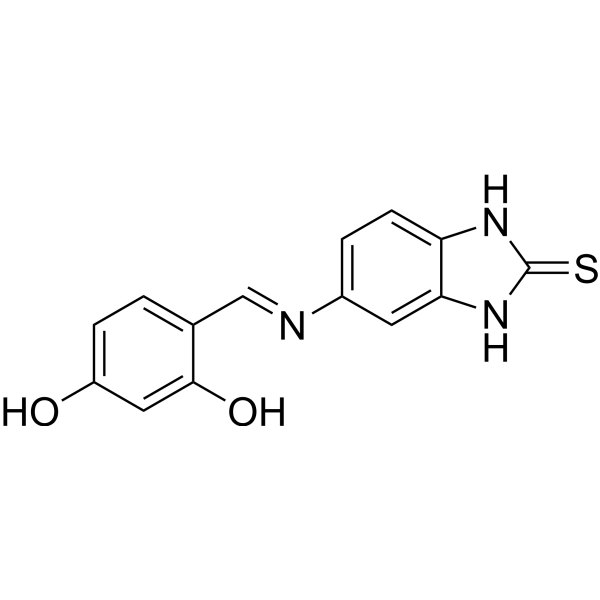
HPPD-IN-8 is a 4-hydroxyphenylpyruvate dioxygenase (HPPD) inhibitor, with an IC50 of 0.0273 μM and a Ki of 0.226 nM against Arabidopsis thaliana. HPPD-IN-8 can be used for herbicide-related research .
loading...
    loading...
Cat. No.: HY-L925
9,363 compounds

Cysteine proteases (CPs), a key enzyme family regulating physiological metabolism and mediating pathological processes (such as abnormal bone resorption, tumour invasion, and pathogen infection), represent a core therapeutic target for developing specific inhibitors in disease intervention. Currently reported CP inhibitors primarily achieve their inhibitory function by precisely binding to CP active pockets (e.g., S1-S4 non-primed regions or S1'-S2' primed regions) and forming covalent/non-covalent interactions with the active site cysteine residues, providing clear structural references for the development of novel inhibitors.

This compound library, designed based on the core strategy of "similarity-based known active structures", contains over 200 cysteine protease inhibitors. Leveraging AI-driven molecular screening technology, it retains the critical pharmacological and shape features of reported CP inhibitors, serving as a specialized tool for efficiently discovering novel cysteine protease inhibitors.

Cat. No.: HY-P1609
CAS No.: 105116-61-8
Target:  

Renin Enteropeptidase

Research Areas:  

Cardiovascular Disease

CP-69799 is an azahomostatine-containing oligopeptide transition-state analogue inhibitor with a hog renin IC50 of 6e-9 M, human plasma renin IC50 of 3e-7 M and Ki of 0.310 μM, and endothiapepsin Ki of 0.27 μM. CP-69799 binds endothiapepsin’s active site cleft in extended conformation, fills S4 to S3' pockets, displaces native solvent molecules, induces domain rotation, and reduces thermal mobility of endothiapepsin’s flap and helix regions. CP-69799 acts as a transition-state analogue inhibitor of hog renin and human plasma renin. CP-69799 contains a polar lysine residue at the P2' position, with a nitrogen atom replacing the P1' Cα atom of the hydroxyethylene dipeptide isostere. CP-69799 can be used for the research of hypertension .
loading...
    loading...
  • 1

