



ALG-055009

Based on 1 Customer Validation
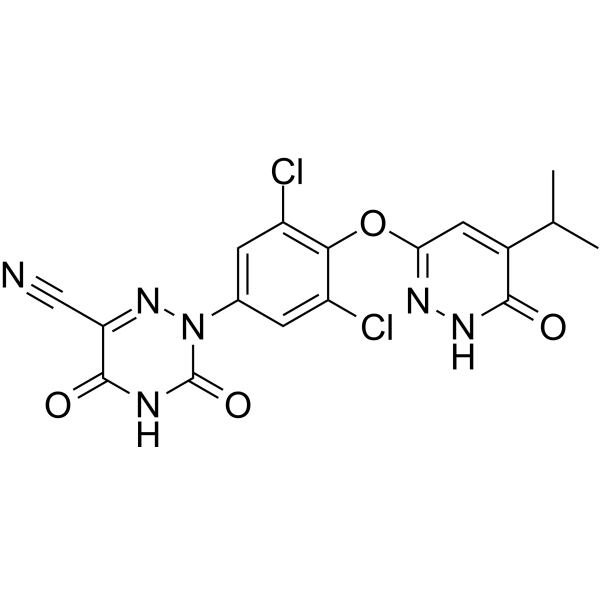
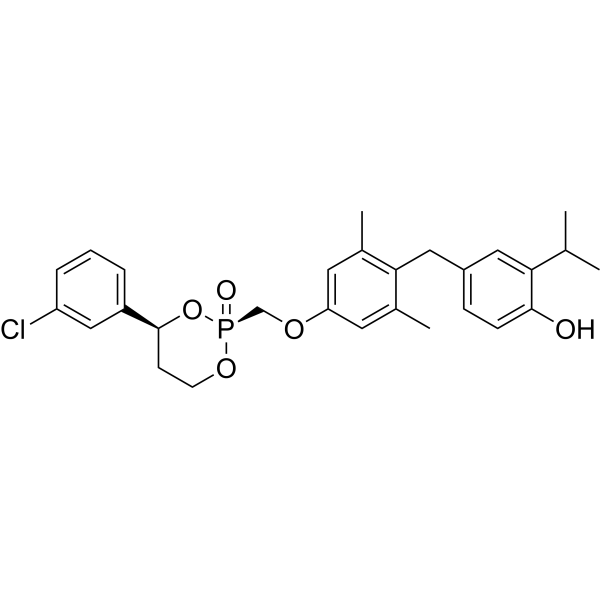
ALG-055009 is a selective and orally active Thyroid Hormone Receptor Beta (THR-β) agonist with an EC50 of 0.063 μM. ALG-055009 binds to the T3 hormone pocket of human THR-β, forming polar interactions with protein residues. ALG-055009 can lower total cholesterol levels in rats on a high-fat diet. ALG-055009 exhibits high metabolic stability, good permeability, a long in vivo half-life, and limited drug-drug interaction liability. ALG-055009 can be used in studies related to metabolic dysfunction-associated fatty liver disease.
For research use only. We do not sell to patients.
- Purity : 95.32%
- CAS No.: 2542029-03-6
- Formula: C16H14Cl2N6O4
- Molecular Weight:425.23
-
Storage:Powder -20°C, 3 years , 4°C, 2 years ; In solvent -80°C, 6 months , -20°C, 1 month


To place orders, for customer services and technical support, please contact: MedChemExpress USA
Tel: 609-228-6898 E-mail: [email protected] [email protected]


-
 Biological Activity
-
Chemical Information
-
Solvent & Solubility
- Protocols
- Purity & Documentation
- References
-
 Help & FAQs





Biological Activity
Description
IC50 & Target
[1]|
THR-β 0.063 μM (EC50) |
Cellular Effect
|
Cell Line

|
Type | Value | Description | References |
|---|---|---|---|---|
| Huh-7 | EC50 |
9 nM
Compound: 14
|
Effect on CPT1A gene expression in human Huh-7 cells measured for 24 hrs
Effect on CPT1A gene expression in human Huh-7 cells measured for 24 hrs
|
[PMID: 39221768] |
In Vitro
ALG-055009 (Compound 14) (1 h) potently activates recombinant human THR-β with an EC50 of 0.063 μM and shows 5.7-fold selectivity for THR-β over recombinant human THR-α in a TR-FRET coactivator biochemical assay[1].
ALG-055009 (18-24 h) activates THR-β in transfected HEK293T cells with an EC50 of 0.050 μM and shows 3.8-fold selectivity for THR-β over THR-α in a luciferase reporter gene assay[1].
ALG-055009 (24 h) induces CPT1A gene expression in Huh-7 liver-derived cells with an EC50 of 9 nM, demonstrating potent on-target activity related to mitochondrial fatty acid β-oxidation[1].
ALG-055009 (1 μM; 0-180 min) shows high metabolic stability in cryopreserved mouse, rat, dog, cynomolgus monkey, and human hepatocytes[1].
ALG-055009 has low CYP450 inhibition potential in human liver microsomes, with an IC50 of 112 μM for CYP2C8, 37 μM for CYP2C9, and IC50 values >50 μM for CYP1A2, CYP2B6, CYP2C19, CYP2D6, and CYP3A4[1].
ALG-055009 (0.07-50 μM; 10 min) weakly inhibits recombinant human UGT1A1 with an IC50 of 37.5 μM, indicating low risk of glucuronidation-related drug-drug interactions[1].
ALG-055009 (5 μM; 1 h) shows good permeability across Caco-2 cell monolayers with an A to B Papp of 2.2 × 10⁻⁶ cm/s and a low efflux ratio of 6[1].
ALG-055009 (2 μM; 4 h) shows high plasma protein binding (>96%) in mouse, rat, dog, cynomolgus monkey, and human plasma[1].
ALG-055009 (5 μM; 60 min) has blood-to-plasma ratios of 0.49 to 0.64 in mouse, rat, dog, cynomolgus monkey, and human whole blood, showing no preferential red blood cell partitioning[1].
ALG-055009 is neither a substrate nor an
inhibitor (IC50 = 34.4 and 23.8 μM, respectively) of BCRP or
OATP1B1[1].
ALG-055009 (up to 10 μM) shows no inhibition of human Nav1.5, Cav1.2, or hERG potassium channels at concentrations up to 10 μM, indicating low cardiovascular safety risk[1].
MedChemExpress (MCE) has not independently confirmed the accuracy of these methods. They are for reference only.
Parmacokinetics
| Species | Dose | Route | CL | Vss | T1/2 | Cmax | AUC0-inf | F |
|---|---|---|---|---|---|---|---|---|
| Mice[1] | 5 mg/kg | i.v. | 3.52 mL/min/kg | 0.694 L/kg | 2.27 h | / | 23704 ng·h/mL | / |
| Mice[1] | 5 mg/kg | p.o. | / | / | 2.97 h | 3547 ng/mL | 17977 ng·h/mL | 75.8 % |
| Rat[1] | 1 mg/kg | i.v. | 1.40 mL/min/kg | 0.627 L/kg | 7.22 h | / | 11957 ng·h/mL | / |
| Rat[1] | 5 mg/kg | p.o. | / | / | 7.59 h | 7560 ng/mL | 60124 ng·h/mL | 101 % |
| Rat[1] | 0.03 mg/kg | p.o. | / | / | / | 12.9 ng/mL | 117 ng·h/mL | 35.1 % |
| Rat[1] | 0.1 mg/kg | p.o. | / | / | / | 52.7 ng/mL | 698 ng·h/mL | 62.7 % |
| Rat[1] | 0.3 mg/kg | p.o. | / | / | / | 249 ng/mL | 3651 ng·h/mL | 109 % |
| Dog[1] | 1 mg/kg | i.v. | 0.895 mL/min/kg | 0.687 L/kg | 10.6 h | / | 18624 ng·h/mL | / |
| Dog[1] | 5 mg/kg | p.o. | / | / | 9.26 h | 4673 ng/mL | 51873 ng·h/mL | 55.7 % |
| Dog[1] | 0.03 mg/kg | p.o. | / | / | / | 4.47 ng/mL | 158 ng·h/mL | 29.3 % |
| Dog[1] | 0.3 mg/kg | p.o. | / | / | 12.9 h | 206 ng/mL | 4160 ng·h/mL | 74.5 % |
| Cynomolgus Monkey[1] | 1 mg/kg | i.v. | 1.59 mL/min/kg | 0.597 L/kg | 7.72 h | 8107 ng/mL | 10987 ng·h/mL | / |
| Cynomolgus Monkey[1] | 5 mg/kg | p.o. | / | / | 8.03 h | / | 45735 ng·h/mL | 83.3 % |
In Vivo
MedChemExpress (MCE) has not independently confirmed the accuracy of these methods. They are for reference only.
-
Animal Model:Sprague-Dawley (male, high fat diet-induced hypercholesterolemia)[1]
-
Dosage:0.015 mg/kg; 0.05 mg/kg; 0.075 mg/kg; 0.15 mg/kg; 0.5 mg/kg; 1.5 mg/kg
-
Administration:p.o.; single dose
-
Result:Reduced serum total cholesterol by 66.9% at 1.5 mg/kg.
Reduced serum low-density lipoprotein cholesterol by 72.3% at 1.5 mg/kg.
Reduced serum total T3 by 64.7% at 1.5 mg/kg.
Reduced serum total T4 by 63.8% at 1.5 mg/kg.
Increased liver Dio1 gene and Me1 gene expression at 0.075-0.5 mg/kg.
Clinical Trial
| NCT Number | Sponsor | Condition | Start Date |
Phase
|
|---|---|---|---|---|
| NCT01329991 | 2011-05 | PHASE1 |


Chemical Information
-
CAS No. 2542029-03-6
-
Appearance Solid
-
Molecular Weight 425.23
-
Formula C16H14Cl2N6O4
-
Color Off-white to light yellow
-
SMILES
CC(C1=CC(OC2=C(Cl)C=C(N3N=C(C(NC3=O)=O)N)C=C2Cl)=NNC1=O)C
-
Shipping
Room temperature in continental US; may vary elsewhere.
-
Storage
Powder -20°C 3 years 4°C 2 years In solvent -80°C 6 months -20°C 1 month


Solvent & Solubility
In Vitro:
DMSO : 50 mg/mL (117.58 mM; Need ultrasonic; Hygroscopic DMSO has a significant impact on the solubility of product, please use newly opened DMSO)
Please refer to the solubility information to select the appropriate solvent. Once prepared, please aliquot and store the solution to prevent product inactivation from repeated freeze-thaw cycles.
Storage method and period of stock solution: -80°C, 6 months; -20°C, 1 month. When stored at -80°C, please use it within 6 months. When stored at -20°C, please use it within 1 month.
Please refer to the solubility information to select the appropriate solvent. Once prepared, please aliquot and store the solution to prevent product inactivation from repeated freeze-thaw cycles.
Storage method and period of stock solution: -80°C, 6 months; -20°C, 1 month. When stored at -80°C, please use it within 6 months. When stored at -20°C, please use it within 1 month.
Concentration (start) × Volume (start) = Concentration (final) × Volume (final)
In Vivo:
Select the appropriate dissolution method based on your experimental animal and administration route.
- For the following dissolution methods, please ensure to first prepare a clear stock solution using an In Vitro approach and then sequentially add co-solvents:
- To ensure reliable experimental results, the clarified stock solution can be appropriately stored based on storage conditions. As for the working solution for In Vivo experiments, it is recommended to prepare freshly and use it on the same day.
- The percentages shown for the solvents indicate their volumetric ratio in the final prepared solution. If precipitation or phase separation occurs during preparation, heat and/or sonication can be used to aid dissolution.
Add each solvent one by one: 10% DMSO 40% PEG300 5% Tween-80 45% Saline
Solubility: ≥ 2.5 mg/mL (5.88 mM); Clear solution
This protocol yields a clear solution of ≥ 2.5 mg/mL (saturation unknown).
Taking 1 mL working solution as an example, add 100 μL DMSO stock solution (25.0 mg/mL) to 400 μL PEG300, and mix evenly; then add 50 μL Tween-80 and mix evenly; then add 450 μL Saline to adjust the volume to 1 mL.
Preparation of Saline: Dissolve 0.9 g sodium chloride in ddH₂O and dilute to 100 mL to obtain a clear Saline solution.
In Vivo Dissolution Calculator
Please enter the basic information of animal experiments:
-
-
-
-
Recommended: Prepare an additional quantity of animals to account for potential losses during experiments.
Please enter your animal formula composition:
-
%DMSO +
Recommended: Keep the proportion of DMSO in working solution below 2% if your animal is weak.
-
%+
-
+%Tween-80 + +
-
%Saline +
The co-solvents required include: DMSO, . All of co-solvents are available by MedChemExpress (MCE). , Tween 80. All of co-solvents are available by MedChemExpress (MCE).
Working solution concentration: 0.22 mg/mL
Method for preparing stock solution: mg drug dissolved in μL DMSO. Stock solution concentration: mg/mL.
1. Take μL DMSO stock solution;
2. Add μL .
μL , mix evenly;
3. Then add μL Tween 80, mix evenly;
4. Then add μL
Please ensure that the stock solution in the first step is dissolved to a clear state, and add co-solvents in sequence. You can use ultrasonic heating (ultrasonic cleaner, recommended frequency 20-40 kHz), vortexing, etc. to assist dissolution.


Purity & Documentation
-
Data Sheet (277 KB)
-
SDS (251 KB)
- English - EN (251 KB)
- Français - FR (251 KB)
- Deutsch - DE (251 KB)
- Norwegian - NO (251 KB)
- Español - ES (251 KB)
- Swedish - SV (251 KB)
- Italian - IT (251 KB)
- Korean - KR (251 KB)
- Portuguese - PT (251 KB)
-
Handling Instructions (2659 KB)
References


Complete Stock Solution Preparation Table
Please refer to the solubility information to select the appropriate solvent. Once prepared, please aliquot and store the solution to prevent product inactivation from repeated freeze-thaw cycles.
Storage method and period of stock solution: -80°C, 6 months; -20°C, 1 month. When stored at -80°C, please use it within 6 months. When stored at -20°C, please use it within 1 month.
| Optional Solvent | Concentration Solvent Mass | 1 mg | 5 mg | 10 mg | 25 mg |
|---|---|---|---|---|---|
| DMSO | 1 mM | 2.3517 mL | 11.7583 mL | 23.5167 mL | 58.7917 mL |
| 5 mM | 0.4703 mL | 2.3517 mL | 4.7033 mL | 11.7583 mL | |
| 10 mM | 0.2352 mL | 1.1758 mL | 2.3517 mL | 5.8792 mL | |
| 15 mM | 0.1568 mL | 0.7839 mL | 1.5678 mL | 3.9194 mL | |
| 20 mM | 0.1176 mL | 0.5879 mL | 1.1758 mL | 2.9396 mL | |
| 25 mM | 0.0941 mL | 0.4703 mL | 0.9407 mL | 2.3517 mL | |
| 30 mM | 0.0784 mL | 0.3919 mL | 0.7839 mL | 1.9597 mL | |
| 40 mM | 0.0588 mL | 0.2940 mL | 0.5879 mL | 1.4698 mL | |
| 50 mM | 0.0470 mL | 0.2352 mL | 0.4703 mL | 1.1758 mL | |
| 60 mM | 0.0392 mL | 0.1960 mL | 0.3919 mL | 0.9799 mL | |
| 80 mM | 0.0294 mL | 0.1470 mL | 0.2940 mL | 0.7349 mL | |
| 100 mM | 0.0235 mL | 0.1176 mL | 0.2352 mL | 0.5879 mL |


ALG-055009 Related Classifications
HY-168046 Related Classifications
 Powered by Bioz