1. Search Result
Search Result
Results for "

axon degeneration

" in MedChemExpress (MCE) Product Catalog:

15

Inhibitors & Agonists

1

Peptides

1

Natural
Products

Cat. No. Product Name Target Research Areas Chemical Structure
  • HY-128700
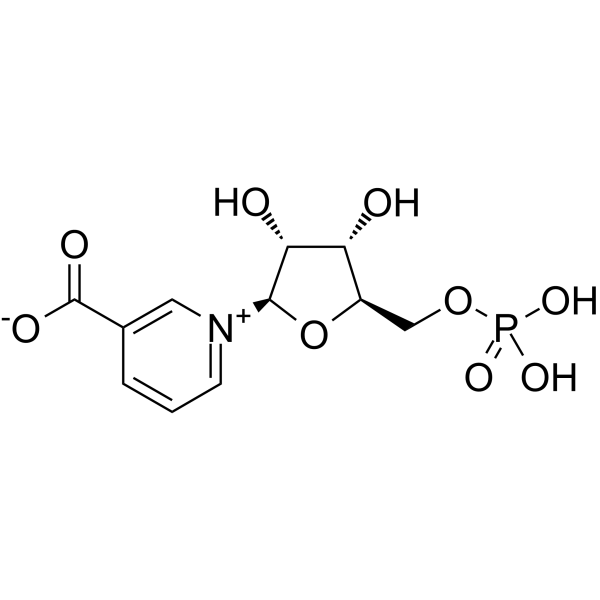
    Nicotinic acid mononucleotide
    1 Publications Verification

    Endogenous Metabolite Sirtuin Neurological Disease Inflammation/Immunology Cancer
    Nicotinic acid mononucleotide acts as a SARM1 inhibitor and a NAD + biosynthesis intermediate, with an IC50 value of 93.3 μM against SARM1. Nicotinic acid mononucleotide exerts axon-protective effects, delays axonal degeneration, elevates NAD + levels, enhances Sirt1 activity, improves myocardial capillary density and alleviates myocardial fibrosis. Nicotinic acid mononucleotide reverses diabetic cardiomyopathy in diabetic mice by increasing myocardial NAD + levels. Nicotinic acid mononucleotide is applicable to research related to cancer, multiple sclerosis, diabetic cardiomyopathy, neurodegenerative diseases and Huntington's disease .
    Nicotinic acid mononucleotide
  • HY-114332

    MAP3K JNK Neurological Disease Metabolic Disease
    GNE-8505 is an orally active, blood-brain barrier-permeable selective dual leucine zipper kinase (DLK) inhibitor. GNE-8505 has an IC50 of 0.144 μM for pJNK, and EC50 of 0.457 μM for DRG. GNE-8505 inhibits the DLK/JNK pathway, reduces stress-induced c-Jun phosphorylation levels, decreases neuronal death and suppresses axonal degeneration. GNE-8505 reduces phosphorylated c-Jun levels in the retina, spinal cord and brain tissues of mice. GNE-8505 is applicable to research related to Alzheimer's disease and amyotrophic lateral sclerosis (ALS) .
    GNE-8505
  • HY-145917

    Toll-like Receptor (TLR) Neurological Disease
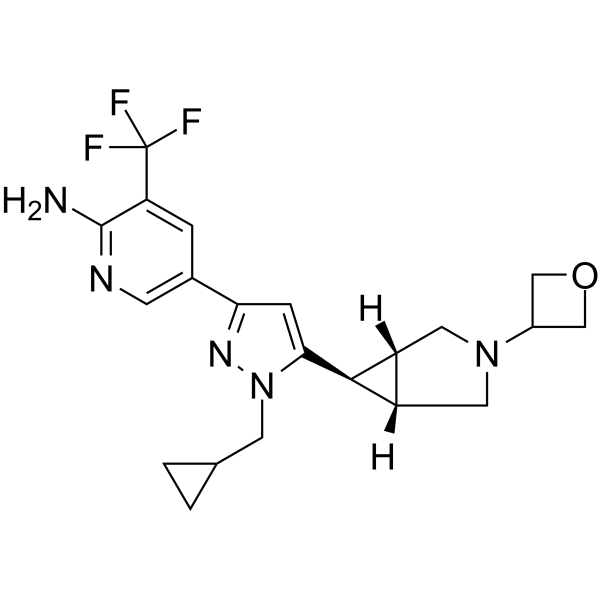
    SARM1-IN-2 (Example 82) is a SARM1 inhibitor (IC50 <1 μM) that inhibits axon regeneration. Axon regeneration refers to the process by which neuronal axons attempt to restore their structure and function after axonal degeneration. SARM1-IN-2 inhibits axon regeneration by reducing or inhibiting the binding of SARM1 to NAD+. SARM1-IN-2 can be used to study axonal degeneration .
    SARM1-IN-2
  • HY-P10227

    ONL-1204

    Fatty Acid Synthase (FASN) Apoptosis Interleukin Related Toll-like Receptor (TLR) NOD-like Receptor (NLR) Caspase Neurological Disease
    Xelafaslatide (ONL-1204) is a Fas receptor antagonist. Xelafaslatide blocks the Fas receptor signaling pathway and inhibits downstream apoptosis and inflammatory pathways. Xelafaslatide suppresses neuroinflammation and microglial activation in glaucoma models, protects retinal ganglion cells and prevents axonal degeneration. Xelafaslatide is applicable to relevant research on glaucoma .
    Xelafaslatide
  • HY-Y0315

    2,5-HD

    Drug Metabolite Neurological Disease
    Hexane-2,5-dione (2,5-HD) is a cytotoxic agent. Hexane-2,5-dione causes an accumulation of neurofilaments within axons in rats that may lead to their degeneration. Hexane-2,5-dione is promising for research of neurodegenerative diseases (e.g., Alzheimer's, Parkinson's) .
    Hexane-2,5-dione
  • HY-164495

    FAAH Thyroid Hormone Receptor Inflammation/Immunology Endocrinology
    Sob-AM2 is a potent substrate (Km=1.3 μM) targeting fatty acid amide hydrolase (FAAH) expressed in the brain and has blood-brain barrier permeability. Sob-AM2 delivers high concentrations of Sobetirome (HY-14823) to the central nervous system with minimal peripheral systemic dose, thereby stimulating central thyroid hormone receptor β (TRβ). In addition, Sob-AM2 can prevent myelin and axon degeneration in experimental autoimmune encephalomyelitis (EAE) mice .
    Sob-AM2
  • HY-148629

    JNK Neurological Disease
    GDC-0134 (RG6000) is a modulator targeting dual leucine zipper kinase (DLK) that can cross the blood-brain barrier. By inhibiting the kinase activity of DLK, GDC-0134 blocks the activation of the downstream JNK signaling pathway, suppresses DLK-dependent retrograde signal transduction of axon-to-soma degeneration, and exerts neuroprotective activity. GDC-0134 reduces TDP-43 protein aggregation and decreases the degree of neuromuscular junction denervation in motor neurons. GDC-0134 can be used in the research of amyotrophic lateral sclerosis (ALS), Alzheimer's disease and other DLK-related neurodegenerative diseases .
    GDC-0134
  • HY-128700A

    Endogenous Metabolite Sirtuin Metabolic Disease
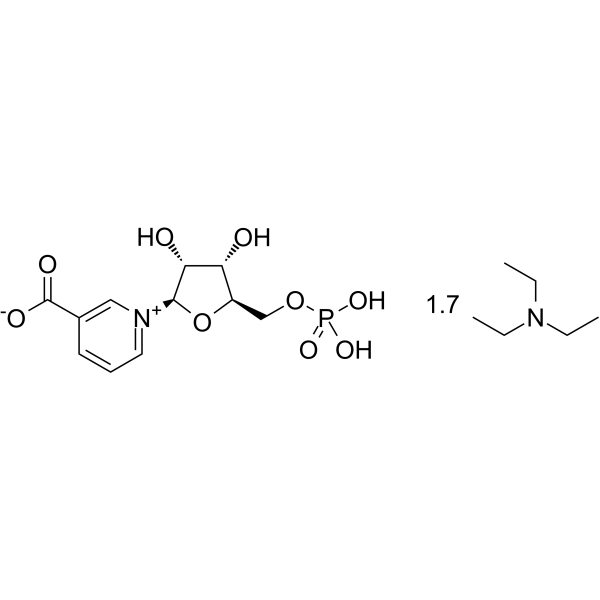
    Nicotinic acid mononucleotide triethylamine acts as a SARM1 inhibitor and a NAD + biosynthesis intermediate, with an IC50 value of 93.3 μM against SARM1. Nicotinic acid mononucleotide triethylamine exerts axon-protective effects, delays axonal degeneration, elevates NAD + levels, enhances Sirt1 activity, improves myocardial capillary density and alleviates myocardial fibrosis. Nicotinic acid mononucleotide triethylamine reverses diabetic cardiomyopathy in diabetic mice by increasing myocardial NAD + levels. Nicotinic acid mononucleotide triethylamine is applicable to research related to cancer, multiple sclerosis, diabetic cardiomyopathy, neurodegenerative diseases and Huntington's disease .
    Nicotinic acid mononucleotide triethylamine
  • HY-134269A

    7-deaza-8-bromo-cADPR disodium; 7-deaza-8-bromo-cyclic ADP ribose disodium

    Calcium Channel Neurological Disease
    8-Br-7-CH-cADPR disodium (7-Deaza-8-bromo-cADPR) is a potent cADPR antagonist. 8-Br-7-CH-cADPR disodium shows partial inhibition of calcium elevation caused by sTIR dimerization. 8-Br-7-CH-cADPR disodium significantly decreases Paclitaxel (HY-B0015)-induced axon degeneration .
    8-Br-7-CH-cADPR disodium
  • HY-W008341

    Toll-like Receptor (TLR) Neurological Disease
    5-Chloroisoquinoline (compound 42) is an inhibitor of SARM1 (Sterile alpha and toll/interleukin receptor (TIR) motif containing protein 1), an enzyme involved in axon degeneration that catalyzes multiple activities through a ternary complex mechanism. 5-Chloroisoquinoline can be used in the study of neurodegenerative diseases or axon degeneration .
    5-Chloroisoquinoline
  • HY-134269

    7-Deaza-8-bromo-cADPR; 7-Deaza-8-bromo-cyclic ADP ribose

    Calcium Channel Neurological Disease
    8-Br-7-CH-cADPR (7-Deaza-8-bromo-cADPR) is a potent cADPR antagonist. 8-Br-7-CH-cADPR shows partial inhibition of calcium elevation caused by sTIR dimerization. 8-Br-7-CH-cADPR significantly decreases Paclitaxel (HY-B0015)-induced axon degeneration .
    8-Br-7-CH-cADPR
  • HY-182500

    Toll-like Receptor (TLR) Neurological Disease
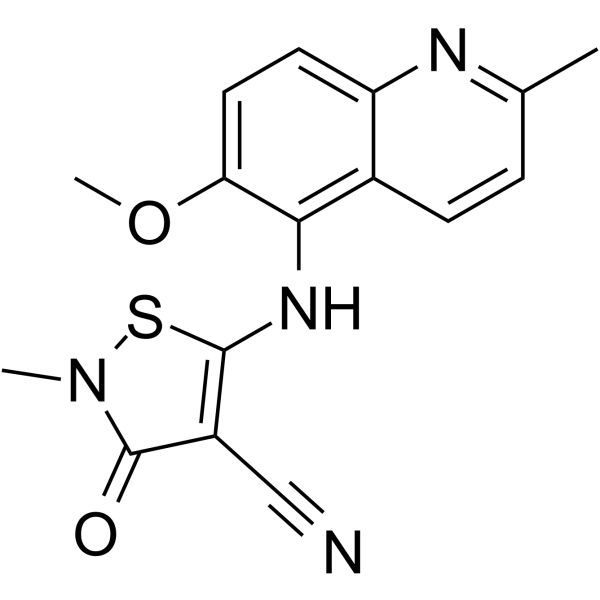
    SARM1-IN-9 (Compound MY-13B) is a stereoselective SARM1 inhibitor. SARM1-IN-9 is applicable to research related to axon degeneration-dependent neurological diseases .
    SARM1-IN-9
  • HY-182500A

    Toll-like Receptor (TLR) Neurological Disease
    (S,S)-SARM1-IN-9 (Compound MY-13A) is a stereoselective SARM1 inhibitor with covalent binding properties. (S,S)-SARM1-IN-9 covalently modifies Cys311 in the autoregulatory ARM domain of wild-type SARM1, thereby blocking NADase activity, without inhibiting the SARM1 C311A or SARM1 C311S mutants. (S,S)-SARM1-IN-9 blocks vacor- and vincristine-induced axon degeneration in primary rodent dorsal root ganglion neurons. (S,S)-SARM1-IN-9 can be used for research on axon degeneration-dependent neurological disorders, including chemotherapy-induced peripheral neuropathy .
    (S,S)-SARM1-IN-9
  • HY-182940

    Toll-like Receptor (TLR) Neurological Disease
    SARM1-IN-10 is an orally active SARM1 inhibitor with a pIC50 of 7.1 and a pKd of 8.3. As a base-exchange inhibitor, SARM1-IN-10 forms a NAD + adduct at the active site of the TIR domain of SARM1, blocks enzymatic function, and induces a unique rotameric state of W662 at the catalytic site of SARM1. SARM1-IN-10 acts as a paradoxical neurodegeneration inducer at low doses and an inhibitor at high doses, and it can exacerbate or protect against SARM1-mediated neurodegeneration depending on concentration. SARM1-IN-10 can be used in studies of peripheral neurodegeneration .
    SARM1-IN-10
  • HY-181662

    MAP3K Neurological Disease
    DLK-IN-2 is a selective inhibitor of DLK and neuroprotective agent. DLK-IN-2 shows no significant inhibition against CYPs 3A4, 2D6 and 2C9. DLK-IN-2 inhibits acute axonal palmitoylation of DLK, blocks DLK-dependent pro-degenerative axon-to-soma retrograde signaling and suppresses c-Jun phosphorylation. DLK-IN-2 can be used for the mechanistic study of neurodegenerative diseases .
    DLK-IN-2

Inquiry Online

Your information is safe with us. * Required Fields.

Salutation


Country or Region *

Applicant Name *


Organization Name *

Department *


Email Address *


Product Name *

Cat. No.


Requested quantity *

Phone Number *


Remarks

Inquiry Online

Inquiry Information

Product Name:
Cat. No.:
Quantity:
MCE Japan Authorized Agent:

