1. Search Result
Search Result
Results for "

postsynaptic sites

" in MedChemExpress (MCE) Product Catalog:

6

Inhibitors & Agonists

1

Screening Libraries

Cat. No. Product Name Target Research Areas Chemical Structure
  • HY-14785

    NLX-112; F13640

    5-HT Receptor Neurological Disease
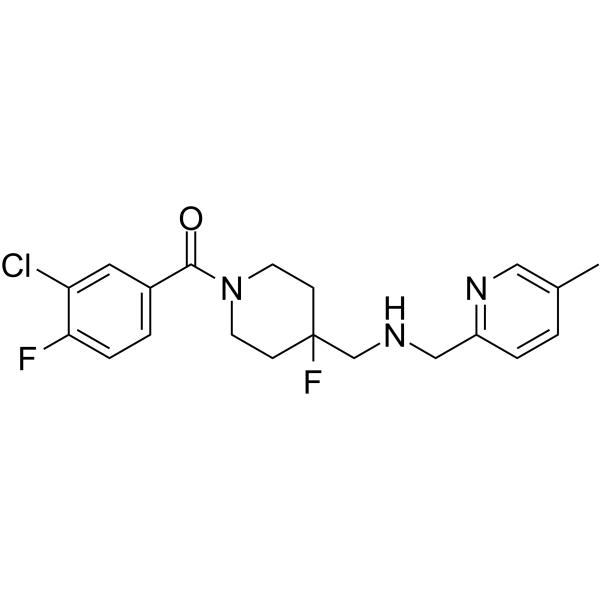
    Befiradol (NLX-112) is a highly selective 5-HT1A receptor agonist that acts on both presynaptic and postsynaptic sites. Befiradol attenuates fentanyl-induced respiratory depression in neonatal and adult rats. Befiradol reduces the duration of fentanyl-induced analgesia and sedation in adult rats. Befiradol can be used in studies related to opioid-induced respiratory depression .
    Befiradol
  • HY-129517

    iGluR Neurological Disease
    UBP714 exhibts agonistic activity for recombinant GluN1/GluN2 receptor by binding to the positive allosteric site (PAM) of NMDARs. UBP714 enhances NMDAR-mediated field excitatory postsynaptic potentials (f-EPSPs) in Xenopus oocytes .
    UBP714
  • HY-14785A

    NLX-112 hydrochloride; F 13640 hydrochloride

    5-HT Receptor Neurological Disease Metabolic Disease
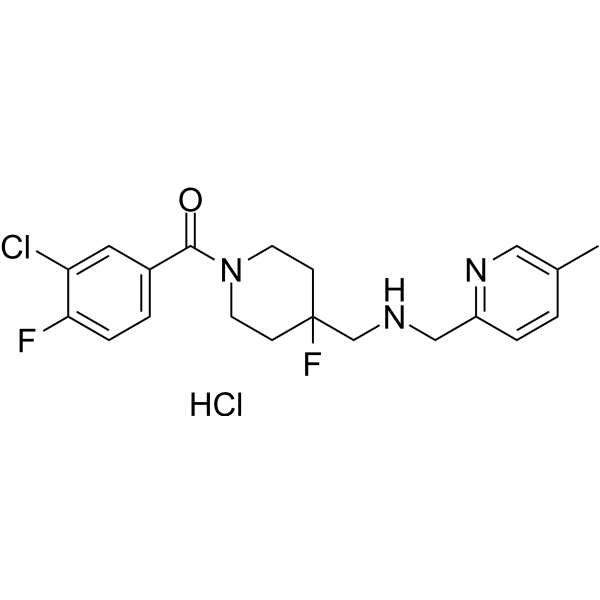
    Befiradol (NLX-112) hydrochloride is a highly selective 5-HT1A receptor agonist that acts on both presynaptic and postsynaptic sites. Befiradol hydrochloride attenuates fentanyl-induced respiratory depression in neonatal and adult rats. Befiradol reduces the duration of fentanyl-induced analgesia and sedation in adult rats. Befiradol hydrochloride can be used in studies related to opioid-induced respiratory depression .
    Befiradol hydrochloride
  • HY-Y0282

    NSC 77384; Sanibrom 40

    Environmental Pollutants Neurological Disease
    Sodium bromide (NSC 77384; Sanibrom 40) is a GABA-ergic system modulator that crosses the blood-brain barrier, and it effectively reduces and blocks epileptiform discharges. Sodium bromide exerts significant anticonvulsant effects by enhancing GABA-ergic inhibitory functions, such as increasing the amplitude of inhibitory postsynaptic currents and paired-pulse inhibition. Sodium bromide specifically enhances stimulation-induced extracellular alkalosis without affecting baseline pH or subsequent acidosis processes. Sodium bromide exhibits species-specific pharmacokinetic characteristics, competes with chloride ions for renal tubular reabsorption sites, and serves as a marker for extracellular fluid volume. Sodium bromide can be used in the research of epilepsy and related neurological diseases .
    Sodium bromide
  • HY-182677

    5-HT Receptor Dopamine Receptor Neurological Disease
    EF-7412 is a dual antagonist of the 5-HT1A receptor and dopamine D2 receptor, with Ki values of 27 nM and 22 nM, respectively. EF-7412 acts as an antagonist at both pre- and postsynaptic 5-HT1A receptor sites, blocking 8-OH-DPAT (HY-112061)-induced hypothermia, behavioral syndrome, and corticosterone elevation in vivo. EF-7412 increases hypothalamic 5-HIAA/5-HT and DOPAC/DA ratios, alters 5-HT and DA neuronal activity, and slightly decreases spontaneous motor activity. EF-7412 can be used for research on 5-HT1A/D2 receptor regulation and related neural pathways .
    EF-7412
  • HY-180372

    5-HT Receptor Adrenergic Receptor GABA Receptor Serotonin Transporter Dopamine Receptor Neurological Disease
    CSP-2503 is a potent and selective 5-HT1A receptor agonist , with an EC50 of 0.15 μM and a Ki of 4.1 nM. CSP-2503 exhibits excellent selectivity over α1-adrenoceptors (Ki > 1000 nM), 5-HT4 receptors, and benzodiazepine receptors. CSP-2503 inhibits cAMP increase in vitro and exhibits anxiolytic activity in vivo. CSP-2503 can be used for the research of anxiety-related disorders .
    CSP-2503

Inquiry Online

Your information is safe with us. * Required Fields.

Salutation


Country or Region *

Applicant Name *


Organization Name *

Department *


Email Address *


Product Name *

Cat. No.


Requested quantity *

Phone Number *


Remarks

Inquiry Online

Inquiry Information

Product Name:
Cat. No.:
Quantity:
MCE Japan Authorized Agent:

