1. Search Result
Search Result
Results for "

tumor-targeted uptake

" in MedChemExpress (MCE) Product Catalog:

10

Inhibitors & Agonists

4

Biochemical Assay Reagents

1

Peptides

1

Inhibitory Antibodies

Cat. No. Product Name Target Research Areas Chemical Structure
  • HY-168943

    Biochemical Assay Reagents Cancer
    PLGA nanoparticles, 100nm, are biodegradable tumor-targeting nanocarriers that can serve as drug delivery enhancers and multidrug resistance inhibitors. PLGA nanoparticles, 100nm, passively enriched through the EPR effect and actively targeted via ligand-mediated endocytosis, can encapsulate various antitumor active molecules. PLGA nanoparticles, 100nm can specifically recognize multiple types of tumor cells and improve cellular uptake, cytotoxicity and antiproliferative effects after modification with ligands such as transferrin, folic acid, and RGD. PLGA nanoparticles, 100nm can encapsulate various therapeutic drugs and can be surface modified to achieve targeting, imaging, and prolonged circulation time, making them suitable for cancer-related research .
    PLGA nanoparticles, 100nm
  • HY-P10444

    Radionuclide-Drug Conjugates (RDCs) CXCR Cancer
    DOTA Conjugated JM#21 derivative 7 (compound Ligand-7) is a derivative of CXCR4 targeting peptide conjugated with DOTA and can be used to produce radioligands. Radiolabeled DOTA Conjugated JM#21 derivative 7, i.e., 177Lu-DOTA, has excellent CXCR4 tumor targeting. In vitro biodistribution results of 177Lu-DOTA showed very low uptake in all non-targeted organs except kidney . DOTA Conjugated JM#21 derivative 7 can be used for the synthesis/research of Radionuclide-Drug Conjugates (RDCs).
    DOTA Conjugated JM#21 derivative 7
  • HY-168943A

    Biochemical Assay Reagents Cancer
    PLGA nanoparticles, 200nm, are biodegradable tumor-targeting nanocarriers that can serve as drug delivery enhancers and multidrug resistance inhibitors. PLGA nanoparticles, 200nm, passively enriched through the EPR effect and actively targeted via ligand-mediated endocytosis, can encapsulate various antitumor active molecules. PLGA nanoparticles, 200nm can specifically recognize multiple types of tumor cells and improve cellular uptake, cytotoxicity and antiproliferative effects after modification with ligands such as transferrin, folic acid, and RGD. PLGA nanoparticles, 200nm can encapsulate various therapeutic drugs and can be surface modified to achieve targeting, imaging, and prolonged circulation time, making them suitable for cancer-related research .
    PLGA nanoparticles, 200nm
  • HY-168943B

    Biochemical Assay Reagents Cancer
    PLGA nanoparticles, 500nm, are biodegradable tumor-targeting nanocarriers that can serve as drug delivery enhancers and multidrug resistance inhibitors. PLGA nanoparticles, 500nm, passively enriched through the EPR effect and actively targeted via ligand-mediated endocytosis, can encapsulate various antitumor active molecules. PLGA nanoparticles, 500nm can specifically recognize multiple types of tumor cells and improve cellular uptake, cytotoxicity and antiproliferative effects after modification with ligands such as transferrin, folic acid, and RGD. PLGA nanoparticles, 500nm can encapsulate various therapeutic drugs and can be surface modified to achieve targeting, imaging, and prolonged circulation time, making them suitable for cancer-related research .
    PLGA nanoparticles, 500nm
  • HY-168943C

    Biochemical Assay Reagents Cancer
    PLGA nanoparticles, 1μm, are biodegradable tumor-targeting nanocarriers that can serve as drug delivery enhancers and multidrug resistance inhibitors. PLGA nanoparticles, 1μm, passively enriched through the EPR effect and actively targeted via ligand-mediated endocytosis, can encapsulate various antitumor active molecules. PLGA nanoparticles, 1μm can specifically recognize multiple types of tumor cells and improve cellular uptake, cytotoxicity and antiproliferative effects after modification with ligands such as transferrin, folic acid, and RGD. PLGA nanoparticles, 1μm can encapsulate various therapeutic drugs and can be surface modified to achieve targeting, imaging, and prolonged circulation time, making them suitable for cancer-related research .
    PLGA nanoparticles, 1μm
  • HY-121470

    AH5183

    Others Others
    Vesamicol is a compound used to synthesize radiolabeled derivatives that can be used as sigma receptor ligands for tumor targeting inhibition and have shown certain potential in cellular uptake, biodistribution and inhibition experiments.
    Vesamicol
  • HY-144793

    Microtubule/Tubulin Cancer
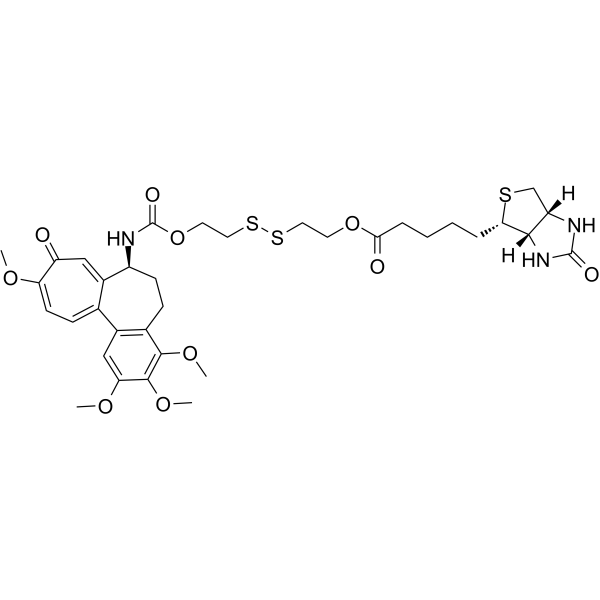
    Deac-SS-Biotin is a potent antitumor agent with improved tumor targeting effects and reduced off-target toxicities. Deac-SS-Biotin uptakes into the cells through biotin-mediated internalization. Deac-SS-Biotin combined with DTT (Glutathione mimetic) can effectively inhibit microtubule assembly and displays greater antitumor activity .
    Deac-SS-Biotin
  • HY-W010713

    Fimaporfin free base

    Photosensitizer Cancer
    Meso-tetraphenylchlorin (TPCS2a) is a photosensitizer with poor water solubility, which limits its use in the blood circulation. However, TPCS2a@NPs nanoparticles can be prepared based on polylactic-co-polyethylene glycol acid (PLGA) polymer core loaded with TPCS2. Such nanoparticles can be coated with mesenchymal stem cell-derived plasma membranes (mMSCs) to form mMSC-TPCS2a@NPs, which prolongs blood circulation time and improves tumor targeting ability. Compared with uncoated TPCS2a@NPs, mMSC-TPCS2a@NPs can reduce macrophage uptake by 54% to 70% under different conditions. Both nanoparticle forms are effectively accumulated in MCF7 and MDA-MB-231 breast cancer cells, while uptake in normal breast epithelial cells MCF10A is significantly lower .
    Meso-tetraphenylchlorin
  • HY-P992339

    Radionuclide-Drug Conjugates (RDCs) Cancer
    cT84.66 is a highly efficient tumor-targeting agent against carcinoembryonic antigen (CEA). cT84.66 engages in bivalent binding with CEA via variable region antigen-binding sites, enabling precise targeting of CEA-producing tumor cells for delivery of therapeutic radiation. cT84.66 exhibits high tumor uptake rate, rapid clearance rate, and excellent tumor-to-blood ratio. With dual functions as an imaging agent and an antibody-directed radiotherapy agent, cT84.66 is widely used in studies of colorectal cancer and metastatic CEA-positive malignancies .
    cT84.66
  • HY-184245

    Topoisomerase HSP Apoptosis Cancer
    Hsp90-IN-48 is an orally active Hsp90 inhibitor with an IC50 of 19.4 nM. Hsp90-IN-48 improves tumor-cell uptake and intracellular active-component release, and suppresses tumor metastasis. Hsp90-IN-48 induces G2/M phase cell cycle arrest and tumor cell apoptosis whlie simultaneously inhibits Top1/Top2 activity. Hsp90-IN-48 inhibits tumor growth and can be used for colon cancer research .
    Hsp90-IN-48

Inquiry Online

Your information is safe with us. * Required Fields.

Salutation


Country or Region *

Applicant Name *


Organization Name *

Department *


Email Address *


Product Name *

Cat. No.


Requested quantity *

Phone Number *


Remarks

Inquiry Online

Inquiry Information

Product Name:
Cat. No.:
Quantity:
MCE Japan Authorized Agent:

