



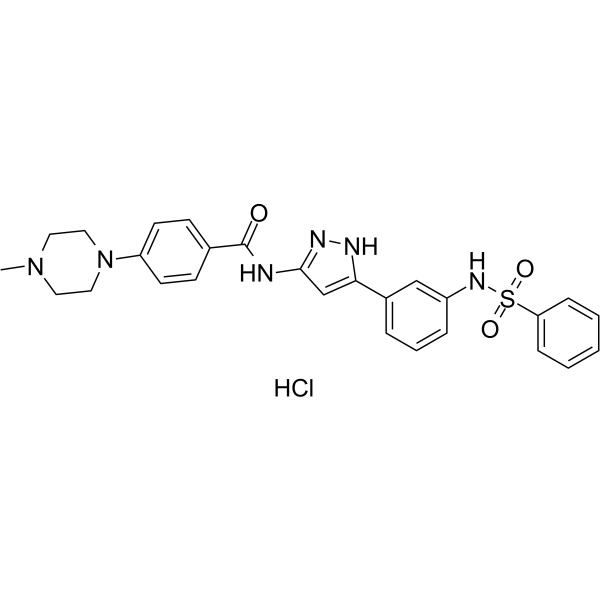
BPR1J-097 Hydrochloride
Based on 1 publication(s) in Google Scholar
BPR1J-097 Hydrochloride is a novel and potent FLT3 inhibitor with an IC50 of 11 nM.
For research use only. We do not sell to patients.
- Purity : 99.20%
- Formula: C27H29ClN6O3S
- Molecular Weight:553.08
-
Storage:
4°C, sealed storage, away from moisture
* In solvent : -80°C, 6 months; -20°C, 1 month (sealed storage, away from moisture)

To place orders, for customer services and technical support, please contact: MedChemExpress USA
Tel: 609-228-6898 E-mail: [email protected] [email protected]


-
 Biological Activity
-
Chemical Information
-
Solvent & Solubility
- Protocols
- Purity & Documentation
- References
-
 Help & FAQs


Publications Citing Use of MedChemExpress (MCE) BPR1J-097 Hydrochloride
More

Biological Activity
Description
IC50 & Target
IC50: 11 nM (FLT3)[1]
In Vitro
BPR1J-097 Hydrochloride is a novel and potent FLT3 inhibitor with an IC50 of 11nM. Phosphorylation of all FLT3-WT, FLT3-IDT, and FLT3-D835Y are inhibited by BPR1J-097 Hydrochloride at a concentration as low as 10 nM. BPR1J-097 Hydrochloride suppresses the phosphorylation of FLT3 and STAT5 in a dose-dependent manner. The IC50 values of BPR1J-097 Hydrochloride on MOLM-13 and MV4-11 cells are 21±7 and 46±14 nM, respectively. The emergence of active caspase-3 is observed in MOLM-13 cells treated with BPR1J-097 Hydrochloride at 10 nM. The effect of BPR1J-097 Hydrochloride seems to be weaker in MV4-11 cells as caspase-3 is not evident until 100 nM of BPR1J-097 Hydrochloride is applied to treat cells[1].
MedChemExpress (MCE) has not independently confirmed the accuracy of these methods. They are for reference only. Further protocols information, click here.
In Vivo
MedChemExpress (MCE) has not independently confirmed the accuracy of these methods. They are for reference only.


Chemical Information
-
Appearance Solid
-
Molecular Weight 553.08
-
Formula C27H29ClN6O3S
-
Color White to off-white
-
SMILES
O=C(NC1=NNC(C2=CC=CC(NS(=O)(C3=CC=CC=C3)=O)=C2)=C1)C4=CC=C(N5CCN(C)CC5)C=C4.Cl
-
Shipping
Room temperature in continental US; may vary elsewhere.
-
Storage
4°C, sealed storage, away from moisture
* In solvent : -80°C, 6 months; -20°C, 1 month (sealed storage, away from moisture)


Publications (1)
-
Journal Impact Factor
-
Most Recent
-
Cell Rep
A generalized strategy to kill leukemic cells by targeting the regulatory systems governing mitochondrial membrane potential. [Abstract]2025 Nov 25;44(11):116496. PMID: 41166305


Solvent & Solubility
In Vitro:
DMSO : 6 mg/mL (10.85 mM; Need ultrasonic and warming; Hygroscopic DMSO has a significant impact on the solubility of product, please use newly opened DMSO)
H2O : 2 mg/mL (3.62 mM; Need ultrasonic)
Please refer to the solubility information to select the appropriate solvent. Once prepared, please aliquot and store the solution to prevent product inactivation from repeated freeze-thaw cycles.
Storage method and period of stock solution: -80°C, 6 months; -20°C, 1 month (sealed storage, away from moisture). When stored at -80°C, please use it within 6 months. When stored at -20°C, please use it within 1 month.
* Note: If you choose water as the stock solution, please dilute it to the working solution, then filter and sterilize it with a 0.22 μm filter before use.
Please refer to the solubility information to select the appropriate solvent. Once prepared, please aliquot and store the solution to prevent product inactivation from repeated freeze-thaw cycles.
Storage method and period of stock solution: -80°C, 6 months; -20°C, 1 month (sealed storage, away from moisture). When stored at -80°C, please use it within 6 months. When stored at -20°C, please use it within 1 month.
* Note: If you choose water as the stock solution, please dilute it to the working solution, then filter and sterilize it with a 0.22 μm filter before use.
Concentration (start) × Volume (start) = Concentration (final) × Volume (final)

Protocols
-
Cell Cytotoxicity Assay
Cytotoxicity assays are usually based on the assessment of cell membrane damage, which can also be indirectly detected by measuring cell viability. Detection methods include MTT assay, CKK-8 assay, LDH assay and ATP assay, etc.


Purity & Documentation
-
Data Sheet (274 KB)
-
SDS (251 KB)
- English - EN (251 KB)
- Français - FR (251 KB)
- Deutsch - DE (251 KB)
- Norwegian - NO (251 KB)
- Español - ES (251 KB)
- Swedish - SV (251 KB)
- Italian - IT (251 KB)
- Korean - KR (251 KB)
- Portuguese - PT (251 KB)
-
Handling Instructions (2659 KB)
References


Complete Stock Solution Preparation Table
Please refer to the solubility information to select the appropriate solvent. Once prepared, please aliquot and store the solution to prevent product inactivation from repeated freeze-thaw cycles.
Storage method and period of stock solution: -80°C, 6 months; -20°C, 1 month (sealed storage, away from moisture). When stored at -80°C, please use it within 6 months. When stored at -20°C, please use it within 1 month.
| Optional Solvent | Concentration Solvent Mass | 1 mg | 5 mg | 10 mg | 25 mg |
|---|---|---|---|---|---|
| H2O / DMSO | 1 mM | 1.8081 mL | 9.0403 mL | 18.0806 mL | 45.2014 mL |
| DMSO | 5 mM | 0.3616 mL | 1.8081 mL | 3.6161 mL | 9.0403 mL |
| 10 mM | 0.1808 mL | 0.9040 mL | 1.8081 mL | 4.5201 mL |
* Note: If you choose water as the stock solution, please dilute it to the working solution, then filter and sterilize it with a 0.22 μm filter before use.


BPR1J-097 Hydrochloride Related Classifications
HY-13537A Related Classifications
 Powered by Bioz