



Glucagon-like peptide 1 (1-37), human
Based on 1 publication(s) in Google Scholar
Glucagon-like peptide 1 (1-37), human is a highly potent agonist of the GLP-1 receptor.
For research use only. We do not sell to patients.
- Purity : 99.32%
- CAS No.: 87805-34-3
- Formula: C186H275N51O59
- Molecular Weight:4169.48
-
Storage:
Sealed storage, away from moisture.
Powder -80°C, 2 years , -20°C, 1 year* In solvent : -80°C, 6 months; -20°C, 1 month (sealed storage, away from moisture)


To place orders, for customer services and technical support, please contact: MedChemExpress USA
Tel: 609-228-6898 E-mail: [email protected] [email protected]


-
 Biological Activity
-
Chemical Information
- Protocol
- Purity & Documentation
- References
-
 Help & FAQs





Publications Citing Use of MedChemExpress (MCE) Glucagon-like peptide 1 (1-37), human
More

Biological Activity
Description
IC50 & Target
GLP-1 receptor[1]
Cellular Effect
|
Cell Line

|
Type | Value | Description | References |
|---|---|---|---|---|
| HEK293 | EC50 |
0.09 nM
Compound: GLP-1
|
Agonist activity at rat GLP1R expressed in HEK293 cells assessed as stimulation of cAMP levels incubated for 6 hrs by multiple response element/cAMP response element (MRE/CRE)-driven reporter gene assay
Agonist activity at rat GLP1R expressed in HEK293 cells assessed as stimulation of cAMP levels incubated for 6 hrs by multiple response element/cAMP response element (MRE/CRE)-driven reporter gene assay
|
[PMID: 22103243] |
In Vitro
Glucagon-like peptide-1 (GLP-1) is produced by the posttranslational processing of proglucagon and acts as a regulator of various homeostatic events. GLP-1(1-37) is more stable than GLP-1(7-37), with 94.7% of the initial amount of peptide left after a 4h exposure to mouse serum. GLP-1(1-37) is confirmed to be a highly potent agonist of the GLP-1 receptor (GLP-1R) by measuring the expression of the luciferase reporter gene expression in transiently transfected human embryonic kidney (HEK293) cells[1].
MedChemExpress (MCE) has not independently confirmed the accuracy of these methods. They are for reference only.
In Vivo
MedChemExpress (MCE) has not independently confirmed the accuracy of these methods. They are for reference only.


Chemical Information
-
CAS No. 87805-34-3
-
Appearance Solid
-
Molecular Weight 4169.48
-
Formula C186H275N51O59
-
Color White to off-white
-
Synonyms
GLP-1 (1-37) human
-
Sequence
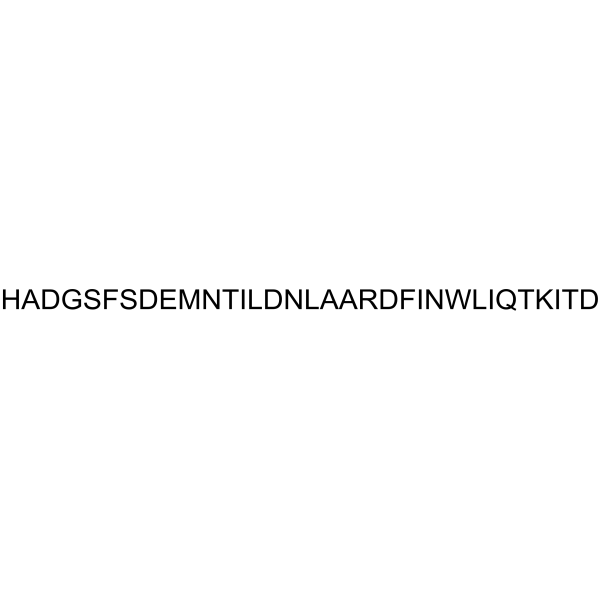
His-Asp-Glu-Phe-Glu-Arg-His-Ala-Glu-Gly-Thr-Phe-Thr-Ser-Asp-Val-Ser-Ser-Tyr-Leu-Glu-Gly-Gln-Ala-Ala-Lys-Glu-Phe-Ile-Ala-Trp-Leu-Val-Lys-Gly-Arg-Gly
-
Sequence Shortening
HDEFERHAEGTFTSDVSSYLEGQAAKEFIAWLVKGRG
-
Shipping
Room temperature in continental US; may vary elsewhere.
-
Storage
Sealed storage, away from moisture
Powder -80°C 2 years -20°C 1 year * In solvent : -80°C, 6 months; -20°C, 1 month (sealed storage, away from moisture)


Publications (1)
-
Journal Impact Factor
-
Most Recent
-
Neural Regen Res
Topical administration of GLP-1 eyedrops improves retinal ganglion cell function by facilitating presynaptic GABA release in early experimental diabetes. [Abstract]2026 Feb 1;21(2):800-810. PMID: 38934389

Protocol
Cell Assay[1]
HEK293 cells (5×10⁴) are seeded in a 96-well plate and transiently cotransfected with the GLP-1R plasmid and the CRE-luciferase reporter plasmid. After a 48 h transfection, different concentrations of GLP-1(1–37) or GLP-1(7–37) are added, and the cells are incubated for 5 h. The cells are harvested for a luciferase assay using a luciferase assay[1].
MedChemExpress (MCE) has not independently confirmed the accuracy of these methods. They are for reference only.
Animal Administration[1]
Mice[1]
The normal KM mice are fasted for 16 h before the administration (i.p.) of GLP-1 and glucose. GLP-1(1-37) (25 nmol/kg) with or without exendin(9-39) (250 nmol/kg) is given in combination with glucose (4 g/kg). GLP-1(7-37) (25 nmol/kg) with or without exendin(9-39) (250 nmol/kg) is also administrated in combination with glucose (4 g/kg). The control group is treated with saline (NaCl, 9 g/l) and glucose (4 g/kg). The IPGTT is carried out at 0, 15, 30 and 60 min after glucose and protein administration, and the blood glucose levels are measured as described above[1].
MedChemExpress (MCE) has not independently confirmed the accuracy of these methods. They are for reference only.


Purity & Documentation
-
Data Sheet (264 KB)
-
SDS (394 KB)
- English - EN (394 KB)
- Français - FR (394 KB)
- Deutsch - DE (394 KB)
- Norwegian - NO (394 KB)
- Español - ES (394 KB)
- Swedish - SV (394 KB)
- Italian - IT (394 KB)
- Korean - KR (394 KB)
- Portuguese - PT (394 KB)
-
Handling Instructions (2659 KB)
References

Calculators
Concentration (start) × Volume (start) = Concentration (final) × Volume (final)


Glucagon-like peptide 1 (1-37), human Related Classifications
HY-P1145 Related Classifications
 Powered by Bioz