1. Anti-infection
  2. HBV
  3. Morphothiadin

Morphothiadin is a potent inhibitor on the replication of both wild-type and adefovir (HY-B1826)-resistant HBV with an IC50 of 12 nM.

연구목적의 판매만을 진행합니다. 환자를 대상으로 한 판매는 하지 않습니다.

Morphothiadin

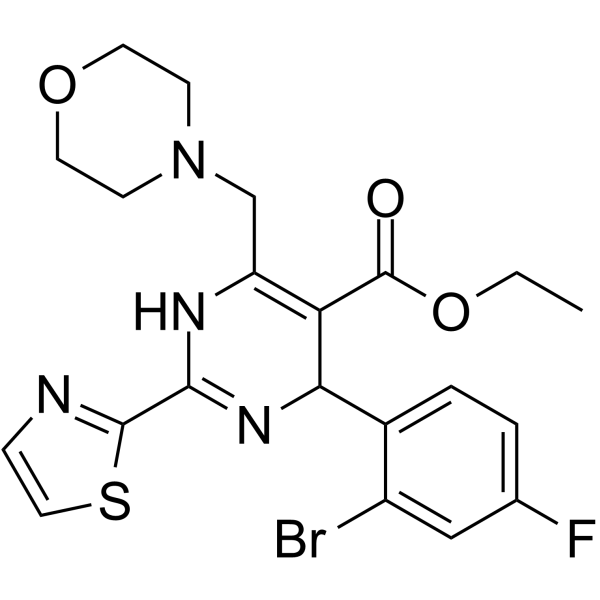
Morphothiadin 화학구조

CAS No. : 1092970-12-1

사이즈 가격 재고 수량
Solid + Solvent (Highly Recommended)
10 mM * 1 mL in DMSO
ready for reconstitution
해외재고보유
Solution
10 mM * 1 mL in DMSO 해외재고보유
Solid
1 mg 해외재고보유
5 mg 해외재고보유
10 mg 해외재고보유
25 mg 해외재고보유
50 mg 해외재고보유
100 mg 해외재고보유
200 mg   견적 받기  
500 mg   견적 받기  

* 장바구니에 담기 전 물품의 수량을 선택해 주십시오.

This product is a controlled substance and not for sale in your territory.

고객리뷰

Based on 6 publication(s) in Google Scholar

Other Forms of Morphothiadin:

Top Publications Citing Use of Products
  • Biological Activity

  • Protocol

  • 순도&문서

  • References

  • 고객리뷰

제품 설명

Morphothiadin is a potent inhibitor on the replication of both wild-type and adefovir (HY-B1826)-resistant HBV with an IC50 of 12 nM.

IC50 & Target

IC50: 12 nM (HBV)[1]

Cellular Effect
Cell Line Type Value Description References
CCRF-CEM CC50
69 3
Compound: GLS4
Cytotoxicity against human CEM cells assessed as growth inhibition by CellTiter 96 non-radioactive cell proliferation colorimetric assay
[PMID: 28094179]
CCRF-CEM CC50
68.7 3
Compound: GLS4
Cytotoxicity against human CEM cells assessed as reduction in cell viability by MTT assay
[PMID: 33421915]
CCRF-CEM CC50
68.7 3
Compound: GLS4
Cytotoxicity against human CEM cells assessed as reduction in cell viability by MTT assay
[PMID: 33421915]
CCRF-CEM CC50
68.7 3
Compound: GLS4
Cytotoxicity against human CEM cells assessed as reduction in cell viability by MTT assay
[PMID: 33421915]
CCRF-CEM CC50
69 3
Compound: GLS4
Cytotoxicity against human CEM cells assessed as growth inhibition by CellTiter 96 non-radioactive cell proliferation colorimetric assay
[PMID: 28094179]
CCRF-CEM CC50
69 3
Compound: GLS4
Cytotoxicity against human CEM cells assessed as growth inhibition by CellTiter 96 non-radioactive cell proliferation colorimetric assay
[PMID: 28094179]
HEK293 IC50
0.86 3
Compound: GLS4; GLS4JHS
Inhibition of human ERG expressed in HEK293 cells at -80 mV holding potential by manual-patch-clamp electrophysiology assay
[PMID: 29381358]
HEK293 IC50
0.86 3
Compound: GLS4; GLS4JHS
Inhibition of human ERG expressed in HEK293 cells at -80 mV holding potential by manual-patch-clamp electrophysiology assay
[PMID: 29381358]
HEK293 IC50
0.86 3
Compound: GLS4; GLS4JHS
Inhibition of human ERG expressed in HEK293 cells at -80 mV holding potential by manual-patch-clamp electrophysiology assay
[PMID: 29381358]
HepG2 CC50
> 100 3
Compound: GLS4
Cytotoxicity against human HepG2 cells assessed as reduction in cell viability by MTT assay
[PMID: 33421915]
HepG2 CC50
49.2 3
Compound: GLS4
Cytotoxicity in human HepG2 cells assessed as induction of cell killing
[PMID: 32421339]
HepG2 CC50
> 100 3
Compound: GLS4
Cytotoxicity against human HepG2 cells assessed as growth inhibition by CellTiter 96 non-radioactive cell proliferation colorimetric assay
[PMID: 28094179]
HepG2 CC50
> 100 3
Compound: GLS4
Cytotoxicity against human HepG2 cells assessed as growth inhibition by CellTiter 96 non-radioactive cell proliferation colorimetric assay
[PMID: 28094179]
HepG2 CC50
>100 3
Compound: GLS4
Cytotoxicity against human HepG2 cells assessed as growth inhibition by CellTiter 96 non-radioactive cell proliferation colorimetric assay
[PMID: 28094179]
HepG2 IC50
0.012 3
Compound: 5; GLS4
Inhibition of HBV DNA replication in HepG2 cells by southern blot analysis
10.1039/C4MD00521J
HepG2 CC50
>100 3
Compound: GLS4
Cytotoxicity against human HepG2 cells assessed as reduction in cell viability by MTT assay
[PMID: 33421915]
HepG2 CC50
> 100 3
Compound: GLS4
Cytotoxicity against human HepG2 cells assessed as reduction in cell viability by MTT assay
[PMID: 33421915]
HepG2 CC50
49.2 3
Compound: GLS4
Cytotoxicity in human HepG2 cells assessed as induction of cell killing
[PMID: 32421339]
HepG2 IC50
0.012 3
Compound: 5; GLS4
Inhibition of HBV DNA replication in HepG2 cells by southern blot analysis
10.1039/C4MD00521J
HepG2 2.2.15 CC50
> 45 3
Compound: 8n
Cytotoxicity in human HepG2.215 cells assessed as reduction in cell viability after 5 days by CCK8 assay
[PMID: 28082068]
HepG2 IC50
0.012 3
Compound: 5; GLS4
Inhibition of HBV DNA replication in HepG2 cells by southern blot analysis
10.1039/C4MD00521J
HepG2 2.2.15 EC50
0.0066 3
Compound: GLS4
Antiviral activity against HBV infected in human HepG2.2.15 cells assessed as reduction in viral DNA levels incubated for 6 days by PCR analysis
[PMID: 32421339]
HepG2 2.2.15 CC50
>45 3
Compound: 8n
Cytotoxicity in human HepG2.215 cells assessed as reduction in cell viability after 5 days by CCK8 assay
[PMID: 28082068]
PBMC CC50
28 3
Compound: GLS4
Cytotoxicity against human PBMC assessed as growth inhibition by CellTiter 96 non-radioactive cell proliferation colorimetric assay
[PMID: 28094179]
HepG2 2.2.15 CC50
> 45 3
Compound: 8n
Cytotoxicity in human HepG2.215 cells assessed as reduction in cell viability after 5 days by CCK8 assay
[PMID: 28082068]
HepG2 2.2.15 EC50
0.0066 3
Compound: GLS4
Antiviral activity against HBV infected in human HepG2.2.15 cells assessed as reduction in viral DNA levels incubated for 6 days by PCR analysis
[PMID: 32421339]
PBMC CC50
28.4 3
Compound: GLS4
Cytotoxicity against human PBMC cells assessed as reduction in cell viability by MTT assay
[PMID: 33421915]
HepG2 2.2.15 EC50
0.0066 3
Compound: GLS4
Antiviral activity against HBV infected in human HepG2.2.15 cells assessed as reduction in viral DNA levels incubated for 6 days by PCR analysis
[PMID: 32421339]
PBMC CC50
28 3
Compound: GLS4
Cytotoxicity against human PBMC assessed as growth inhibition by CellTiter 96 non-radioactive cell proliferation colorimetric assay
[PMID: 28094179]
Vero CC50
17.7 3
Compound: GLS4
Cytotoxicity against African green monkey Vero cells assessed as reduction in cell viability by MTT assay
[PMID: 33421915]
HepaRG CC50
> 30 3
Compound: GLS4
Cytotoxicity against human HepaRG cells assessed as effect on cell viability
[PMID: 33062174]
Vero CC50
18 3
Compound: GLS4
Cytotoxicity against African green monkey Vero cells assessed as growth inhibition by CellTiter 96 non-radioactive cell proliferation colorimetric assay
[PMID: 28094179]
PBMC CC50
28.4 3
Compound: GLS4
Cytotoxicity against human PBMC cells assessed as reduction in cell viability by MTT assay
[PMID: 33421915]
Vero CC50
18 3
Compound: GLS4
Cytotoxicity against African green monkey Vero cells assessed as growth inhibition by CellTiter 96 non-radioactive cell proliferation colorimetric assay
[PMID: 28094179]
Vero CC50
17.7 3
Compound: GLS4
Cytotoxicity against African green monkey Vero cells assessed as reduction in cell viability by MTT assay
[PMID: 33421915]
PBMC CC50
28 3
Compound: GLS4
Cytotoxicity against human PBMC assessed as growth inhibition by CellTiter 96 non-radioactive cell proliferation colorimetric assay
[PMID: 28094179]
PBMC CC50
28.4 3
Compound: GLS4
Cytotoxicity against human PBMC cells assessed as reduction in cell viability by MTT assay
[PMID: 33421915]
Vero CC50
17.7 3
Compound: GLS4
Cytotoxicity against African green monkey Vero cells assessed as reduction in cell viability by MTT assay
[PMID: 33421915]
Vero CC50
18 3
Compound: GLS4
Cytotoxicity against African green monkey Vero cells assessed as growth inhibition by CellTiter 96 non-radioactive cell proliferation colorimetric assay
[PMID: 28094179]
In Vitro

Morphothiadin is a potent inhibitor on the replication of both wild-type and adefovir-resistant HBV with an IC50 of 12 nM. Morphothiadin (GLS4) shows no toxicity up to 25 μM. The cytotoxic dose whereby 50% of cells die (CC50) for primary hepatocytes is 115 μM for Morphothiadin (P<0.001). The CC90 is 190 μM for Morphothiadin (P<0.01) in HepAD38 cells. Morphothiadin strongly inhibits virus accumulation in the supernatant of HepAD38 cells at 25 nM to 100 nM (P<0.02). Results show a concentration-dependent decrease of core protein in cells treated with Morphothiadin[2].

MedChemExpress (MCE) has not independently confirmed the accuracy of these methods. They are for reference only.

In Vivo

The area under the concentration-time curve from 0 to 24 h (AUC0-24) of Morphothiadin (GLS4) is 556 h ng/mL. After intravenous administration of 10 mg/kg Morphothiadin, the total plasma clearance and apparent volume distribution are 4.2 liters/h/kg and 7.38 liters/kg, respectively. The bioavailability of Morphothiadin is 25.5%. It is found that virus titers have increased 83.5-fold in mice treated with 3.75 mg/kg per day of Morphothiadin, 28.3-fold among mice treated with 7.5 mg/kg per day, but only 3- to 6-fold among mice treated with the higher doses of Morphothiadin. There is generally an inverse relationship between Morphothiadin dose and virus titer, with the greatest rebound seen in mice treated with 3.75 mg/kg per day of Morphothiadin (540-fold) and the smallest rebound in mice treated with 60 mg/kg per day (23-fold) (P<0.001). The Morphothiadin doses of >7.5 mg/kg per day significantly suppresses the virus replication cycle throughout the treatment period, while Morphothiadin doses of >15 mg/kg per day suppresses virus for up to 2 weeks after the end of treatment[2].

MedChemExpress (MCE) has not independently confirmed the accuracy of these methods. They are for reference only.

분자량

509.39

화학식

C21H22BrFN4O3S

CAS No.
Appearance

Solid

Color

Light yellow to yellow

SMILES

O=C(C1=C(CN2CCOCC2)NC(C3=NC=CS3)=NC1C4=CC=C(F)C=C4Br)OCC

선적

Room temperature in continental US; may vary elsewhere.

보관
Powder -20°C 3 years
4°C 2 years
In solvent -80°C 2 years
-20°C 1 year
용액&용해도
In Vitro: 

DMSO : 62.5 mg/mL (122.70 mM; ultrasonic and warming and heat to 60°C; Hygroscopic DMSO has a significant impact on the solubility of product, please use newly opened DMSO)

Preparing
Stock Solutions
Concentration Solvent Mass 1 mg 5 mg 10 mg
1 mM 1.9631 mL 9.8157 mL 19.6313 mL
5 mM 0.3926 mL 1.9631 mL 3.9263 mL
View the Complete Stock Solution Preparation Table

* Please refer to the solubility information to select the appropriate solvent. Once prepared, please aliquot and store the solution to prevent product inactivation from repeated freeze-thaw cycles.
Storage method and period of stock solution: -80°C, 2 years; -20°C, 1 year. When stored at -80°C, please use it within 2 years. When stored at -20°C, please use it within 1 year.

  • 몰농도 계산기

  • 농도 희석 계산기

Mass (g) = Concentration (mol/L) × Volume (L) × Molecular Weight (g/mol)

Mass
=
Concentration
×
Volume
×
Molecular Weight *

Concentration (start) × Volume (start) = Concentration (final) × Volume (final)

This equation is commonly abbreviated as: C1V1 = C2V2

Concentration (start)

C1

×
Volume (start)

V1

=
Concentration (final)

C2

×
Volume (final)

V2

In Vivo:

Select the appropriate dissolution method based on your experimental animal and administration route.

For the following dissolution methods, please ensure to first prepare a clear stock solution using an In Vitro approach and then sequentially add co-solvents:
To ensure reliable experimental results, the clarified stock solution can be appropriately stored based on storage conditions. As for the working solution for in vivo experiments, it is recommended to prepare freshly and use it on the same day.
The percentages shown for the solvents indicate their volumetric ratio in the final prepared solution. If precipitation or phase separation occurs during preparation, heat and/or sonication can be used to aid dissolution.

  • Protocol 1

    Add each solvent one by one:  10% DMSO    40% PEG300    5% Tween-80    45% Saline

    Solubility: ≥ 3 mg/mL (5.89 mM); Clear solution

    This protocol yields a clear solution of ≥ 3 mg/mL (saturation unknown).

    Taking 1 mL working solution as an example, add 100 μL DMSO stock solution (30.0 mg/mL) to 400 μL PEG300, and mix evenly; then add 50 μL Tween-80 and mix evenly; then add 450 μL Saline to adjust the volume to 1 mL.

    Preparation of Saline: Dissolve 0.9 g sodium chloride in ddH₂O and dilute to 100 mL to obtain a clear Saline solution.
  • Protocol 2

    Add each solvent one by one:  10% DMSO    90% Corn Oil

    Solubility: ≥ 3 mg/mL (5.89 mM); Clear solution

    This protocol yields a clear solution of ≥ 3 mg/mL (saturation unknown). If the continuous dosing period exceeds half a month, please choose this protocol carefully.

    Taking 1 mL working solution as an example, add 100 μL DMSO stock solution (30.0 mg/mL) to 900 μL Corn oil, and mix evenly.

In Vivo Dissolution Calculator
Please enter the basic information of animal experiments:

Dosage

mg/kg

Animal weight
(per animal)

g

Dosing volume
(per animal)

μL

Number of animals

Recommended: Prepare an additional quantity of animals to account for potential losses during experiments.
Please enter your animal formula composition:
%
DMSO +
+
%
Tween-80 +
%
Saline
Recommended: Keep the proportion of DMSO in working solution below 2% if your animal is weak.
The co-solvents required include: DMSO, . All of co-solvents are available by MedChemExpress (MCE). , Tween 80. All of co-solvents are available by MedChemExpress (MCE).
Calculation results:
Working solution concentration: mg/mL
Method for preparing stock solution: mg drug dissolved in μL  DMSO (Stock solution concentration: mg/mL).
The concentration of the stock solution you require exceeds the measured solubility. The following solution is for reference only. If necessary, please contact MedChemExpress (MCE).
Method for preparing in vivo working solution for animal experiments: Take μL DMSO stock solution, add μL . μL , mix evenly, next add μL Tween 80, mix evenly, then add μL Saline.
 If the continuous dosing period exceeds half a month, please choose this protocol carefully.
Please ensure that the stock solution in the first step is dissolved to a clear state, and add co-solvents in sequence. You can use ultrasonic heating (ultrasonic cleaner, recommended frequency 20-40 kHz), vortexing, etc. to assist dissolution.
순도&문서

Purity: 99.79%

References
Cell Assay 
[2]

HepAD38 cells are grown to about 80% confluence in 0.3 μg/mL of tetracycline (TET). After the removal of TET, the cells are treated with different doses of Morphothiadin (GLS4), or no drug. Cell viability is monitored by 3-(4,5-dimethyl-2-thiazolyl)-2,5-diphenyl-2H-tetrazolium bromide (MTT) assay[2].

MCE 는 독립적으로 이러한 방법들의 정확성을 확인하지 않았습니다. 참고용으로만 봐주십시오.

Animal Administration
[2]

ICR mice are used to evaluate the pharmacokinetic (PK) properties of Morphothiadin (GLS4). Following oral administration of 10 mg/kg (of body weight) of Morphothiadin to male mice, the concentration of Morphothiadin in plasma is determined using liquid chromatography-tandem mass spectrometry (LC/MS/MS). For toxicity studies, ICR mice are given Morphothiadin by gavage over a 4-week period and then kept off drug for another 2 weeks. Groups consisting of 20 male plus 20 female mice are administered a vehicle (1% methyl-2-hydroxyethyl cellulose), 35.7, 118.9, or 356.6 mg/kg per day in a volume corresponding to 20 mL/kg. Ten mice per dose group are euthanized 2 weeks after the end of drug treatment. Body weight, food consumption, serum albumin levels, and adverse effects are determined[2].

MCE 는 독립적으로 이러한 방법들의 정확성을 확인하지 않았습니다. 참고용으로만 봐주십시오.

References

Complete Stock Solution Preparation Table

* Please refer to the solubility information to select the appropriate solvent. Once prepared, please aliquot and store the solution to prevent product inactivation from repeated freeze-thaw cycles.
Storage method and period of stock solution: -80°C, 2 years; -20°C, 1 year. When stored at -80°C, please use it within 2 years. When stored at -20°C, please use it within 1 year.

Optional Solvent Concentration Solvent Mass 1 mg 5 mg 10 mg 25 mg
DMSO 1 mM 1.9631 mL 9.8157 mL 19.6313 mL 49.0783 mL
5 mM 0.3926 mL 1.9631 mL 3.9263 mL 9.8157 mL
10 mM 0.1963 mL 0.9816 mL 1.9631 mL 4.9078 mL
15 mM 0.1309 mL 0.6544 mL 1.3088 mL 3.2719 mL
20 mM 0.0982 mL 0.4908 mL 0.9816 mL 2.4539 mL
25 mM 0.0785 mL 0.3926 mL 0.7853 mL 1.9631 mL
30 mM 0.0654 mL 0.3272 mL 0.6544 mL 1.6359 mL
40 mM 0.0491 mL 0.2454 mL 0.4908 mL 1.2270 mL
50 mM 0.0393 mL 0.1963 mL 0.3926 mL 0.9816 mL
60 mM 0.0327 mL 0.1636 mL 0.3272 mL 0.8180 mL
80 mM 0.0245 mL 0.1227 mL 0.2454 mL 0.6135 mL
100 mM 0.0196 mL 0.0982 mL 0.1963 mL 0.4908 mL
  • No file chosen (Maximum size is: 1024 Kb)
  • If you have published this work, please enter the PubMed ID.
  • Your name will appear on the site.

Morphothiadin Related Classifications

Help & FAQs
  • Do most proteins show cross-species activity?

    Species cross-reactivity must be investigated individually for each product. Many human cytokines will produce a nice response in mouse cell lines, and many mouse proteins will show activity on human cells. Other proteins may have a lower specific activity when used in the opposite species.

최근 본 상품:

온라인 문의

Your information is safe with us. * Required Fields.

상품명


Requested Quantity *

고객명 *


호칭

메일주소 *


전화번호 *

Department


회사명 *

City

Country or Region *


비고

대량구매 문의

Inquiry Information

상품명:
Morphothiadin
Cat. No.:
HY-108917
수량:
MCE Japan Authorized Agent: