



Ribitol
Based on 3 publication(s) in Google Scholar
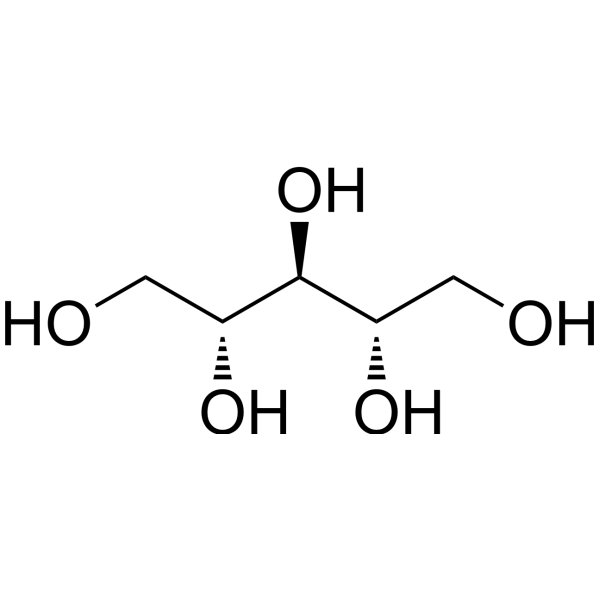
Ribitol is a crystalline pentose alcohol formed by the reduction of ribose. Enhancing the flux of D-glucose to the pentose phosphate pathway in Saccharomyces cerevisiae for the production of D-ribose and ribitol.
For research use only. We do not sell to patients.
- Purity : 99.93%
- CAS No.: 488-81-3
- Formula: C5H12O5
- Molecular Weight:152.15
-
Storage:Powder -20°C, 3 years , 4°C, 2 years ; In solvent -80°C, 2 years , -20°C, 1 year

To place orders, for customer services and technical support, please contact: MedChemExpress USA
Tel: 609-228-6898 E-mail: [email protected] [email protected]


-
 Biological Activity
-
Chemical Information
-
Solvent & Solubility
- Purity & Documentation
- References
-
 Help & FAQs


-
HY-17363
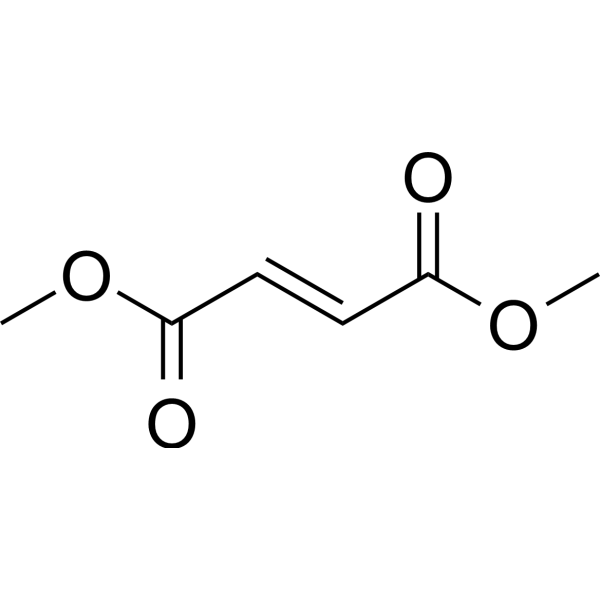
Dimethyl fumarateNrf2 Activator -

HY-100582R
Ribitol (Standard)Pentose Alcohol -
HY-13966
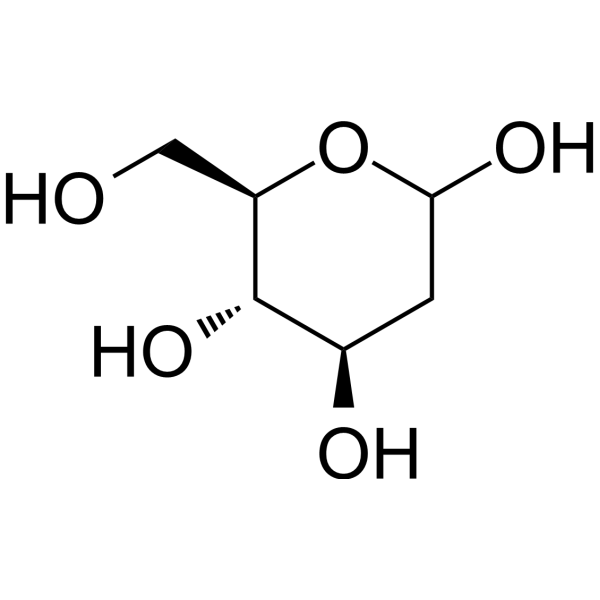
2-Deoxy-D-glucoseGlycolysis Inhibitor -
HY-116285
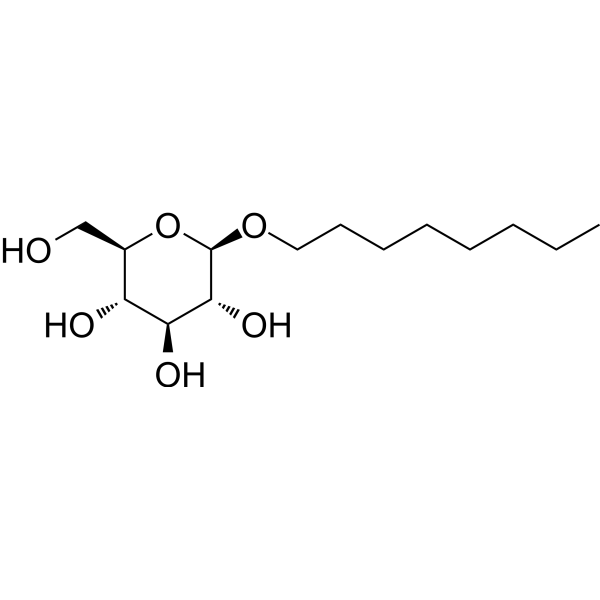
n-Octyl β-D-glucopyranosideNon-Ionic Detergent -
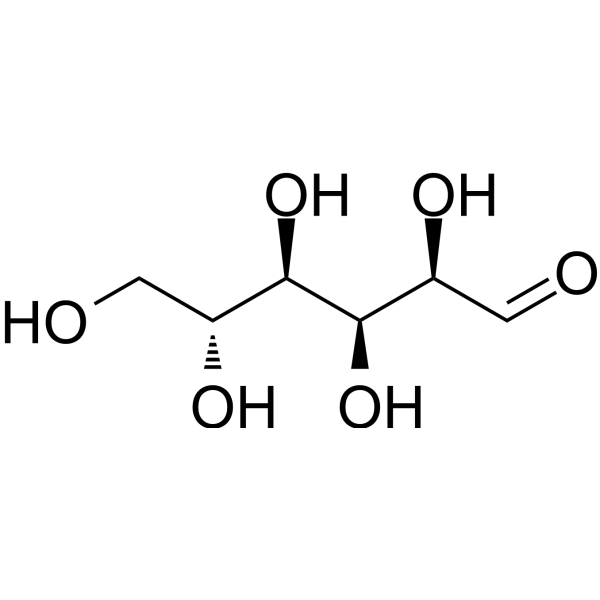
HY-B0389
D-GlucoseMonosaccharide -

HY-D0842A
BSA Protein (Low Endotoxin,Fatty acid free)Oligonucleotide-binding Protein -

HY-D0842
BSA ProteinGlobular Protein -
HY-116282C
Dextran sulfate sodium salt (MW 35000-45000)Colitis Inducer -
HY-116282
Dextran sulfate sodium salt (MW 5000)Complement Inhibitor -
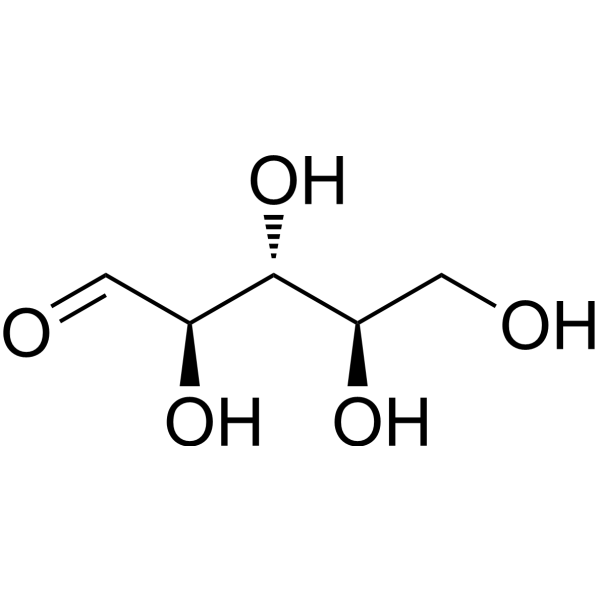
HY-W018772
D-Ribose(mixture of isomers) -

HY-B0389R
D-Glucose (Standard)Monosaccharide
Publications Citing Use of MedChemExpress (MCE) Ribitol
MoreAll Endogenous Metabolite Isoforms
More

Biological Activity
Description
IC50 & Target
|
Human Endogenous Metabolite |
Microbial Metabolite |
In Vitro
Ribitol is a reduced sugar[1]. Phosphoglucose isomerase-deficient (pgi1) strains of Saccharomyces cerevisiae are studied for the production of D-ribose and Ribitol from D-glucose via the intermediates of the pentose phosphate pathway. Overexpression of the gene encoding sugar phosphate phosphatase (DOG1) of S. cerevisiae is needed for the production of D-ribose and Ribitol. The engineered strains are compared for their ability to produce the PPP-derived 5-carbon compounds Ribitol and D-ribose from D-glucose[2].
MedChemExpress (MCE) has not independently confirmed the accuracy of these methods. They are for reference only.
Clinical Trial
| NCT Number | Sponsor | Condition | Start Date |
Phase

|
|---|---|---|---|---|
| NCT01329991 | Plexxikon| | 2011-05 | PHASE1 |


Chemical Information
-
CAS No. 488-81-3
-
Appearance Solid
-
Molecular Weight 152.15
-
Formula C5H12O5
-
Color White to off-white
-
SMILES
OC[C@@H](O)[C@@H](O)[C@@H](O)CO
-
Synonyms
Adonitol; Adonite; BBP-418
-
Structure Classification
-
Initial Source
-
Shipping
Room temperature in continental US; may vary elsewhere.
-
Storage
Powder -20°C 3 years 4°C 2 years In solvent -80°C 2 years -20°C 1 year


Publications (3)
-
Journal Impact Factor
-
Most Recent
-
Cell Rep
Accessibility to Peptidoglycan Is Important for the Recognition of Gram-Positive Bacteria in Drosophila. [Abstract]2019 May 21;27(8):2480-2492.e6. PMID: 31116990 -
Drug Deliv Transl Res
Leveraging quantum chemical properties in transfer learning for predicting blood-brain barrier permeability of drugs. [Abstract]2025 Oct 29. PMID: 41160380 -


Solvent & Solubility
In Vitro:
H2O : 33.33 mg/mL (219.06 mM; Need ultrasonic)
DMSO : 1.1 mg/mL (7.23 mM; Need ultrasonic; Hygroscopic DMSO has a significant impact on the solubility of product, please use newly opened DMSO)
Please refer to the solubility information to select the appropriate solvent. Once prepared, please aliquot and store the solution to prevent product inactivation from repeated freeze-thaw cycles.
Storage method and period of stock solution: -80°C, 2 years; -20°C, 1 year. When stored at -80°C, please use it within 2 years. When stored at -20°C, please use it within 1 year.
* Note: If you choose water as the stock solution, please dilute it to the working solution, then filter and sterilize it with a 0.22 μm filter before use.
Please refer to the solubility information to select the appropriate solvent. Once prepared, please aliquot and store the solution to prevent product inactivation from repeated freeze-thaw cycles.
Storage method and period of stock solution: -80°C, 2 years; -20°C, 1 year. When stored at -80°C, please use it within 2 years. When stored at -20°C, please use it within 1 year.
* Note: If you choose water as the stock solution, please dilute it to the working solution, then filter and sterilize it with a 0.22 μm filter before use.
Concentration (start) × Volume (start) = Concentration (final) × Volume (final)


Purity & Documentation
-
Data Sheet (281 KB)
-
SDS (254 KB)
- English - EN (254 KB)
- Français - FR (254 KB)
- Deutsch - DE (254 KB)
- Norwegian - NO (254 KB)
- Español - ES (254 KB)
- Swedish - SV (254 KB)
- Italian - IT (254 KB)
- Korean - KR (254 KB)
- Portuguese - PT (254 KB)
-
Handling Instructions (2659 KB)
References
[1]. Praissman JL, et al. The functional O-mannose glycan on α-dystroglycan contains a phospho-Ribitol primed for matriglycan addition. Elife. 2016 Apr 29;5. pii: e14473. [Content Brief]
[2]. Toivari MH, et al. Enhancing the flux of D-glucose to the pentose phosphate pathway in Saccharomyces cerevisiae for the production of D-ribose and ribitol. Appl Microbiol Biotechnol. 2010 Jan;85(3):731-9. [Content Brief]


Complete Stock Solution Preparation Table
Please refer to the solubility information to select the appropriate solvent. Once prepared, please aliquot and store the solution to prevent product inactivation from repeated freeze-thaw cycles.
Storage method and period of stock solution: -80°C, 2 years; -20°C, 1 year. When stored at -80°C, please use it within 2 years. When stored at -20°C, please use it within 1 year.
| Optional Solvent | Concentration Solvent Mass | 1 mg | 5 mg | 10 mg | 25 mg |
|---|---|---|---|---|---|
| DMSO / H2O | 1 mM | 6.5725 mL | 32.8623 mL | 65.7246 mL | 164.3115 mL |
| 5 mM | 1.3145 mL | 6.5725 mL | 13.1449 mL | 32.8623 mL | |
| H2O | 10 mM | 0.6572 mL | 3.2862 mL | 6.5725 mL | 16.4312 mL |
| 15 mM | 0.4382 mL | 2.1908 mL | 4.3816 mL | 10.9541 mL | |
| 20 mM | 0.3286 mL | 1.6431 mL | 3.2862 mL | 8.2156 mL | |
| 25 mM | 0.2629 mL | 1.3145 mL | 2.6290 mL | 6.5725 mL | |
| 30 mM | 0.2191 mL | 1.0954 mL | 2.1908 mL | 5.4771 mL | |
| 40 mM | 0.1643 mL | 0.8216 mL | 1.6431 mL | 4.1078 mL | |
| 50 mM | 0.1314 mL | 0.6572 mL | 1.3145 mL | 3.2862 mL | |
| 60 mM | 0.1095 mL | 0.5477 mL | 1.0954 mL | 2.7385 mL | |
| 80 mM | 0.0822 mL | 0.4108 mL | 0.8216 mL | 2.0539 mL | |
| 100 mM | 0.0657 mL | 0.3286 mL | 0.6572 mL | 1.6431 mL |
* Note: If you choose water as the stock solution, please dilute it to the working solution, then filter and sterilize it with a 0.22 μm filter before use.


Ribitol Related Classifications
HY-100582 Related Classifications
 Powered by Bioz