



Bacterial
Anything that destroys bacteria or suppresses their growth or their ability to reproduce. Heat, chemicals such as chlorine, and antibiotic drugs all have antibacterial properties. Many antibacterial products for cleaning and handwashing are sold today. Such products do not reduce the risk for symptoms of viral infectious diseases in otherwise healthy persons. This does not preclude the potential contribution of antibacterial products to reducing symptoms of bacterial diseases in the home.
All Product Categories
-
Bacterial Inhibitors
(7553)
View all products
-
Bacterial Agonists
(3)
View all products
-
Bacterial Antagonists
(9)
View all products
-
Bacterial Activators
(25)
View all products
-
Bacterial Modulators
(27)
View all products
-
Bacterial Chemicals
(2)
View all products
-
Bacterial Inducers
(6)
View all products
-
Bacterial Controls
(14)
View all products
-
Bacterial Substrates
(2)
View all products
-
Bacterial Ligand
(1)
View all products
-
Bacterial Related Products (8893)
Related Products (8893)

-
Antibodies (14)
-
Related Compound Screening Libraries (1)
-
Sulfamethylphenazole potassium
 0 ImagesCat. No.: HY-105828BCAS No.: 18179-68-5Synonyms: Sulfapyrazole potassium; Vesulong potassiumSulfamethylphenazole potassium (Sulfapyrazole potassium; Vesulong potassium) is a long-acting sulfonamide antibacterial agent. Sulfamethylphenazole potassium maintains effective chemotherapeutic blood concentrations through the slow release of free sulfonamide from a protein-binding reservoir and can be used in combination with antibiotics such as Terramycin for bovine hemorrhagic septicemia. Sulfamethylphenazole potassium exhibits moderate antimycobacterial activity against Mycobacterium tuberculosis H37Rv (MIC = 15.38 μg/mL) and inhibitory activity against CYP 2C9. Sulfamethylphenazole potassium can be used in studies related to tuberculosis and hemorrhagic septicemia.
-
ME-1036
 0 ImagesCat. No.: HY-122174CAS No.: 432038-96-5Synonyms: CP-5609ME-1036 (CP-5609) is a carbapenem antibiotic. ME-1036 against resistant Gram-positive organisms, including Methicillin-resistant Staphylococcus aureus (MRSA), and vancomycin-resistant Enterococci (VRE), and ESBL-producing E. coli and K. pneumoniae but is not effective against P. aeruginosa.
-
Peptide 5e
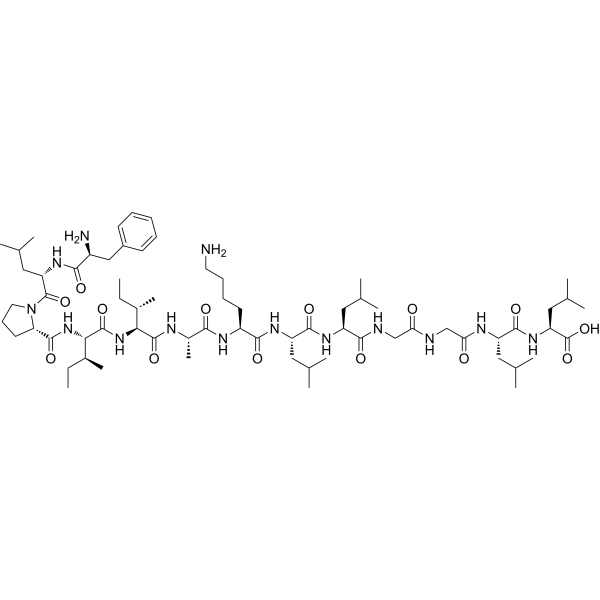 0 ImagesCat. No.: HY-P5720CAS No.: 908065-89-4Peptide 5e is an antimicrobial peptide. Peptide 5e inhibits E. coli, S. aureus, and C. albicans with MIC values of 30, 5, 25 μg/mL respectively.
-
Axinysone B
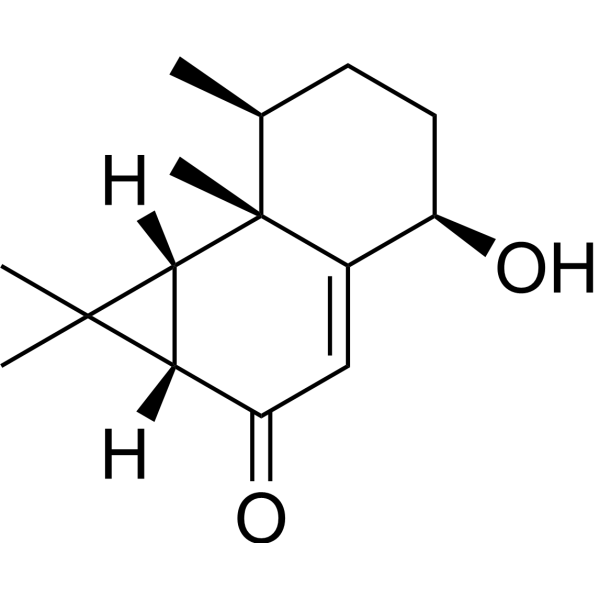 0 ImagesCat. No.: HY-N12149CAS No.: 1114491-60-9Axinysone B can be isolated from Laurencia similis. Axinysone B has antibacterial activity against Staphylococcus sp..
-
Arizonin B2
 0 ImagesCat. No.: HY-N14042CAS No.: 108905-76-6Arizonin B2 is a microbial metabolite with anti-Gram-positive bacterial activities.
-
N,N-Dimethyl-N-(3-(trimethoxysilyl)propyl)tetradecan-1-aminium chloride
 0 ImagesCat. No.: HY-W654567CAS No.: 41591-87-1N,N-Dimethyl-N-(3-(trimethoxysilyl)propyl)tetradecan-1-aminium chloride is a cationic surfactant of the silylated quaternary ammonium salt type, possessing dual functions of antibacterial activity and silane coupling. N,N-Dimethyl-N-(3-(trimethoxysilyl)propyl)tetradecan-1-aminium chloride can be used as a cationic silane coupling agent, antibacterial surface treatment agent, and disinfectant.
-
CHIR-29498
 0 ImagesCat. No.: HY-118971CAS No.: 236102-25-3CHIR-29498 is an antibacterial peptoid. CHIR-29498 is active against both Gram-positive and Gram-negative bacteria. CHIR-29498 can be used for the study of fatal Staphylococcus aureus.
-
MMV675968
 0 ImagesCat. No.: HY-182684CAS No.: 159308-73-3MMV675968 is an inhibitor of Acinetobacter baumannii dihydrofolate reductase (AbDHFR) with an IC50 of 8.5 nM, and it exhibits selectivity against human DHFR. MMV675968 inhibits dihydrofolate reductase in Cryptosporidium, Plasmodium, and Escherichia coli, disrupting the thymidylate cycle and folate biosynthesis pathway. MMV675968 inhibits the growth of multiple A. baumannii strains, including clinical isolates and environmental isolates. MMV675968 is applicable to research related to A. baumannii infections.
-
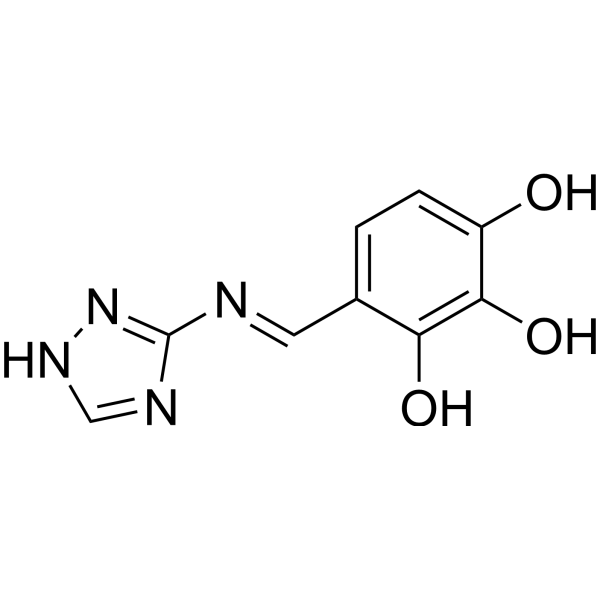
Defucogilvocarcin V
 0 ImagesCat. No.: HY-N14819CAS No.: 80155-95-9Defucogilvocarcin V is a gilvocarcin antibiotic with activity against Gram-positive bacteria.
-
Trisaccharides 3
 0 ImagesCat. No.: HY-185308CAS No.: 895525-81-2Trisaccharides 3 (compoudn 3) is a GlfT2 acceptor substrate with a 50 μM Ka. Trisaccharides 3 acts as an acceptor substrate for the β-(1→6) galactofuranosyl transferase activity of GlfT2, binds competitively at GlfT2’s single active site pocket, and undergoes galactosylation by GlfT2 with UDP-Galf to form a tetrasaccharide product. Trisaccharides 3 can be used for the research of tuberculosis, hiv-associated Mycobacterium avium infections.
-
Antibacterial agent 165
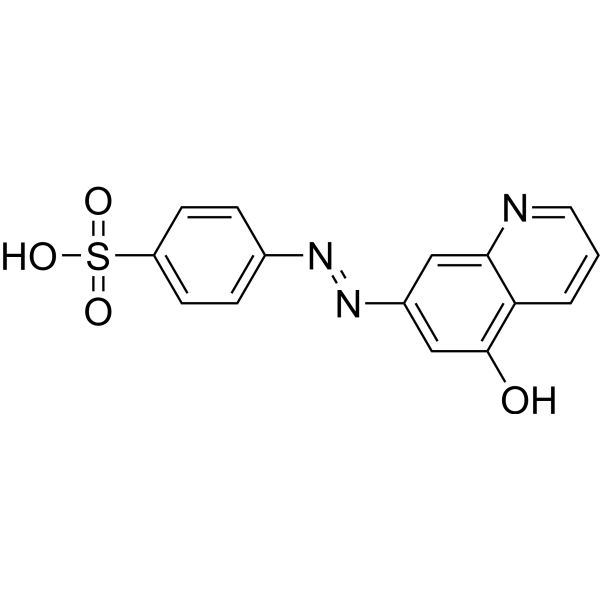 0 ImagesCat. No.: HY-157142Antibacterial agent 165 (compound 3), a hydroxyquinoline derivative, is a potent bacterial inhibitor. Antibacterial agent 165 inhibits methicillin-resistant Staphylococcus aureus (MRSA).
-
5-Bromo-5-nitro-1,3-dioxane (Standard)
 0 ImagesCat. No.: HY-W014316RCAS No.: 30007-47-75-Bromo-5-nitro-1,3-dioxane (Standard) is the analytical standard of 5-Bromo-5-nitro-1,3-dioxane (HY-W014316). This product is intended for research and analytical applications. 5-Bromo-5-nitro-1,3-dioxane is a broad-spectrum antimicrobial agent active against Gram-positive bacteria, Gram-negative bacteria and fungi. 5-Bromo-5-nitro-1,3-dioxane oxidizes free thiol groups to their corresponding disulfides. 5-Bromo-5-nitro-1,3-dioxane induces intracellular substance leakage in Escherichia coli and Staphylococcus aureus. 5-Bromo-5-nitro-1,3-dioxane modulates the oxygen consumption of Escherichia coli and Staphylococcus aureus.
-
Bensuldazic acid
 0 ImagesCat. No.: HY-W811579CAS No.: 1219-77-8Bensuldazic acid (compound 4f) is a lipophilic 3,5-disubstituted tetrahydro-2H-1,3,5-thiadiazine-2-thione (THTT) derivative that can be used as a prodrug model. Bensuldazic acid has antifungal activity.
-
Sucralfate (Standard)
 0 ImagesCat. No.: HY-B0644RCAS No.: 54182-58-0Synonyms: Sucrose octasulfate-aluminum complex (Standard)Sucralfate (Standard) is the analytical standard of Sucralfate. This product is intended for research and analytical applications. Sucralfate (Sucrose octasulfate-aluminum complex) is a potent and orally active gastroprotectant with no systemic effects. Sucralfate inhibits peptic activity and binds to negatively charged subepithelial proteins exposed during mucosal injury, forming a viscous layer that protects the vascular bed and proliferative zone. Sucralfate is used for prevention and research of several gastrointestinal diseases in vivo.

-
CPW-86-363
 0 ImagesCat. No.: HY-169811CAS No.: 84080-55-7CPW-86-363 is a novel broad-spectrum cephalosporin with antibacterial activity.
-
7-Demethylpiericidin A1
 0 ImagesCat. No.: HY-N14731CAS No.: 155148-30-47-Demethylpiericidin A1 is a pierceridin antibiotic. 7-Demethylpiericidin A1 has antifungal and Gram-negative bacteria activity.
-
IMB-YH-8
 0 ImagesCat. No.: HY-116611CAS No.: 17615-10-0IMB-YH-8 is a serine/threonine protein kinase (PknB) inhibitor. IMB-YH-8 has strong antibacterial activity against Mycobacterium tuberculosis (MIC = 0.25 µg/mL). IMB-YH-8 can be used in the research of tuberculosis.
-
Mupirocin lithium (Standard)
 0 ImagesCat. No.: HY-W108875RCAS No.: 73346-79-9Synonyms: BRL-4910A lithium (Standard); Pseudomonic acid lithium (Standard)Mupirocin (lithium) (Standard) is the analytical standard of Mupirocin lithium (HY-W108875). This product is intended for research and analytical applications. Mupirocin lithium is an antibiotic. Mupirocin lithium inhibits bacterial isoleucyl-tRNA synthetase, blocking protein synthesis. Mupirocin lithium has high activity against Gram-positive bacteria such as Staphylococcus and Streptococcus, as well as some Gram-negative bacteria (such as Haemophilus influenzae). Mupirocin lithium can be used in the research of diseases such as skin infections (such as MRSA infections) and chronic sinusitis.




