



Drug Metabolite
Drug metabolite results when a drug is metabolized into a modified form which continues to produce effects. Drug metabolism redox reactions such as heteroatom dealkylations, hydroxylations, heteroatom oxygenations, reductions, and dehydrogenations can yield active metabolites, and in rare cases even conjugation reactions can yield an active metabolite.
All Product Categories
-
Drug Metabolite Related Products (2020)
Related Products (2020)

-
Antibodies (1)
-
Related Compound Screening Libraries (1)

-
(±)-Equol (Standard)
 0 Images(±)-Equol (Standard) is the analytical standard of (±)-Equol. This product is intended for research and analytical applications. (±)-Equol is the racemate of equol. (±)-equol exhibits EC50s of 200 and 74 nM for human ERα and ERβ, respectively. Equol is a metabolite of the soy isoflavones, daidzin and daidzein.
-
2Carboxy-MMHP
 0 ImagesCat. No.: HY-W587411CAS No.: 82975-93-7Synonyms: Mono[2-(carboxymethyl)hexyl] phthalate; MCHPMono[2-(carboxymethyl)hexyl] phthalate (MCHP) is a metabolite of Di-(2-ethylhexyl)phthalate (DEHP). DEH is an endocrine disrupting chemical that is widely used as the major plasticizer.
-
O-Desethylreboxetine
 0 ImagesCat. No.: HY-183453CAS No.: 351330-75-1O-Desethylreboxetine is the major metabolite of Reboxetine (HY-14560), which is catalyzed by the CYP3A4 enzyme. O-Desethylreboxetine can be used in depression-related research.
-
10-Hydroxywarfarin
 0 Images10-Hydroxywarfarin, a metabolite of (R)-(+)-Warfarin (HY-W015998 ), is a CYP2C9 and vitamin K epoxide reductase complex 1 (VKOR) inhibitor with IC50s of 1.6 µM and 80 ng/mL, respectively.
-
Homomangiferin
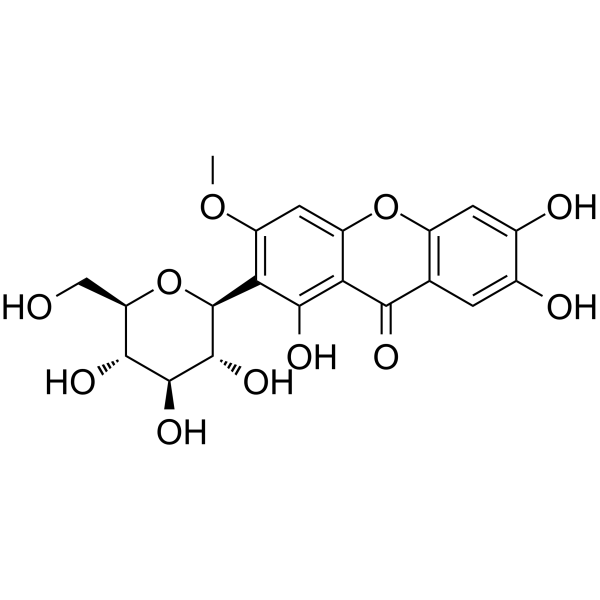 0 ImagesCat. No.: HY-111811CAS No.: 21794-66-1Homomangiferin is mangiferin monomethyl ether. Homomangiferin has important medicinal properties and is widely used to relieve many symptoms, for example coughing and asthma.
-
p,p'-DDE (Standard)
 0 ImagesSynonyms: 4,4'-DDE (Standard); p,p'-Dichlorodiphenyldichloroethylene (Standard)p,p'-DDE (Standard) is the analytical standard of p,p'-DDE. This product is intended for research and analytical applications. p,p'-DDE (4,4'-DDE) is the major and persistent metabolite of DDT. p,p'-DDE is a orally active androgen receptor antagonist with an IC50 of 5 μM and a Ki of 3.5 μM. p,p'-DDE can affect the development and function of the male reproductive system. Additionally, high serum concentrations of p,p'-DDE may be a risk factor for type 2 diabetes in women.
-
2,6-Diisopropylnaphthalene
 0 ImagesCat. No.: HY-W014277CAS No.: 24157-81-12,6-Diisopropylnaphthalene is a substituted naphthalene compound, metabolite precursor and potato sprout inhibitor. 2,6-Diisopropylnaphthalene is metabolized in rats only via oxidation of its isopropyl chains, producing five major unconjugated urinary metabolites, glucuronide conjugates of these metabolites, while a small amount of the parent drug is excreted in urine. 2,6-Diisopropylnaphthalene inhibits sprouting of stored potato tubers; when used alone, it only provides a short-term sprout-inhibiting effect.
-
5Oxo-MEHTP
 0 ImagesCat. No.: HY-W726483CAS No.: 1684398-40-05Oxo-MEHTP is an urinary metabolite of di(2-ethylhexyl) terephthalate (DEHTP). 5Oxo-MEHTP is predominantly excreted in glucuronidated form via urine.
-
Lansoprazole sulfone-13C6
 0 ImagesCat. No.: HY-W008614S1CAS No.: 1261398-50-8Synonyms: AG-1813-13C6Lansoprazole sulfone (AG-1813)-13C6 is 13C labeled Lansoprazole sulfone (HY-W008614). Lansoprazole sulfone, Lansoprazole (HY-13662) metabolite, is a H+, K+-ATPase inhibitor. Lansoprazole sulfone has potential applications in duodenal ulcer, gastric ulcer, gastroesophageal reflux disease and Zolinger Ellison disease.
-
Fenthoxon
 0 ImagesCat. No.: HY-W343578CAS No.: 6552-12-1Fenthoxon is a fenthion metabolite. Fenthion is an organophosphate insecticide.
-
Raloxifene Bismethyl Ether
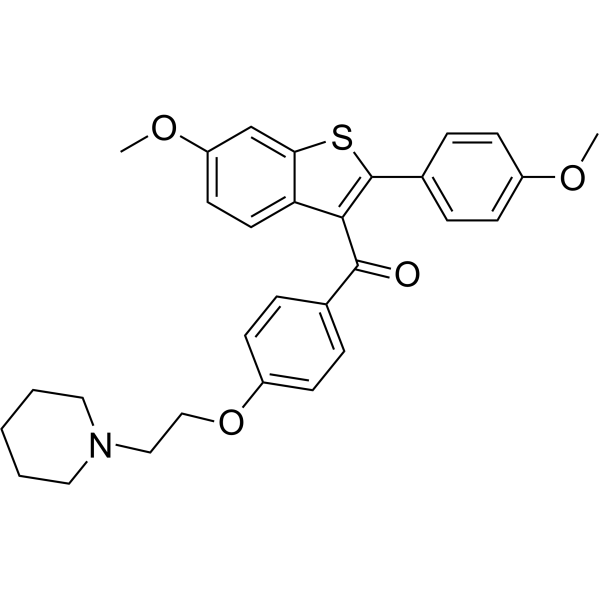 0 ImagesCat. No.: HY-135580CAS No.: 84541-38-8Raloxifene Bismethyl Ether is a metabolite of Raloxifene and an estrogen receptor inactive compound on which both hydroxyl groups are absent.
-
FUB-PB-22 3-carboxyindole metabolite
 0 ImagesFUB-PB-22 3-carboxyindole metabolite is the main metabolite of FDU-PB-22 and FUB-PB-22.
-
AB-CHMINACA metabolite M5A
 0 ImagesCat. No.: HY-W709579CAS No.: 2207957-90-0AB-CHMINACA metabolite M5A is a metabolite of AB-CHMINACA in the liver.
-
(±)13,14-EDT
 0 ImagesCat. No.: HY-169045CAS No.: 355016-19-2(±)13,14-EDT is an oxylipin and a metabolite of Adrenic acid (HY-W013215) formed via the cytochrome P450 (CYP) pathway.
-
Monoethylglycinexylidide hydrochloride (Standard)
 0 ImagesCat. No.: HY-W099331RCAS No.: 7729-94-4Synonyms: MEGX hydrochloride (Standard); Norlidocaine hydrochloride (Standard)Monoethylglycinexylidide hydrochloride (Standard) is the analytical standard of Monoethylglycinexylidide hydrochloride (HY-W099331). This product is intended for research and analytical applications. Monoethylglycinexylidide hydrochloride (MEGX hydrochloride; Norlidocaine hydrochloride) is the major metabolite of Lidocaine (HY-B0185), produced via oxidative metabolism by cytochrome P-450 enzymes in the liver. Monoethylglycinexylidide hydrochloride can be used for research on liver cirrhosis.
-
2,2-Dichloro-1,1-ethanediol
 0 ImagesCat. No.: HY-W154117CAS No.: 16086-14-92,2-Dichloro-1,1-ethanediol is a metabolite of the insecticides Dichlorvos (HY-B1312) and Trichlorphon, is mutagenic in the Salmonella/microsome test.
-
15-Keto-prostaglandin E2-d4
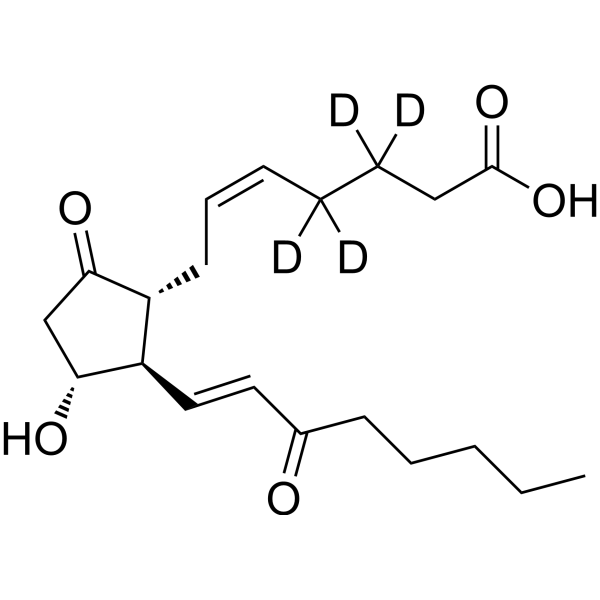 0 ImagesCat. No.: HY-113205S1CAS No.: 2738376-85-515-Keto-prostaglandin E2-d4 is the d4 labeled 15-keto-Prostaglandin E2 (HY-113205). 15-keto-Prostaglandin E2 (15-keto-PGE2) is an endogenous PGE2 metabolite. 15-keto-Prostaglandin E2 inhibits STAT3 activation by binding to the Cys259 residue of STAT3. 15-keto-Prostaglandin E2 binds to and stabilizes EP2 and EP4 receptors. 15-keto-Prostaglandin E2 inhibits the growth and progression of breast cancer cells. 15-keto-Prostaglandin E2 activates PPAR-γ and promotes fungal growth. 15-keto-Prostaglandin E2 disrupts glomerular vascularization during zebrafish development and reduces the surface area of the glomerular filtration barrier.
-
6-Acetamidohexanoic acid (Standard)
 0 ImagesSynonyms: Acexamic acid (Standard); 6-Acetamidocaproic acid (Standard)6-Acetamidohexanoic acid (Acexamic acid; 6-Acetamidocaproic acid) (Standard) is the analytical standard of 6-Acetamidohexanoic acid. This product is intended for research and analytical applications. 6-Acetamidohexanoic acid (Acexamic acid; 6-Acetamidocaproic acid) is a metabolite of Hexamethylene bisacetamide (HMBA) (HY-124284) with anti-pulmonary fibrosis activity. 6-Acetamidohexanoic acid does not induce differentiation of human promyelocytic leukemia cells, but is taken up by such cells. 6-Acetamidohexanoic acid serves as a carboxylic acid substrate component for constructing carboxylesterase-responsive near-infrared phototheranostic probes. 6-Acetamidohexanoic acid is applicable to research related to pulmonary fibrosis, refractory hypoxemia and cervical cancer.
-
2,5-Diamino-6-hydroxy-4-(5-phosphoribosylamino)pyrimidine
 0 ImagesCat. No.: HY-W720429CAS No.: 73477-63-12,5-Diamino-6-hydroxy-4-(5-phosphoribosylamino)pyrimidine is a metabolite in the biosynthesis pathway (purine metabolism process) of Riboflavin (HY-B0456).




