Glycosidase
Glycosidase
Glycosidase are a class of enzymes which catalyze the hydrolysis of glycosidic bonds. In living organisms, Glycosidase are involved in carbohydrate metabolism. They can degrade polysaccharides such as starch and glycogen into monosaccharides, providing energy for cells. Glycosidase also participate in the synthesis and modification of biological macromolecules such as glycoproteins and glycolipids, playing a crucial role in cell recognition and signal transduction. Additionally, in plants and microorganisms, Glycosidase are involved in the metabolism of cell wall polysaccharide components, affecting cell growth, differentiation, and morphogenesis. Gene mutations of Glycosidase can trigger genetic diseases, leading to abnormal metabolism in the body and damage to organ functions. Changes in their activity are associated with various diseases such as diabetes, infectious diseases, and tumors, and can influence the occurrence and development of diseases[1][2].
References:
- [1]. Wang X, et al. Metabolites extracted from microorganisms as potential inhibitors of glycosidases (α-glucosidase and α-amylase): A review. Front Microbiol. 2022 Nov 17;13:1050869.
- [2]. Ohtsubo K, et al. Glycosylation in cellular mechanisms of health and disease. Cell. 2006 Sep 8;126(5):855-67. [Content Brief]
All Product Categories
-
Glycosidase Inhibitors
(456)
View all products
-
Glycosidase Antagonist
(1)
View all products
-
Glycosidase Activators
(20)
View all products
-
Glycosidase Modulators
(8)
View all products
-
Glycosidase Chemical
(1)
View all products
-
Glycosidase Inducers
(2)
View all products
-
Glycosidase Degrader
(1)
View all products
-
Glycosidase Controls
(6)
View all products
-
Glycosidase Substrates
(25)
View all products
-
Glycosidase Ligands
(3)
View all products
-
Glycosidase Related Products (697)
Related Products (697)

-
Antibodies (3)
-
Variegatic acid
 0 ImagesCat. No.: HY-149151CAS No.: 20988-30-1Variegatic acid is a secondary metabolite derived from basidiomycete fungi. Variegatic acid is a PKCβ1 inhibitor with an IC₅₀ of 36.2 μM. Variegatic acid inhibits antigen- or calcium ionophore-induced β-hexosaminidase release (IC₅₀ values of 10.4 μM and 22.2 μM, respectively) and TNF-α secretion (IC₅₀ values of 16.8 μM and 20.1 μM, respectively). Variegatic acid suppresses the enzymatic activity of calcium-activated PKCβ1 and reduces Fe(III) to Fe(II) in a pH-dependent manner, enabling the generation of hydroxyl radicals (·OH) through reaction with H₂O₂, which facilitates the degradation of lignocellulose. Variegatic acid is useful for studying biological degradation and allergic responses.
-
Avenanthramide B
 0 ImagesCat. No.: HY-W795967CAS No.: 108605-69-2Avenanthramide B is an oat phytoalexin, a porcine liver esterase inhibitor, and an amyloglucosidase inhibitor, with an IC50 of 4.4 mg/mL against Aspergillus niger amyloglucosidase. Avenanthramide B increases the activation status of Akt1 and the expression level of eNOS, elevates the levels of NO and cGMP, and reduces the level of superoxide anions. Avenanthramide B acts on amyloglucosidase via a competitive mixed mechanism, functions as a fluorescence quencher, and exerts bidirectional regulatory effects on protein thermal stability. Avenanthramide B serves as a substrate for oat leaf peroxidase. Avenanthramide B can be used in research related to type 2 diabetes.
-
α-Glucosidase-IN-115
 0 ImagesCat. No.: HY-182776α-Glucosidase-IN-115 (compound 3m) is a non-competitive α-Glucosidase inhibitor with an IC50 value of 45.07 μM. α-Glucosidase-IN-115 is applicable to the research of type 2 diabetes.
-
1,3-Dipalmitoleoyl glycerol
 0 ImagesCat. No.: HY-165100CAS No.: 106352-09-4Synonyms: DG(16:1/0:0/16:1); 1,3-Dipalmitolein1,3-Dipalmitoleoyl glycerol (DG(16:1/0:0/16:1)) is a compound isolated from sea cucumber viscera, which has α-glucosidase inhibitory activity and has different degrees of inhibitory effects on α-glucosidase from different sources.
-
β-Xylosidase(thermostable)
 0 ImagesCat. No.: HY-E70889β-Xylosidase (thermostable) can release reducing sugars from birch xylan and catalyze the hydrolysis of 4-methylumbelliferone-β-D-cellobiose and 4-methylumbelliferone-β-D-glucopyranoside. β-Xylosidase does not possess endoxylanase, arabinoxylanase, or β-glucanase activity. β-Xylosidase undergoes post-translational glycosylation modification.
-
N-4′-(p-Trifluoromethylphenyl)butyl-DAB
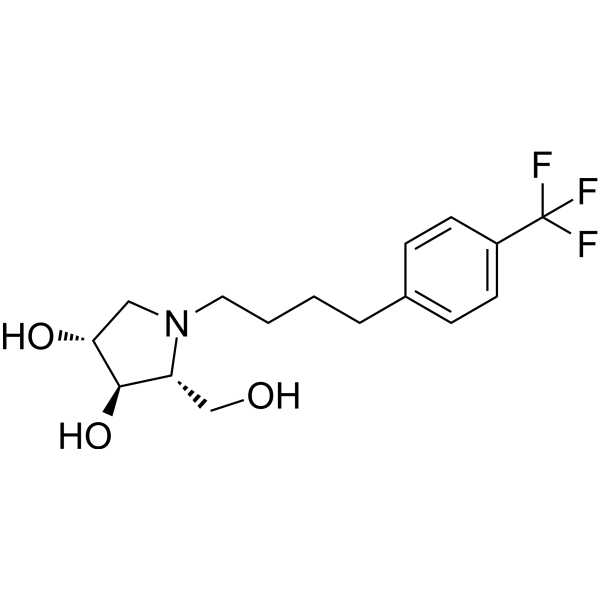 0 ImagesCat. No.: HY-154995CAS No.: 3033570-20-3N-4′-(p-Trifluoromethylphenyl)butyl-DAB (compound 5g) is an agonit of lysosomal acid α-glucosidase (GAA). N-4′-(p-Trifluoromethylphenyl)butyl-DAB increases intracellular GAA activities dose-dependently, in Pompe patient's fibroblasts with the M519V mutation.
-
trans-p-Coumaraldehyde
 0 ImagesCat. No.: HY-W1060183CAS No.: 20711-53-9Synonyms: (E)-4-Hydroxycinnamaldehyde; (E)-p-Hydroxycinnamaldehydetrans-p-Coumaraldehyde ((E)-4-Hydroxycinnamaldehyde) is a natural product. trans-p-Coumaraldehyde can be isolated from the seeds of Petai cina. trans-p-Coumaraldehyde exhibits potential α-glucosidase inhibitory activity. trans-p-Coumaraldehyde can be used in diabetes research.
-
α-Glucosidase-IN-61
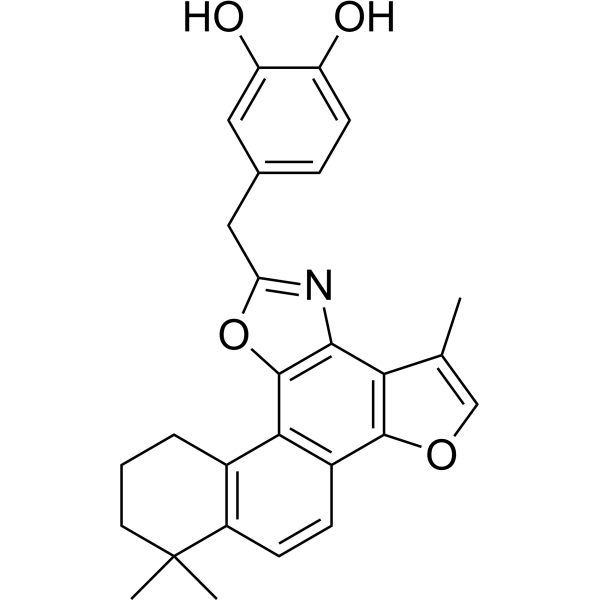 0 ImagesCat. No.: HY-161421α-Glucosidase-IN-61 (Compd 1j), a competitive α-glucosidase inhibitor, demonstrates excellent inhibition with an IC50 of 0.73 μM. α-Glucosidase-IN-61 (Compd 1j) is used for the research of type 2 diabetes mellitus.
-
N-Octyl-α-4-epivalienamine
 0 ImagesCat. No.: HY-153922CAS No.: 942065-96-5N-Octyl-α-4-epivalienamine is an orally active and CNS-penetrant molecular chaperone that induces high expression of the deficient β-galactosidase activity. N-Octyl-α-4-epivalienamine ameliorates symptoms and increase survival rate in a mouse model of GM1-gangliosidosis. N-Octyl-α-4-epivalienamine can be used for neurogenetic disease research.
-
Mannosyl-oligosaccharide 1,2-α-mannosidase IA
 0 ImagesCat. No.: HY-E70304CAS No.: 1505450-17-8Synonyms: MAN1A1Mannosyl-oligosaccharide 1,2-α-mannosidase IA (MAN1A1) is a glycosidase that catalyzes the hydrolysis of α-1,2-linked mannose residues in Man(9)GlcNAc(2) to produce Man(9)GlcNAc(2).
-
Cefetecol
 0 ImagesCat. No.: HY-159796ACAS No.: 117211-03-7Synonyms: GR69153Cefetecol (GR69153) is a semisynthetic β-lactam antibacterial agent and α-glucosidase inhibitor (yeast IC50 = 2.1 μM; Ki = 5.78 μM) that crosses the blood-brain barrier. Cefetecol reduces blood glucose levels in Streptozotocin-induced diabetic mice. Cefetecol decreases the mRNA expression of GSK-3, PPAR-γ, and UCP-3. Cefetecol induces bacterial cell filamentation and exhibits bactericidal activity against Gram-positive and Gram-negative bacteria. Cefetecol is used in the study of diabetes and bacterial infections.
-
Sucrose phosphorylase
 0 ImagesSucrose phosphorylase is a bacterial transglucosidase that catalyzes the conversion of sucrose and phosphate into α-D-glucose-1-phosphate and D-fructose. The glucosylated Sucrose phosphorylase can also be hydrolyzed into α-D-glucose, or transfer the glucoyl to the hydroxyl group of the receptor, and then decomposed into new α-D-glucoside products. The enzymatic activity of base phosphorylase to substrate and product is weak.
-
α-Glucosidase-IN-126
 0 ImagesCat. No.: HY-189670α-Glucosidase-IN-126 is a selective and competitive α-glucosidase inhibitor with an IC50 of 0.2 μM and a Ki of 200 nM. α-Glucosidase-IN-126 blocks carbohydrate hydrolysis, inhibits bovine serum albumin glycation, and dose-dependently reduces blood glucose in a diabetic zebrafish model. α-Glucosidase-IN-126 shows minimal cytotoxicity toward normal fibroblasts at low concentrations. α-Glucosidase-IN-126 can be used for research on type 2 diabetes.
-
3,4-Methylenedioxychalcone
 0 Images3,4-Methylenedioxychalcone (Compound 40) is an α-glucosidase inhibitor with an IC50 of 1870 μM. 3,4-Methylenedioxychalcone is applicable to the research of type 2 diabetes.
-
Isosojagol
 0 ImagesCat. No.: HY-N15602CAS No.: 94390-15-5Isosojagol (Compound 5) is a α-Glucosidase inhibitor with an IC50 of 32.2 μM. Isosojagol can be isolated from the Roots of Dolichos trilobus. Isosojagol has anti-inflammatory activity and inhibits LPS (HY-D1056A1)-induced NO production in RAW264.7 cells. Isosojagol can be used for fracture, soft tissue injuries and rheumatoid arthritis research.
-
Uvagrandol
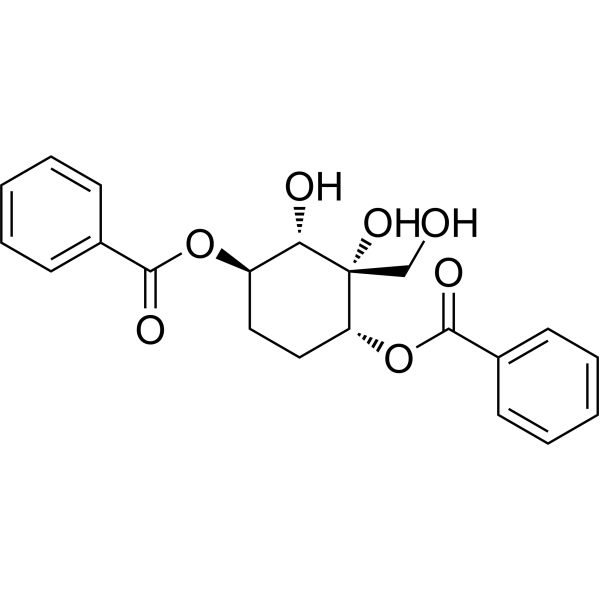 0 ImagesCat. No.: HY-N10606Uvagrandol potently inhibits α-glucosidase and porcine lipase (IC50: 15.2 μM, 11.2 μM respectively). Uvagrandol can be used in the research of Type 2 diabetes and obesity.

-
α-Glucosidase, rice
 0 Imagesα-Glucosidase, rice is a GH31 glycoside hydrolase in rice seeds, with high selectivity for α-1,4-glycosidic bonds. α-Glucosidase, rice can be inhibited by rice husk extracts (IC50 = 1.25 μg/mL) and steroidal components (IC50 = 1.83 μg/mL). α-Glucosidase, rice exists in two major isoforms, among which isoform II is more sensitive to inhibitors. α-Glucosidase, rice can directly bind to and degrade starch granules in rice seeds. α-Glucosidase, rice can form ONG2-I and ONG2-II via post-translational proteolysis. α-Glucosidase, rice can be used in type 2 diabetes research.