



Drug Intermediate
Drug Iintermediate
Drug intermediates are used as raw materials for the production of bulk drugs, or they can refer to a material produced during synthesis of an API that must undergo further molecular change or processing before it becomes an API. Drug intermediates are hygienically formulated using high grade raw materials and they are used in the pharmaceutical and cosmetic industry[1][2].
References:
- [1]. Ma HC, et al. Homochiral Covalent Organic Framework for Catalytic Asymmetric Synthesis of a Drug Intermediate. J Am Chem Soc. 2020 Jul 22;142(29):12574-12578. [Content Brief]
- [2]. Ramachary D B, et al. Development of pharmaceutical drugs, drug intermediates and ingredients by using direct organo‐click reactions[J]. 2008.
All Product Categories
-
Drug Intermediate Related Products (4608)
Related Products (4608)

-
Uradil impurity 1
 0 ImagesUradil impurity 1 is an impurity of Uradil.
-
1-(Piperidin-4-yl)-1H-imidazo[4,5-b]pyridin-2(3H)-one Hydrochloride
![1-(Piperidin-4-yl)-1H-imidazo[4,5-b]pyridin-2(3H)-one Hydrochloride](https://file.medchemexpress.com/product_pic/hy-32694.gif "Click to View 1-(Piperidin-4-yl)-1H-imidazo[4,5-b]pyridin-2(3H)-one Hydrochloride Product Detail") 0 Images1-(Piperidin-4-yl)-1H-imidazo[4,5-b]pyridin-2(3H)-one Hydrochloride is a drug intermediate for synthesis of various active compounds.
0 Images1-(Piperidin-4-yl)-1H-imidazo[4,5-b]pyridin-2(3H)-one Hydrochloride is a drug intermediate for synthesis of various active compounds.
-
2-Pyridinecarbothioamide
 0 Images2-Pyridinecarbothioamide is a building block, that can be used for synthesis of Zn2+ responsive fluorescent probe.
-
L-Iduronic acid sodium salt
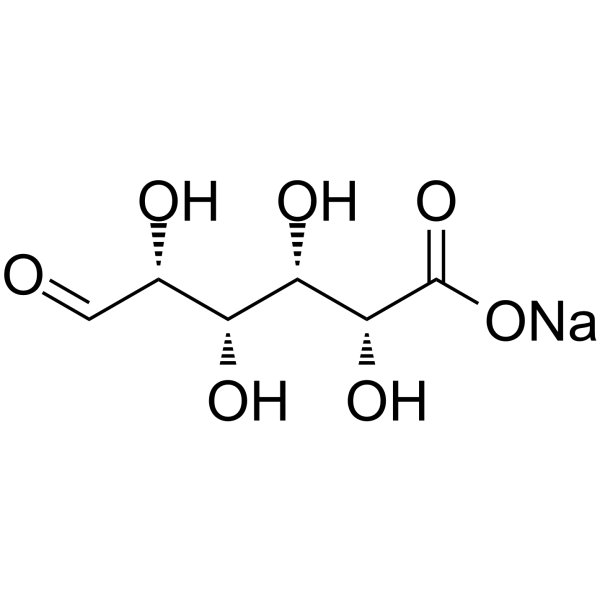 0 ImagesL-Iduronic acid sodium salt is an important monosaccharide component of glycosaminoglycans (GAGs) such as Heparin, Heparan sulfate and Dermatan sulfate.
-
Propofol impurity 1
 0 ImagesCat. No.: HY-W101650CAS No.: 35946-91-9

-
Methyl 3-methoxy-4-nitrobenzoate
 0 ImagesMethyl 3-methoxy-4-nitrobenzoate is a drug intermediate for synthesis of various active compounds.
-
1-(4-Bromophenyl)-1,3-dihydro-2h-imidazol-2-one
 0 ImagesCat. No.: HY-W554832CAS No.: 530080-83-21-(4-Bromophenyl)-1,3-dihydro-2h-imidazol-2-one is a drug intermediate for synthesis of various active compounds.
-
Benzophenonetetracarboxylic dianhydride
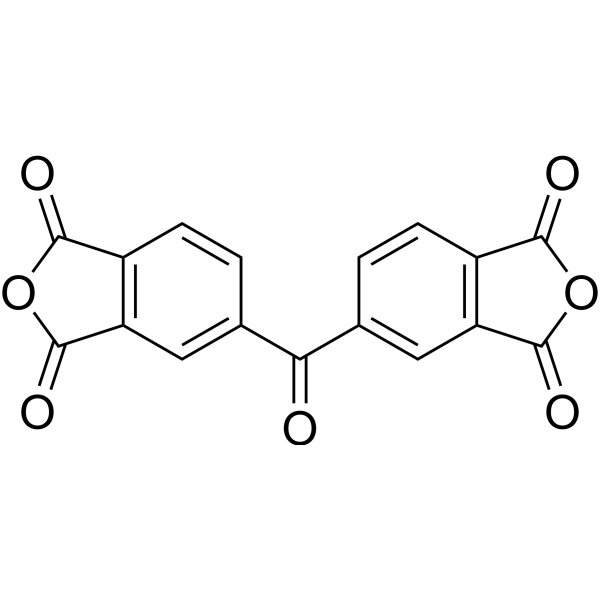 0 ImagesSynonyms: BTDABenzophenonetetracarboxylic dianhydride is widely used in the synthesis of high-performance polyimides and other polymer materials. Benzophenonetetracarboxylic dianhydride reacts with various diamine compounds to form oligoimide chains. These oligimide chains can modify graphene oxide (Go) and enhance its properties.

-
3-Thiophenecarboxaldehyde
 0 ImagesSynonyms: 3-TC3-Thiophenecarboxaldehyde is a thiophene derivative substrate for biocatalytic reduction to 3-thiophenemethanol, and can be processed by Pseudomonas putida S12 cells. 3-Thiophenecarboxaldehyde functions as an intermediate compound. 3-Thiophenecarboxaldehyde exhibits toxicity toward Pseudomonas putida S12 cells at elevated concentrations, reducing specific growth rate and final biomass yield.
-
2,4-Dimethyl-1H-imidazole-5-carbaldehyde
 0 Images2,4-Dimethyl-1H-imidazole-5-carbaldehyde is a drug intermediate for synthesis of various active compounds.
-
3,5-Dimethylbenzonitrile
 0 Images3,5-Dimethylbenzonitrile is a drug impurity.

-
Favipiravir impurity 5
 0 ImagesCat. No.: HY-Z1112CAS No.: 1257072-34-6
-
(2S,5S)-Methyl 5-phenylpyrrolidine-2-carboxylate hydrochloride
 0 Images(2S,5S)-Methyl 5-phenylpyrrolidine-2-carboxylate hydrochloride is a drug intermediate for synthesis of various active compounds.

-
3-(4-Bromo-1H-pyrazol-1-yl)-3-cyclopentylpropanenitrile
 0 ImagesCat. No.: HY-20195ACAS No.: 1822969-98-13-(4-Bromo-1H-pyrazol-1-yl)-3-cyclopentylpropanenitrile is a drug intermediate for synthesis of various active compounds.
-
Tofacitinib impurity 4
 0 ImagesCat. No.: HY-21273CAS No.: 384338-23-2




