



Fluorescent Dye
Fluorescence is a phenomenon of photoluminescence in luminescence. When an atom is irradiated by light, some electrons around the nucleus jump from their original orbitals to higher energy orbitals under the influence of light energy, i.e., from the ground state to the first or second excited single-line state, etc. Due to the instability of the first or second excited singlet state, the electron returns from the excited singlet state to the ground state accompanied by released energy, resulting in fluorescence.
Fluorescent dyes can be covalently bound or physically adsorbed in the structure of the substance. The fluorescence properties allow for the characterization, localization and quantitative analysis of the labeled object. Fluorescent dyes have shown great potential for the detection of proteins, nucleic acids, cells, and immunoassays, attributed to the advantages in non-radioactive contamination, simple experimental operation and easy observation.
Fluorescent dyes have penetrated many fields such as pharmacology, physiology, environmental science, and information science, as well as functional studies of proteins and drug screening.
All Product Categories
-
Fluorescent Dye Related Products (4914)
Related Products (4914)

-
Antibodies (4)
-
Cy3 labled AGN-745 sodium
 0 ImagesCat. No.: HY-177612DCy3 labled AGN-745 sodium is a Cy3 labled AGN-745 sodium.

-
Concanavalin A-Cy3
 0 ImagesCat. No.: HY-NP164NSynonyms: Con A-Cy3Concanavalin A-Cy3 (Con A-Cy3) is a Cy5 (HY-D0822)-labled Concanavalin A (HY-P2149). Concanavalin A is a Ca2+/Mn2+-dependent and mannose/glucose-binding plant lectin. Concanavalin A binds the N- and O-glycosylated proteins of head and neck carcinoma cells glycoproteins (Ex/Em = 554/568 nm).
-
RB-PEG4000-RB
 0 ImagesCat. No.: HY-D2893ESynonyms: Rhodamine B-PEG4000-Rhodamine BRB-PEG4000-RB (Rhodamine B-PEG4000-Rhodamine B) a fluorescent dye composed of two Rhodamine B (HY-Y0016) and PEG. RB-PEG4000-RB can be used for fluorescent labeling and imaging (Ex/Em=546/610 nm).

-
CY3 (solution)
 0 ImagesCat. No.: HY-DY1066CAS No.: 146368-13-0Cy3 (Sulfo-Cyanine3) (solution) is an orange-fluorescent label for protein and nucleic acid (λex=554, λem=568).
Solvent and concentration: DMSO: 10 mM
-
Cyanine5.5 HA (MW 500000)
 0 ImagesCat. No.: HY-D3613Cyanine5.5HA (MW 500000) is hyaluronic acid labeled with Cyanine5.5 and has a molecular weight of 500,000. Cyanine5.5HA (MW 500000) can be used for cell imaging and in vivo imaging of superficial tissues.
-
2-(Naphthalen-2-yl)-2-(pentyloxy)acetonitrile
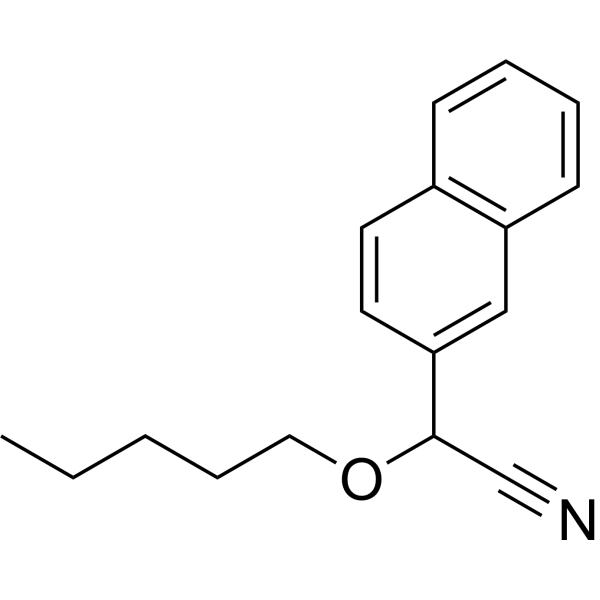 0 ImagesCat. No.: HY-D0138CAS No.: 500372-26-92-(Naphthalen-2-yl)-2-(pentyloxy)acetonitrile is a multifunctional dye. Dyes are important tools in biological experiments. They can help researchers observe and analyze cell structures, track biomolecules, evaluate cell functions, distinguish cell types, detect biomolecules, study tissue pathology and monitor microorganisms. Their applications range from basic scientific research to clinical A wide range of diagnostics. Dyes are also widely used in traditional fields such as textile dyeing, as well as in emerging fields such as functional textile processing, food pigments and dye-sensitized solar cells.
-
Fluo-3 ammonium
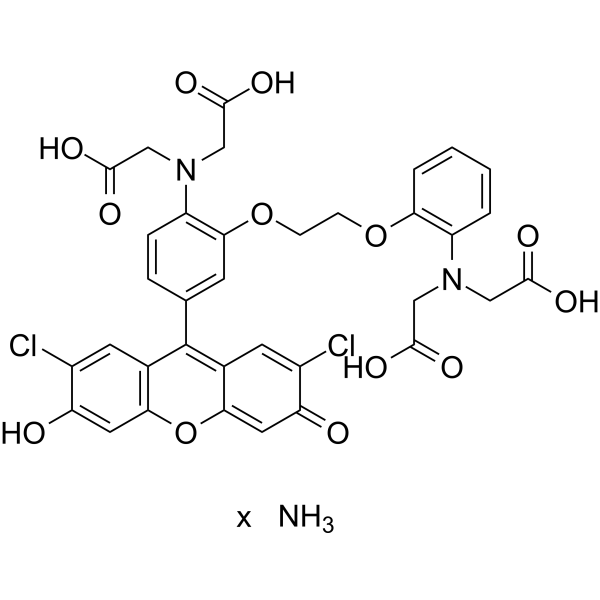 0 ImagesCat. No.: HY-W127795CAS No.: 134907-84-9Fluo-3 ammonium is a cell-impermeable calcium ion (Ca2+) indicator. Fluo-3 ammonium itself is not fluorescent, but it becomes fluorescent after binding to calcium ions (Ex/Em = 488/525 nm).
-
CouCyCF3
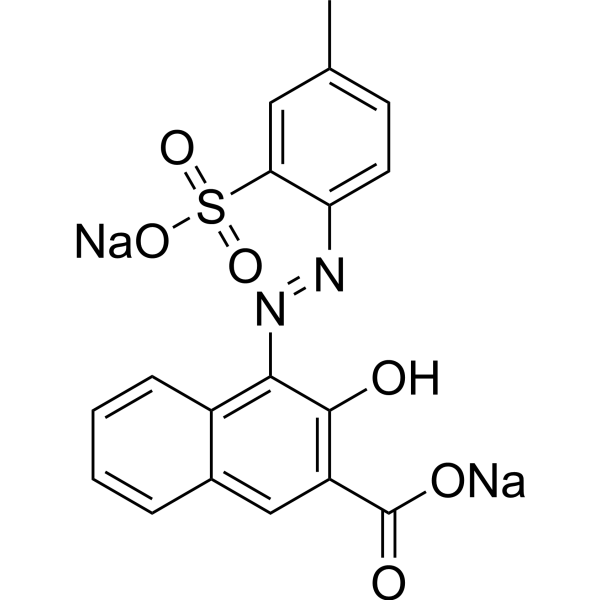
 0 ImagesCat. No.: HY-D3400CouCyCF3 is a fluorescent probe for bacterial cytoplasmic pH, with a pKa of 7.0. CouCyCF3 can be taken up by both Gram-positive and Gram-negative bacteria. Under acidic conditions, the fluorescence of CouCyCF3 in the red channel increases, while its fluorescence in the blue channel increases with elevated pH. A linear quantitative response is achieved via the I_red/I_blue ratio within the pH range of 5.0-7.5, with excitation/emission wavelengths of 445/472 nm (blue) and 640/708 nm (red). CouCyCF3 can be used for studies on bacterial acid tolerance and phagolysosome acidification.
-
Cy3 labled Nedosiran sodium
 0 ImagesCat. No.: HY-132606ECy3 labled Nedosiran sodium is a Cy3 labled Nedosiran sodium.
-
IR 750 Maleimide
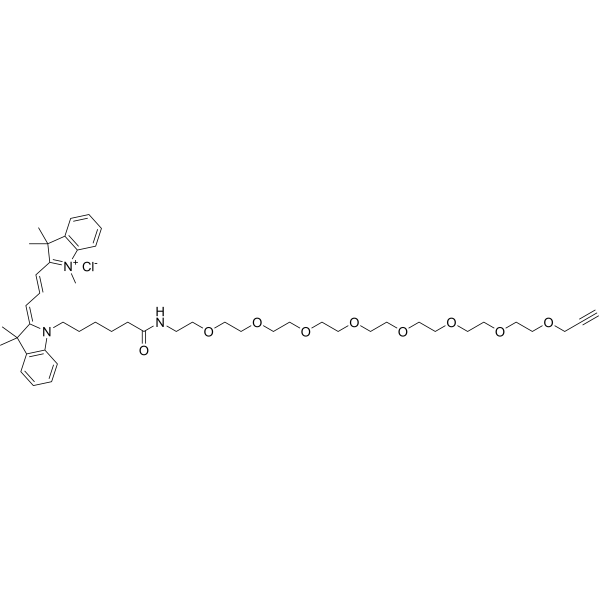
 0 ImagesCat. No.: HY-D3270IR 750 Maleimide is a near-infrared fluorescent dye composed of IRDye 750 near-infrared fluorophore and maleimide reactive group. IR 750 Maleimide can be applied to fluorescent labeling, imaging and detection.
-
FAM labled Salanersen sodium
 0 ImagesCat. No.: HY-177661CFAM labled Salanersen sodiumis a FAM labled Salanersen sodium.
-
Methyl red hydrochloride
 0 ImagesCat. No.: HY-W145108CAS No.: 63451-28-5Methyl red hydrochloride is a pH-sensitive acid-base indicator and colorimetric reagent with a pKa of 5.1. Methyl red hydrochloride achieves visual judgment of the titration endpoint through reversible structural changes of protonation (red, pH < 4.4) and deprotonation (yellow, pH > 6.2). Methyl red hydrochloride is widely used in acid-base titration in chemical analysis and buffer pH monitoring in biochemistry.
-
4Arm-PEG2000-RB
 0 ImagesCat. No.: HY-D2894Synonyms: 4Arm-PEG2000-Rhodamine B4Arm-PEG2000-RB (4Arm-PEG2000-Rhodamine B) is a fluorescent dye composed of Rhodamine B (HY-Y0016) and PEG with a four-arm structure. 4Arm-PEG2000-RB can be used for drug delivery and fluorescence imaging (Ex/Em=546/610 nm).
-
ATTO 594 NHS ester
 0 ImagesCat. No.: HY-D1929ATTO 594 NHS ester is a new fluorescent marker based on the Rhodamine structure. It has strong absorption, high fluorescence quantum yield, high thermal stability and photochemical stability, and is suitable for single molecule detection and high-resolution microscopy. ATTO 594 NHS ester is an NHS ester derivative of ATTO 594 that can be used to label proteins or antibodies.
-
5-TAMRA-Terazine
 0 ImagesCat. No.: HY-W716774CAS No.: 1393381-53-75-TAMRA-Terazine is a fluorescent dye that combines 5-TAMRA (HY-15942) with a Terazine group. 5-TAMRA-Terazine is a click chemistry reagent, it contains a Tetrazine group that can undergo an inverse electron demand Diels-Alder reaction (iEDDA) with molecules containing TCO groups (Ex/Em = 541/567 nm).
-
Mag-Fura-2 AM
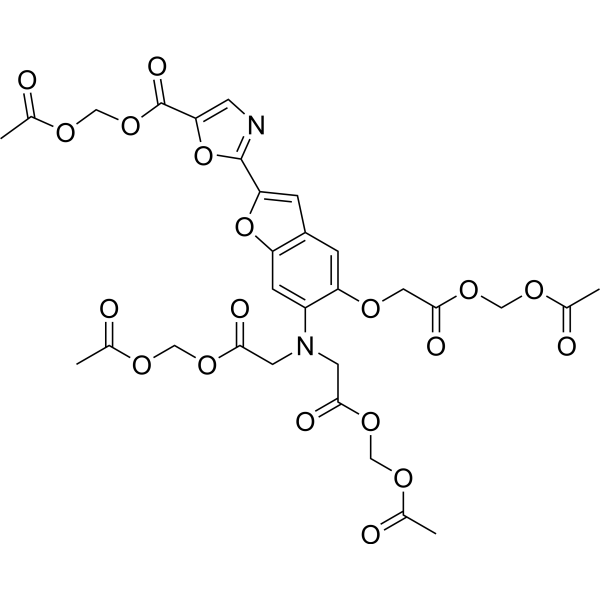 0 ImagesCat. No.: HY-D1701CAS No.: 130100-20-8Calcium is an important part of the human body, usually in the form of calcium, a large number of bones and teeth of the human body, a small amount of blood and tissues. MCE calcium ion detection probe can specifically identify intracellular calcium ions, with high sensitivity, low cytotoxicity, increased AM acetylmethyl ester can enter the cell well, after being sheared by the intracellular esterase stay in the cell to bind to calcium ions, produce strong fluorescence, in addition, Mag-indo-1/AM and Mag-Fluo-4 AM at a certain concentration (usually 5 mM) can effectively identify intracellular magnesium ions.




