



Fluorescent Dye
Fluorescence is a phenomenon of photoluminescence in luminescence. When an atom is irradiated by light, some electrons around the nucleus jump from their original orbitals to higher energy orbitals under the influence of light energy, i.e., from the ground state to the first or second excited single-line state, etc. Due to the instability of the first or second excited singlet state, the electron returns from the excited singlet state to the ground state accompanied by released energy, resulting in fluorescence.
Fluorescent dyes can be covalently bound or physically adsorbed in the structure of the substance. The fluorescence properties allow for the characterization, localization and quantitative analysis of the labeled object. Fluorescent dyes have shown great potential for the detection of proteins, nucleic acids, cells, and immunoassays, attributed to the advantages in non-radioactive contamination, simple experimental operation and easy observation.
Fluorescent dyes have penetrated many fields such as pharmacology, physiology, environmental science, and information science, as well as functional studies of proteins and drug screening.
All Product Categories
-
Fluorescent Dye Related Products (4914)
Related Products (4914)

-
Antibodies (4)
-
5-JOE azide, CHC protected
 0 ImagesCat. No.: HY-D35045-JOE azide, CHC-protected, is a derivative of JOE. It features an azide group for use in click chemistry reactions (CuAAC) and a CHC (cyclohexylcarbodiimide) protecting group for stable oligonucleotide synthesis. 5-JOE azide, CHC-protected, is suitable for click chemistry-based bioconjugation (Ex/Em = 520/548 nm) .
-
5(6)-carbonylated rhodamine 110 maleimide
 0 ImagesCat. No.: HY-D30525(6)-carbonylated rhodamine 110 maleimide is a maleimide-based fluorescent reagent based on 5(6)-carbonylated rhodamine 110. Maleimide can be labeled by forming a stable thioester structure through an affinity addition reaction with a thiol group (-SH) (Ex/Em = 502/527 nm).
-
FAM labled ISIS 104838 sodium
 0 ImagesCat. No.: HY-145726DFAM labled ISIS 104838 sodiumis a FAM labled ISIS 104838 sodium.
-
Flutax 1
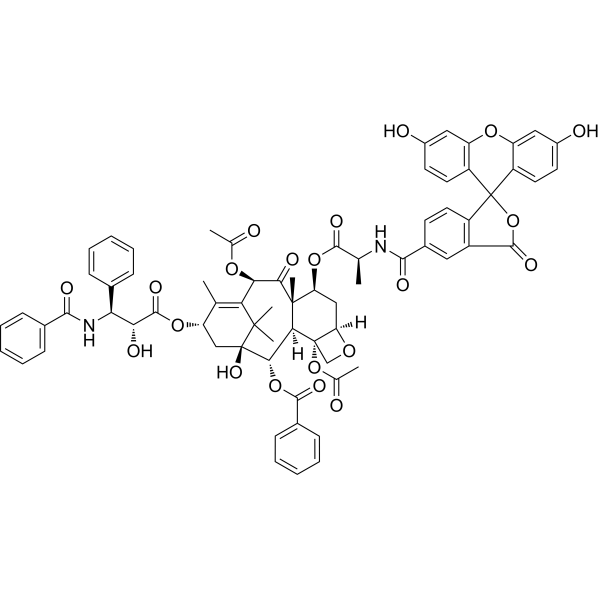 0 ImagesCat. No.: HY-107629CAS No.: 191930-58-2Flutax 1 is a fluorescent Paclitaxel (HY-B0015) derivative, which can be used for microtubule staining (Ex/Em = 495 nm/520 nm).
-
6,7-Dimethoxy-4-coumarinylacetic acid
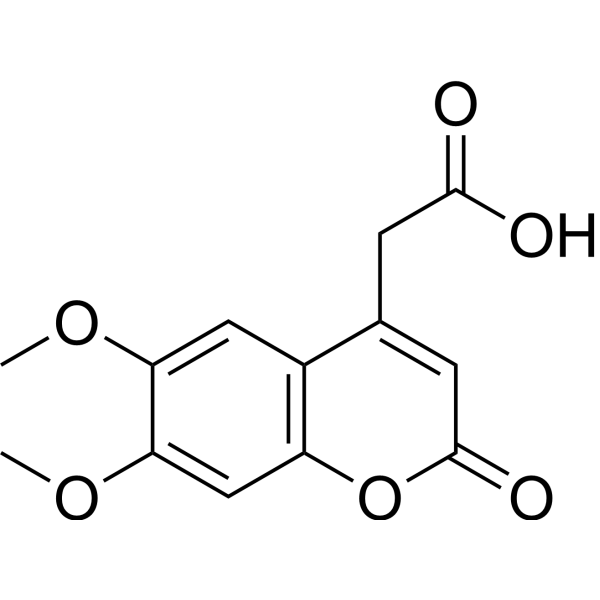 0 ImagesCat. No.: HY-D0065CAS No.: 88404-26-6Synonyms: 2-(6,7-Dimethoxy-2-oxo-2H-chromen-4-yl)acetic acid6,7-Dimethoxy-4-coumarinylacetic acid (2-(6,7-Dimethoxy-2-oxo-2H-chromen-4-yl)acetic acid) is a multifunctional dye. Dyes are important tools in biological experiments. They can help researchers observe and analyze cell structures, track biomolecules, evaluate cell functions, distinguish cell types, detect biomolecules, study tissue pathology and monitor microorganisms. Their applications range from basic scientific research to clinical A wide range of diagnostics. Dyes are also widely used in traditional fields such as textile dyeing, as well as in emerging fields such as functional textile processing, food pigments and dye-sensitized solar cells.

-
12-NBD Stearate
 0 ImagesCat. No.: HY-N15885CAS No.: 117056-67-412-NBD Stearate is a fluorescent fatty acid analogue. 12-NBD Stearate binds to fatty acid binding protein (FABP) and sterol carrier protein-2 (SCP-2). Overexpressing sterol carrier protein-2 (SCP-2) 15-kDa isoform enhances 12-NBD Stearate transport. 12-NBD Stearate is a tool for microscopic long chain fatty acids (LCFA) uptake and internalization studies.
-
Datura Stramonium Lectin (Fluorescein)
 0 ImagesCat. No.: HY-NP097Synonyms: DSL (Fluorescein)Datura Stramonium Lectin (DSL) Fluorescein is a plant lectin that can be used as a probe to specifically bind biomolecules (such as polysaccharides, peptides, etc.).Datura Stramonium Lectin (DSL) Fluorescein is a biological material or organic compound that can be used in life science research.

-
Sambucus Nigra Lectin-AF680
 0 ImagesCat. No.: HY-NP080ISynonyms: SNA-AF680Sambucus Nigra Lectin-AF680 (SNA-AF680) is a phytohemagglutinin labeled with AF680, which can be used as a probe to specifically bind to biomolecules (such as polysaccharides and peptides). Sambucus Nigra Lectin-AF680 precisely locates the distribution of glycan chains on the cell surface through stable fluorescence signals, and can be used for glycobiology research (Ex/Em = 684/707 nm).
-
NE11808
 0 ImagesCat. No.: HY-113933CAS No.: 105462-22-4NE11808 is a potent antiresorptive bisphosphonate that inhibits osteoclast prenylation and effectively inhibits protein prenylation in osteoclasts and suppresses labeling of dye-front end compounds.
-
Cy3 labled IONIS PTP1BRx sodium
 0 ImagesCat. No.: HY-159694DCy3 labled IONIS PTP1BRx sodium is a Cy3 labled IONIS PTP1BRx sodium.
-
Cyanine 7.5 DBCO chloride
 0 ImagesCat. No.: HY-N16324CAS No.: 3091879-62-5
-
BTC tetrapotassium
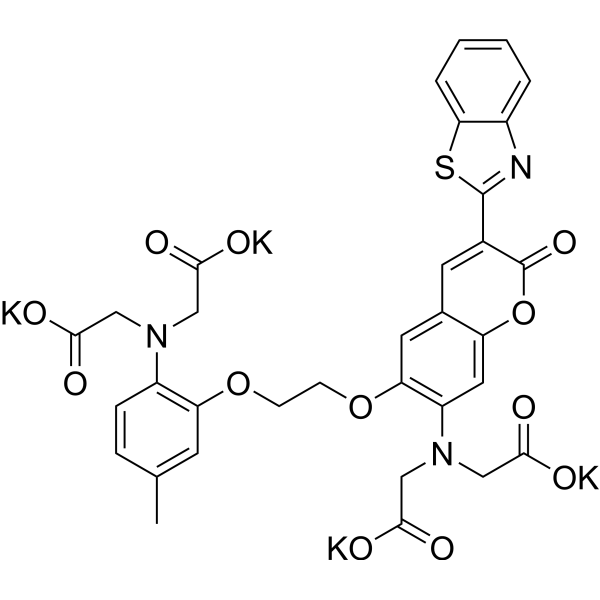 0 ImagesCat. No.: HY-137128CAS No.: 216453-54-2BTC tetrapotassium is a cell-impermeant calcium indicator (Kd approximately 7-26 µM) featuring many desirable properties for cellular calcium imaging, including long excitation wavelengths (400/485 nm), low sensitivity to Mg2+, and accuracy of ratiometric measurement.
-
DA ZP1
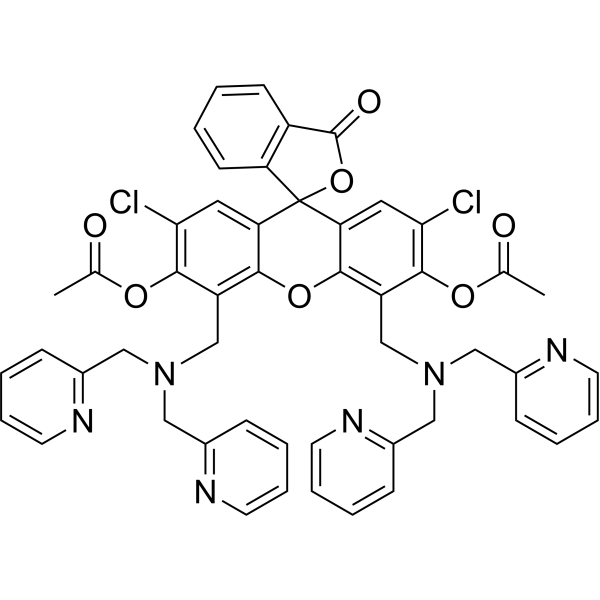 0 ImagesCat. No.: HY-162158CAS No.: 1816254-69-9DA ZP1 is a fluorogenic Zn(II) sensor (Kd Zn2+ = 0.6 nM). Ex / Em = 490 / 522 nm
-
CY5.5-PEG5000-Mal
 0 ImagesCat. No.: HY-D2374CY5.5-PEG5000-Mal is used for preparing fluorescently labeled molecules. It is formed by condensing maleimide groups (Mal), PEG5000, and fluorescent dye CY5.5 (HY-D0924).

-
RB-PEG400-FA
 0 ImagesCat. No.: HY-D2888Synonyms: Rhodamine B-PEG400-FARB-PEG400-FA (Rhodamine B-PEG400-FA) is a fluorescent dye composed of Rhodamine B (HY-Y0016), PEG and Folic acid (FA) (HY-16637). RB-PEG400-FA can be used for cell imaging, folate receptor targeting and detection (Ex/Em=546/610 nm).
-
Ala-Ala-Phe-AMC TFA
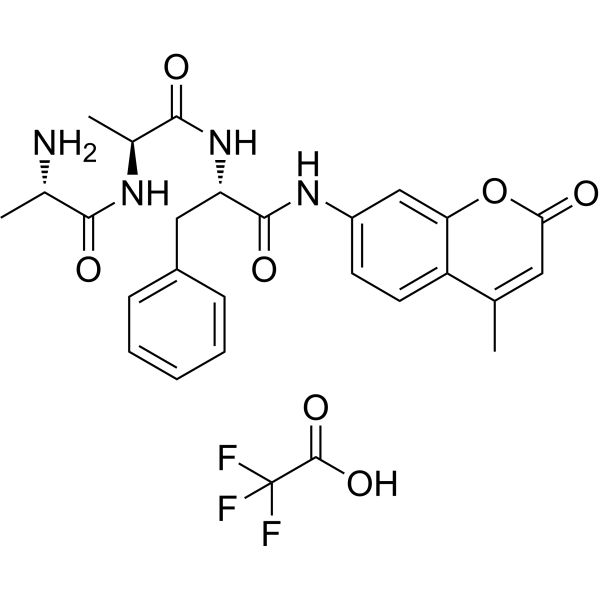 0 ImagesCat. No.: HY-137164ACAS No.: 62037-42-7Ala-Ala-Phe-AMC TFA is the TFA salt form for Ala-Ala-Phe-AMC. Ala-Ala-Phe-AMC TFA is a fluorogenic substrate, which is used to for tripeptidyl peptidase II (TPPII) activity determination.
-
MitoAIE1
 0 ImagesCat. No.: HY-D3119CAS No.: 2246946-49-4MitoAIE1 is a Fluorescent probe for mitochondrial viscosity detection. MitoAIE1 contains a pyridinium structural unit, which endows it with mitochondria-targeting specificity. The detection mechanism of this probe is based on aggregation-induced emission (AIE): in low-viscosity media such as PBS buffer, intramolecular rotation leads to non-radiative energy dissipation, resulting in only weak fluorescence; however, in high-viscosity environments such as the mitochondrial matrix or the vicinity of the inner mitochondrial membrane, such intramolecular motion is restricted, thereby significantly enhancing its fluorescent signal; in addition, this probe is not interfered by changes in microenvironment polarity and pH. Its emission wavelength is 625 nm, with absorption peaks at 325 nm and 450 nm; when transferred from low-viscosity PBS to high-viscosity 99% glycerol, its fluorescence intensity at 625 nm can be increased by 38-fold. It can be used to monitor changes in mitochondrial viscosity during processes such as Stauroporine (HY-15141)-induced apoptosis and starvation-induced mitophagy in live cells, and has good biocompatibility.




