



GLP Receptor
GLP Receptor
The GLP receptors contain two family members, GLP-1 receptor (GLP1R, or GLP-1R) and GLP-2 receptor (GLP2R or GLP-1R), activated by the glucagon-like peptides (GLPs). GLPs are s secreted by intestinal cells; causes insulin release; inhibits glucagon secretion, appetite, and energy intake; and delays gastric emptying because GLP receptors are located on the gut, pancreas, brainstem, hypothalamus, and vagal-afferent nerves. GLP-1 has only one known receptor, GLP1R, and regulates gut motility, appetite, islet function, and glucose homeostasis, whereas GLP-2, the agonist of GLP2R, enhances intestinal nutrient absorption. GLP-1R agonists are used to treat diabetes and obesity, and a GLP-2R agonist is approved to treat short bowel syndrome. An investigation of the actions of GLP receptor activation on gallbladder motility has demonstrated that GLP-2 receptor activation increases gallbladder volume in vivo and decreases spontaneous activity in GBSM bundles ex vivo. Like the inhibitory transmitters, which elicit their actions via an adenylate cyclase-protein kinase A-KATP channel pathway, the GLP-2 receptor signals through this same pathway.
All Product Categories
-
GLP Receptor Inhibitors
(17)
View all products
-
GLP Receptor Agonists
(148)
View all products
-
GLP Receptor Antagonists
(9)
View all products
-
GLP Receptor Activators
(14)
View all products
-
GLP Receptor Modulators
(8)
View all products
-
GLP Receptor Inducer
(1)
View all products
-
GLP Receptor Degrader
(1)
View all products
-
GLP Receptor Controls
(2)
View all products
-
GLP Receptor Ligands
(2)
View all products
-
GLP Receptor Related Products (232)
Related Products (232)

-
Antibodies (1)
-
Liraglutide acetate
 0 ImagesCat. No.: HY-P0014ACAS No.: 1997361-86-0Liraglutide acetate is the acetate form of Liraglutide (HY-P0014), a glucagon-like peptide-1 (GLP-1) receptor agonist studied in type 2 diabetes.
-
BMS-986118
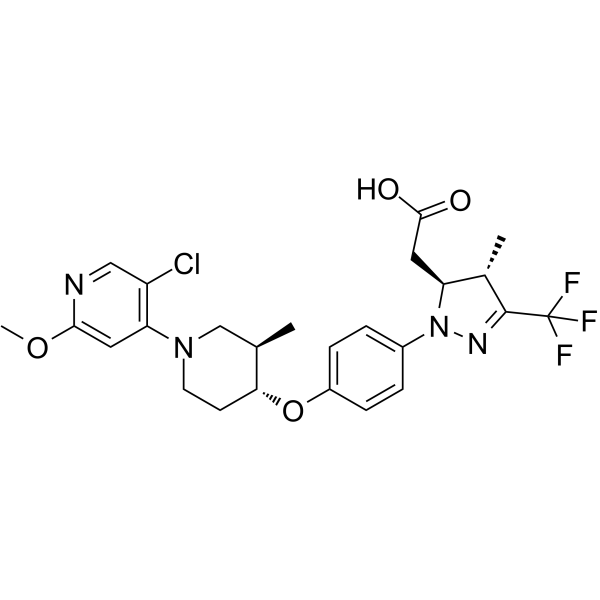 0 ImagesCat. No.: HY-12413ACAS No.: 1610562-74-7BMS-986118 is an orally active and selective GPR40 full agonist (EC50 = 0.07 μM). BMS-986118 induces GLP-1 secretion and increases GLP-1 and insulin levels when combined with DPP-4 inhibitors. BMS-986118 shows sustained glucose-lowering effects. BMS-986118 can be used for research on type 2 diabetes.
-
d-GLP-2 E33A
 0 ImagesCat. No.: HY-P10842d-GLP-2 E33A is an agonist for the glucagon-like peptide 2 receptor (GLP-2R) with an EC50 of 414 nM. d-GLP-2 E33A can activate GLP-2R and increase the phosphorylation of AKT, but has no stimulative effect on GLP-1R. d-GLP-2 E33A can be used in the study of diseases such as intestinal malabsorption and inflammatory bowel diseases.
-
UTG-4
 0 ImagesCat. No.: HY-P11487UTG-4 is a GLP-1R, GIPR, and GCGR agonist with EC50 values of 126.3 pM, 29.2 pM, and 250.2 pM, respectively. UTG-4 binds to HSA (Kd = 14.6 μM). UTG-4 effectively alleviates endothelial-mesenchymal transition. UTG-4 promotes weight loss, inhibits food intake, improves glucose tolerance, and has a significant anti-atherosclerotic effect.
-
GLP-1R-agonist-43
 0 ImagesCat. No.: HY-182502CAS No.: 3092659-72-5GLP-1R-agonist-43 (Compound A) is an orally active GLP-1R agonist with an EC50 of 2.68 nM. GLP-1R-agonist-43 can be used in the research of non-insulin-dependent diabetes mellitus (type 2 diabetes) and obesity.
-
GLP-1R agonist 36
 0 ImagesCat. No.: HY-178769CAS No.: 3084713-99-2GLP-1R agonist 36 (Compound 53) is a GLP-1R agonist with a total of four isomers. GLP-1R agonist 36 can be used for the studies of diabetes and obesity.
-
LXT34
 0 ImagesCat. No.: HY-176838CAS No.: 1609286-95-4LXT34 (Example 2) is a GPR120 agonist. LXT34 has an anti-inflammatory activity. LXT34 promotes GLP-1 formation in the gastrointestinal tract and improves insulin resistance in macrophages and pancreas cells. LXT34 can be used for inflammatory diseases, such as type 2 diabetes, obesity and non-alcoholic fatty liver research.
-
GLP-1R agonist 42
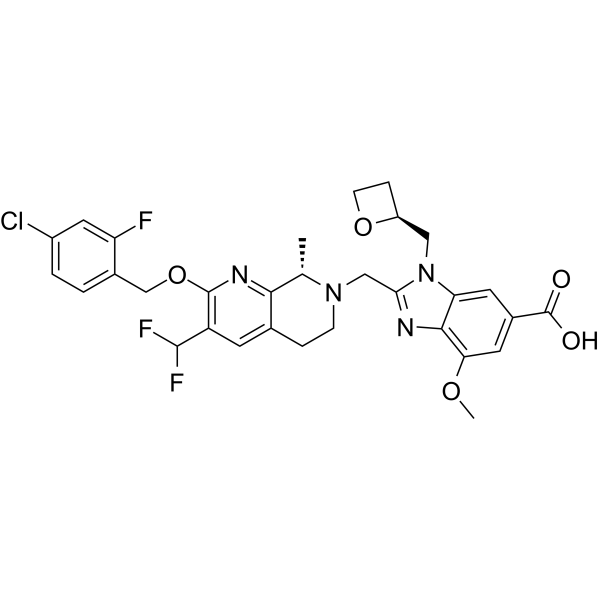 0 ImagesCat. No.: HY-162434CAS No.: 3033288-23-9GLP-1R agonist 42 is an agonist for glucagon-like peptide-1 receptor (GLP-1 receptor), with EC50 of 0.0122 nM.
-
DA5-CH
 0 ImagesCat. No.: HY-P12141CAS No.: 2227651-65-0Synonyms: KP405DA5-CH (KP405) is a blood-brain barrier-permeable GLP-1/GIP receptor agonist. DA5-CH activates GLP-1 and GIP receptors, inhibits the NF-κB inflammatory pathway, reduces α-synuclein (α-synuclein) levels, restores the expression of tyrosine hydroxylase and neurotrophic factors, improves motor function, decreases amyloid plaques and phosphorylated tau protein levels in the hippocampus, restores synaptic plasticity, regulates the PI3K/AKT/GSK3β and CREB signaling pathways, and alleviates mitochondrial stress. DA5-CH can be used for research on Parkinson's disease and Alzheimer's disease.

-
TC2
 0 ImagesCat. No.: HY-P11279TC2 is an efficient GIPR-preferring monomeric quadruple agonist that can respectively activate GIPR, GLP-1R, GcgR, and Y2R with IC50 values of 0.47, 2.1, 30, and 55 nM respectively. TC2 exhibits a significant GLP-1R preference, with a significant reduction in β-inhibitory protein 2 (βArr2) recruitment, while maintaining a strong cAMP signal. TC2 can be used for research on obesity and diabetes.
-
Erzemdutide
 0 ImagesCat. No.: HY-P11667CAS No.: 3061135-14-3
-
Semaglutide, Cy5 labeled
 0 ImagesCat. No.: HY-114118F5Synonyms: Semaglutide-Cys(Cy5)Semaglutide, Cy5-labeled (Semaglutide-Cys(Cy5)) is a CY5 (HY-D0821) -labeled version of Semaglutide (HY-114118) (Ex/Em = 633/670 nm). Semaglutide, Cy5-labeled can be used for studies on Semaglutide receptor binding (GLP-1R), cellular uptake and endocytosis, in vivo tissue distribution, and the targeting efficiency of delivery systems.
-
Berobenatide
 0 ImagesCat. No.: HY-P11235CAS No.: 3028974-74-2Synonyms: PF-08653944; MET-097Berobenatide (PF-08653944; MET-097) is a GLP-1R agonist that exerts functional regulation of GLP-1R biased toward the Gs protein signaling pathway. Berobenatide induces weight loss in diet-induced obese mice. Berobenatide can be used in obesity-related research.
-
GCGR/GLP‐1 receptor agonist P1
 0 ImagesCat. No.: HY-P12143GCGR/GLP‐1 receptor agonist P1 is a dual GCGR/GLP-1R agonist. GCGR/GLP‐1 receptor agonist P1 activates human GCGR in vitro and induces the cyclic adenosine monophosphate (cAMP) signaling pathway. GCGR/GLP‐1 receptor agonist P1 is applicable to research related to type 2 diabetes and obesity.
-
2-Oleoylglycerol-d5
 0 ImagesCat. No.: HY-W701772CAS No.: 946524-37-4Synonyms: 2-OG-d52-Oleoylglycerol-d5 (2-OG-d5) is the deuterium labeled 2-Oleoylglycerol (HY-W011121). 2-Oleoylglycerol (2-OG) is a lipid found in the diet. It is a GPR119 agonist, with an EC50 value of 2.5 μM in activating hGPR119 in transiently transfected COS-7 cells. 2-Oleoylglycerol enhances the inflammatory response of macrophages and promotes fibrosis by activating the GPR119/TAK1/NF-κB/TGF-β1 signaling pathway. It also stimulates glucagon-like peptide 1 (GLP-1) secretion in vivo. 2-Oleoylglycerol is expected to be used in the research of non-alcoholic steatohepatitis (NASH) .
-
GLP-1R agonist 23
 0 ImagesCat. No.: HY-161915CAS No.: 2855245-46-2GLP-1R agonist 23 (Example 376) is a GLP-1R agonist with an EC50 of 0.056 nM. GLP-1R agonist 23 can be used in diabetes research.
-
GLP-1R agonist 13
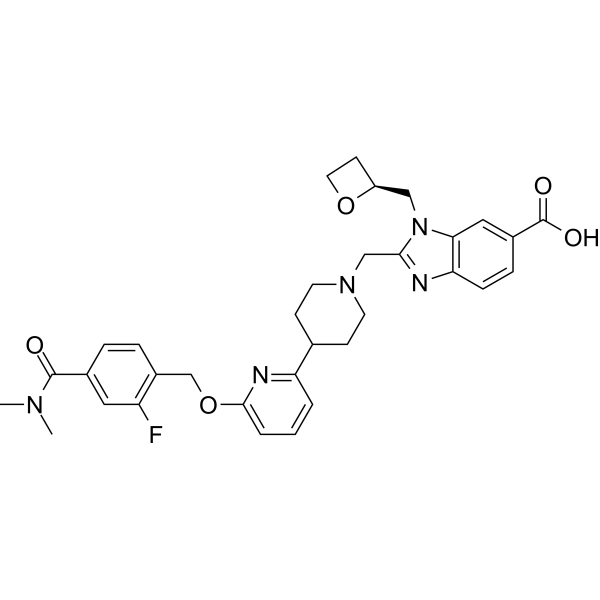 0 ImagesCat. No.: HY-147626CAS No.: 2768016-72-2GLP-1R agonist 13 (Compound 24) is a GLP-1 receptor agonist.
-
Carmegliptin hydrochloride
 0 ImagesCat. No.: HY-10289ACAS No.: 813452-14-1Synonyms: RO-4876904 hydrochlorideCarmegliptin hydrochloride (RO-4876904 hydrochloride) is an orally active and potent DPP‑IV inhibitor with a human DPP‑IV IC50 of 6.8 nM. Carmegliptin hydrochloride binds to the S1 pocket of DPP‑IV, blocks the degradation of GLP‑1, potentiates endogenous GLP‑1, increases plasma insulin levels, alleviates hyperglycemia, improves glucose tolerance. Carmegliptin hydrochloride acts as a substrate for human P‑glycoprotein without inhibiting the transporter, shows low in vitro cell permeability. Carmegliptin hydrochloride can be used for the research of type 2 diabetes, non‑insulin‑dependent diabetes mellitus.
-
(Asp28)-Glucagon (1-29) (human, rat, porcine)
 0 ImagesCat. No.: HY-P4389CAS No.: 1037751-81-7(Asp28)-Glucagon (1-29) (human, rat, porcine) is a glucagon analog and a GCGR agonist, with the Asn at position 28 replaced by Asp. (Asp28)-Glucagon (1-29) (human, rat, porcine) activates GCGR-mediated cAMP signaling, with EC50 values of 0.067 nM and 0.09 nM, respectively, and an EC50 of 7.99 nM for GLP-1R. (Asp28)-Glucagon (1-29) (human, rat, porcine) is useful for studies on glucagon receptor signaling, carbohydrate metabolism, and hypoglycemia.




