



Isotope-Labeled Compounds
Isotope-labeled compounds are chemical substances in which some atoms in their molecules are replaced by isotope atoms. The range of stable isotope products can cover from gases to complex molecules. Isotope-labeled compounds could provide a site-specific investigation of structures, making molecules easily detectable by mass spectrometry and NMR, and maintaining the physico-chemical properties of the target molecule at the same time.
MCE isotope-labeled compounds are all stable isotope-labeled compounds and are non-radioactive labeled substances. MCE isotope-labeled compounds are unique tools for identifying and understanding biological and chemical processes. Stable isotope-labeled products are now getting more and more popular among scientists. The scope of application is gradually penetrating into various scientific fields, such as life sciences, food and medicine, agriculture, environment, geology, etc. Stable isotope-labeled compounds have a wide range of applications in the Life Science areas, such as Metabolomics, Proteomics, Clinical studies, Deuterium drugs, etc.
All Product Categories
-
Isotope-Labeled Compounds Related Products (11051)
Related Products (11051)

-
Oxindole-3-acetic acid-13C6
 0 ImagesCat. No.: HY-W746828CAS No.: 2724918-56-1Oxindole-3-acetic acid-13C6 is 13C labeled Oxindole-3-acetic acid.
-
Dibenzo-p-dioxin-13C12
 0 ImagesCat. No.: HY-W094748S1CAS No.: 125749-32-8Dibenzo-p-dioxin-13C12 is 13C labeled Dibenzo[b,e][1,4]dioxin.
-
Cefiderocol-d6
 0 ImagesCat. No.: HY-17628S1Synonyms: S-649266-d6Cefiderocol-d6 (S-649266-d6) is a deuterated labeled Cefiderocol (HY-17628). Cefiderocol is a siderophore cephalosporin which has a potent activity against a broad range of aerobic Gram-negative bacterial species with MIC50s of 2 μg/mL or less.
-
Methylergonovine-13C,d3
 0 ImagesCat. No.: HY-144507SMethylergonovine-13C,d3 is 13C and deuterium labeled Methylergonovine.
-
2-Chloronaphthalene-d7
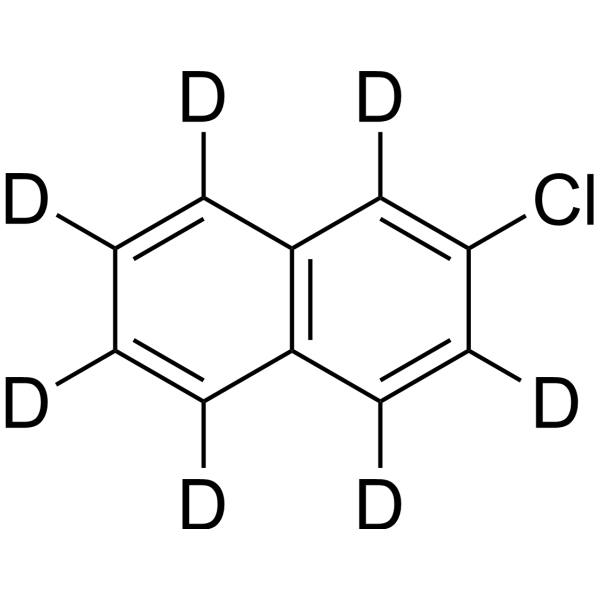 0 ImagesCat. No.: HY-124451SCAS No.: 93951-84-92-Chloronaphthalene-d7 is the deuterium labeled 2-Chloronaphthalene.
-
Primaquine-d3 diphosphate
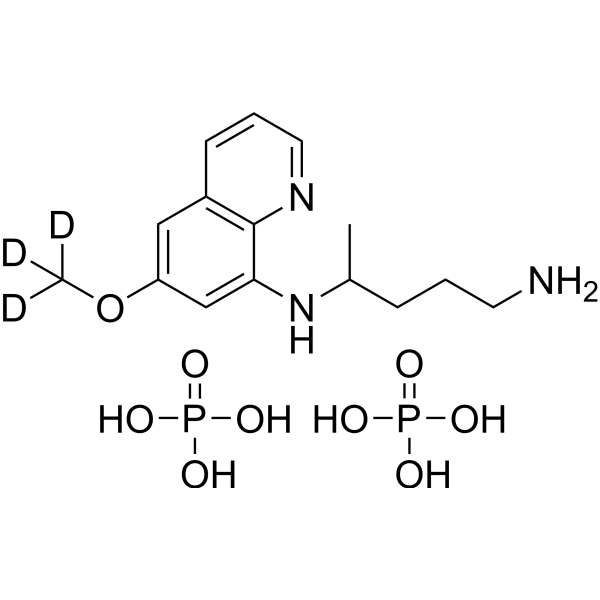 0 ImagesCat. No.: HY-12651SPrimaquine-d3 (diphosphate) is the deuterium labeled Primaquine diphosphate. Primaquine Diphosphate (Primaquine phosphate), an 8-aminoquinoline, exerts a broad spectrum of activities against various stages of parasitic malaria. Primaquine Diphosphate remains as the only agent that destroys late hepatic stages and latent tissue forms of Plasmodium vivax and Plasmodium ovale.
-
Pimozide-d5 N-Oxide
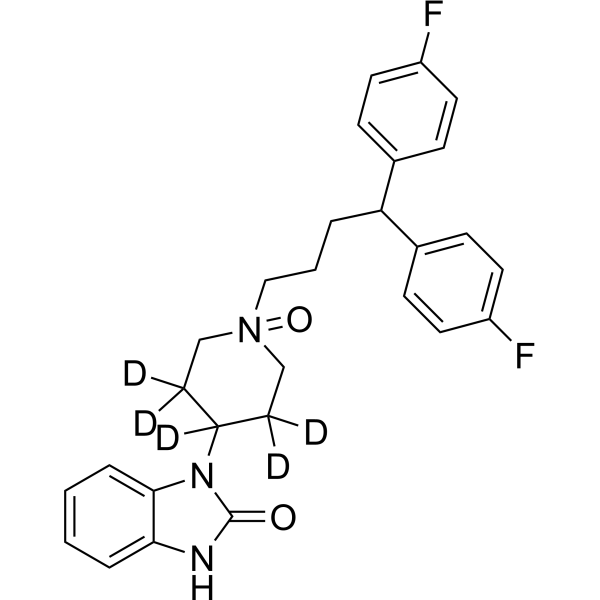 0 ImagesCat. No.: HY-12987S1CAS No.: 1794795-40-6Pimozide-d5 N-Oxide is the deuterium labeled Pimozide. Pimozide is a dopamine receptor antagonist, with Kis of 1.4 nM, 2.5 nM and 588 nM for dopamine D2, D3 and D1 receptors, respectively, and also has affinity at α1-adrenoceptor, with a Ki of 39 nM; Pimozide also inhibits STAT3 and STAT5.
-
Cetalkonium chloride-d7
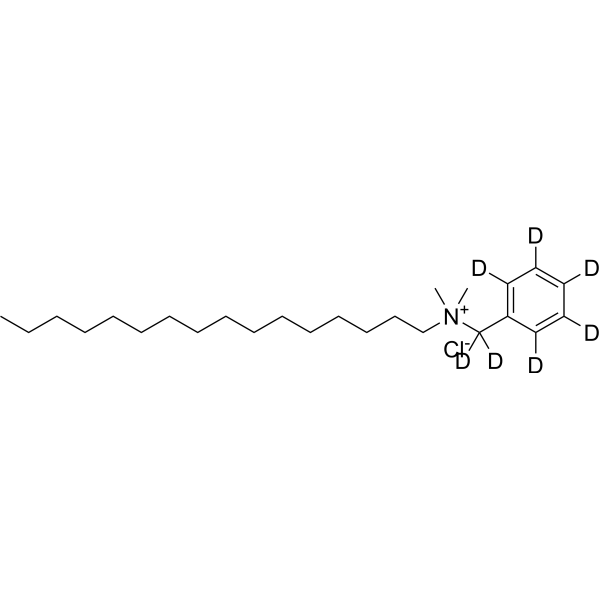 0 ImagesCat. No.: HY-132486SCAS No.: 1998128-85-0Synonyms: Benzyldimethylhexadecylammonium chloride-d7Cetalkonium Chloride-d7 is the deuterium labeled Cetalkonium Chloride.
-
N-Acetyl-S-(N-methylcarbamoyl)-L-cysteine-d3
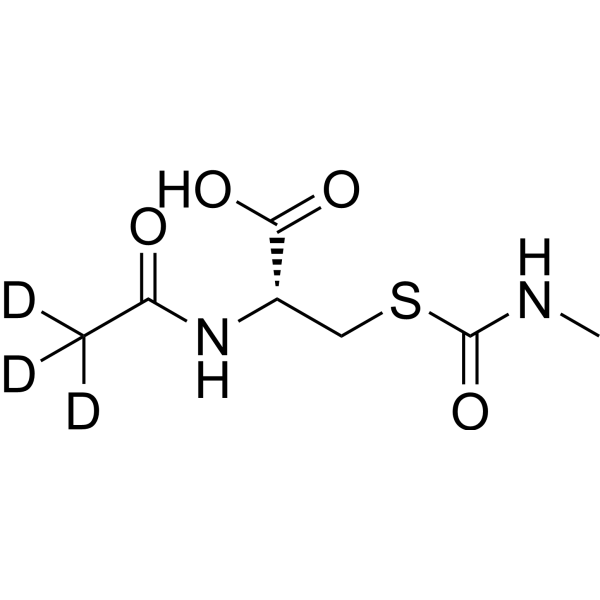 0 ImagesCat. No.: HY-144408SCAS No.: 131685-10-4N-Acetyl-S-(N-methylcarbamoyl)-L-cysteine-d3 is the deuterium labeled N-Acetyl-S-(N-methylcarbamoyl)-L-cysteine.
-
12-(Methyl)tridecanal-d7
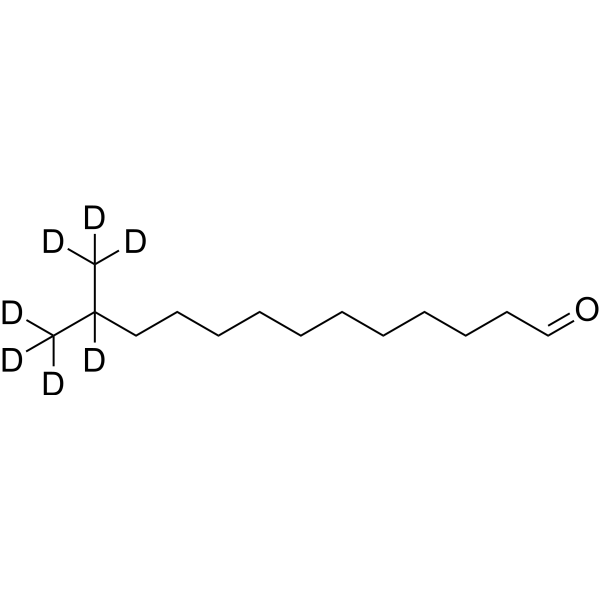 0 ImagesCat. No.: HY-W703502CAS No.: 1794760-14-712-(Methyl-d3)tridecanal-12,13,13,13-d4 is deuterated labeled 12-(Methyl)tridecanal-12,13,13,13.
-
2,2′,3,3′,4,4′,5,5′,6-Nonabromo diphenyl ether-13C12
 0 ImagesCat. No.: HY-W587423S2,2′,3,3′,4,4′,5,5′,6-Nonabromo diphenyl ether-13C12 is 13C labeled 2,2′,3,3′,4,4′,5,5′,6-Nonabromodiphenyl ether.
-
5-Dehydro Tolvaptan-d7
 0 ImagesCat. No.: HY-131679SCAS No.: 1296212-29-75-Dehydro Tolvaptan-d7 is the deuterium labeled 5-Dehydro Tolvaptan.
-
7-Nor-7-carboxycannabidiol-d10
 0 ImagesCat. No.: HY-157061S7-Nor-7-carboxycannabidiol-d10 is deuterium-labeled 7-Nor-7-carboxycannabidiol.
-
2-Hydroxy-3-(4-methylphenyl)propanoic acid-d3
 0 ImagesCat. No.: HY-W185139S2-Hydroxy-3-(4-methylphenyl)propanoic acid-d3 is deuterium-labeled 2-Hydroxy-3-(4-methylphenyl)propanoic acid (HY-W185139).
-
Sulfanitran-d4
 0 ImagesCat. No.: HY-B0947SCAS No.: 1794753-46-0Sulfanitran-d4 is the deuterium labeled Sulfanitran. Sulfanitran is an antibacterial and anticoccidial agent used in poultry feeds. Sulfanitran also is a multidrug resistance protein 2 (MRP2) stimulator that can increase the affinity of MRP2 for estradiol-17-β-D-glucuronide (E217βG).
-
3-Fluoro-4-(hydroxymethyl)benzonitrile-d2
 0 ImagesCat. No.: HY-W001260SCAS No.: 2641114-12-5Synonyms: 4-Cyano-2-fluorobenzyl alcohol-d23-Fluoro-4-(hydroxymethyl)benzonitrile-d2 is the deuterium labeled 3-Fluoro-4-(hydroxymethyl)benzonitrile (HY-W001260).
-
Hydroxy Atrazine-d5
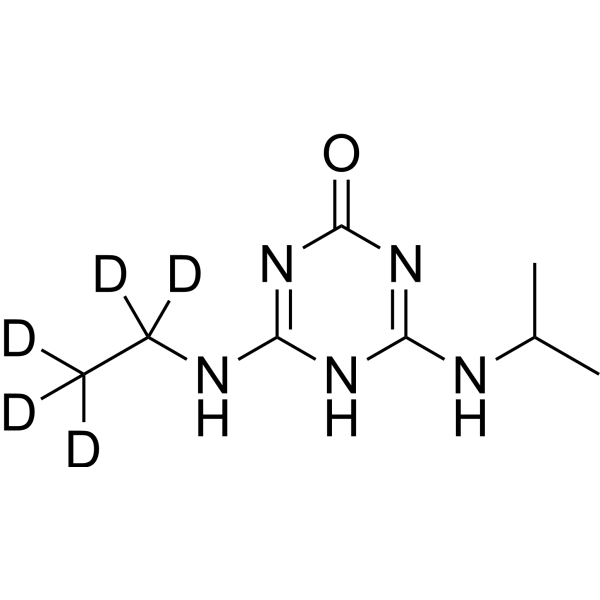 0 ImagesCat. No.: HY-132394SCAS No.: 1276197-25-1Hydroxy Atrazine-d5 is the deuterium labeled Hydroxy Atrazine.
-
C16 Ganglioside GM3-d9 ammonium salt
 0 ImagesCat. No.: HY-165665SC16 Ganglioside GM3-d9 (ammonium salt) is deuterium labeled C16 Ganglioside GM3 (ammonium salt).
-
Phenylpiperazine-d4
 0 ImagesCat. No.: HY-W705067CAS No.: 2089332-74-9Synonyms: 1-Phenylpiperazine-d4; N-phenyl piperazine-d4Phenylpiperazine-d4 (1-Phenylpiperazine-d4) is the deuterium labeled Phenylpiperazine.
-
Avapritinib-d3
 0 ImagesCat. No.: HY-W754911CAS No.: 2408934-57-4Synonyms: BLU-285-d3Avapritinib-d3 (BLU-285-d3) is deuterium labeled Avapritinib. Avapritinib (BLU-285) is a highly potent, selective, and orally active KIT and PDGFRA activation loop mutant kinases inhibitor with IC50s of 0.27 and 0.24 nM for KIT D816V and PDGFRA D842V, respectively. Avapritinib (BLU-285) binds the active conformation of the kinase and shows antitumor activity. Avapritinib (BLU-285) attenuates the transport function of both ABCB1 and ABCG2.



