



Liposome
Liposomes (NPs typically 100–500 nm in diameter) are fabricated from the self-assembly of phospholipids, which consist of a polar phosphate head group and hydrophobic lipid tails. In aqueous environments, the hydrophobic tails self-orient, resulting in a spherical structure comprised of an aqueous core surrounded by a lipophilic bilayer membrane. Liposomes are both biocompatible and biodegradable (e.g., at certain pH and temperature), which can be controlled by modifying the lipid composition. Furthermore, liposomes are amenable to various modifications that improve their efficacy as drug delivery carriers.
All Product Categories
-
Liposome Related Products (1266)
Related Products (1266)

-
C20 Sphingomyelin (d18:1/20:1)
 0 ImagesCat. No.: HY-N15352CAS No.: 222403-67-0C20 Sphingomyelin (d18:1/20:1) is a sphingomyelin substance. The level of C20 Sphingomyelin (d18:1/20:1) is associated with amyotrophic lateral sclerosis and primary lateral sclerosis.
-
DSPE-PEG5000-Cy3
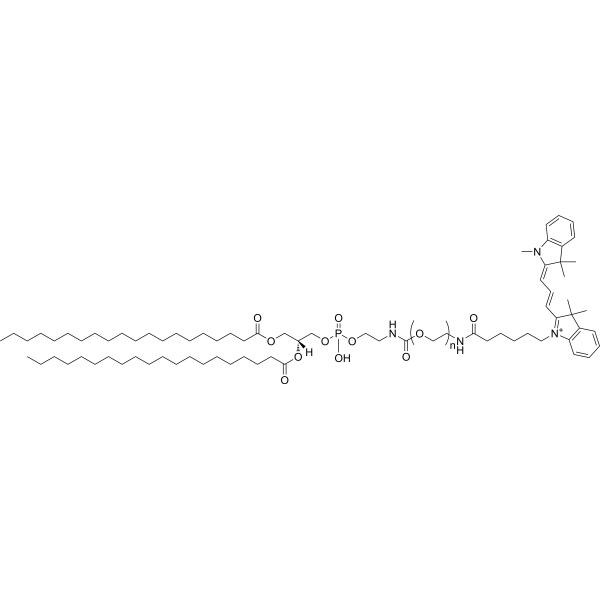 0 ImagesCat. No.: HY-W440910DSPE-PEG5000-Cy3 is a phospholipid PEG polymer with Cy3 dye used in labeling and fluorescence microscopy. The polymer can self-assemble in aqueous solution to form micelles/lipid bilayer and used to prepare liposomes or nanoparticles for nutrients delivery such as mRNA or DNA vaccine.
-
Biotin-PEGn-NHS ester
 0 ImagesCat. No.: HY-W156324CAS No.: 365441-71-0Biotin-PEGn-NHS ester is a biotin-labeled PROTAC linker, which belongs to the PEG class and can be used to synthesize PROTAC molecules. Biotin-PEGn-NHS ester can interact with free neutral avidin in solution and successfully target malignant glioma cells. Biotin-PEGn-NHS ester can also be grafted onto the amino group of GelMA to prepare biotin-modified functionalized hydrogel, gelatin methacryloyl (Bio-GelMA).
-
1,2-Dipentadecanoyl-sn-glycero-3-phosphatidylethanolamine
 0 Images1,2-Dipentadecanoyl-sn-glycero-3-phosphatidylethanolamine is a phospholipid and can be used in the preparation of lipid nanoparticles.
-
DSPE-PEG2000-RVG29
 0 ImagesCat. No.: HY-172705DSPE-PEG2000-RVG29 is a PEG conjugate composed of DSPE and rabies virus glycoprotein 29 (RVG29). RVG29 specifically binds to nicotinic acetylcholine receptors (nAChR) at the blood-brain barrier (BBB), crosses the BBB, and mediates receptor-dependent transcytosis. DSPE-PEG2000-RVG29 can be used for brain-targeted drug delivery, surface modification of nanocarriers, as well as gene and nucleic acid delivery. DSPE-PEG2000-RVG29 is applicable to research related to hypoxic-ischemic brain injury, Parkinson's disease, and other conditions.
-
C3-K2-E14
 0 ImagesSynonyms: G1-nPr-C14EC3-K2-E14 is a multi-ionizable amino-lipid featuring a central tertiary amine with two identical branches and an n-propyl group. Each branch features a propanamide linking to a branched amine, each with two C14 arms and a hydroxyl. Ionizable lipids such as this may be applied in the development of lipid nanoparticles for drug discovery.
-
Lipid 1
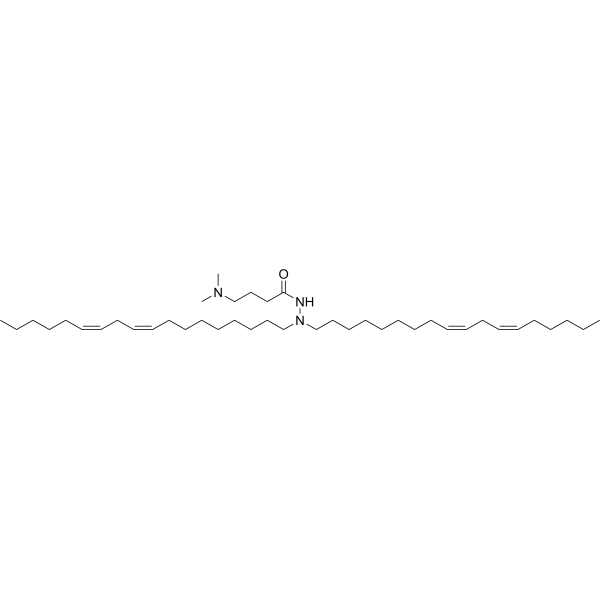 0 ImagesCat. No.: HY-150116CAS No.: 2226547-17-5Lipid 1 is an ionizable amino lipid used for the generation of Lipid nanoparticles (LNPs).
-
1-Myristoyl-2-hydroxy-sn-glycero-3-phosphoethanolamine
 0 ImagesSynonyms: 14:0 Lyso PE; 1-Myristoyl-2-hydroxy-sn-glycero-3-PE; 1-Tetradecanoyl-sn-glycero-3-phosphoethanolamine1-Myristoyl-2-hydroxy-sn-glycero-3-phosphoethanolamine (14:0 Lyso PE) is a lysophospholipid with a phosphoethanolamine head and a myristoyl tail. The free amine group can conjugate with NHS active ester or coupled with carboxylic acid in the presence of a coupling agent. It also induces transient increases in intracellular calcium in PC12 cells . Serum levels of 1-Myristoyl-2-hydroxy-sn-glycero-3-phosphoethanolamine are elevated in patients with malignant breast cancer compared to healthy controls.
-
DSPE-PEG8000-OH
 0 ImagesCat. No.: HY-164722DSPE-PEG8000-OH is a hydroxy-terminated phospholipid PEG polymer. The hydrophobic tails that allows the encapsulation and aggregation of other hydrophobic drugs, and the hydroxy-terminated can be further reacted. DSPE-PEG8000-OH can prepare liposomes or lipid nanoparticles, which can be used in drug delivery and promoting drug absorption research.
-
MGlc-DAG
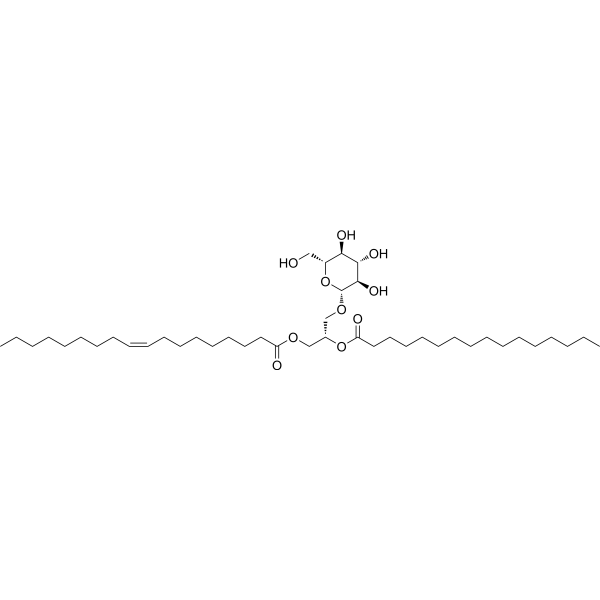 0 ImagesMGlc-DAG, a glycoglycerolipid, can be used for the synthesis of drug delivery compound.
-
DSPE-PEG2000-Rhodamine
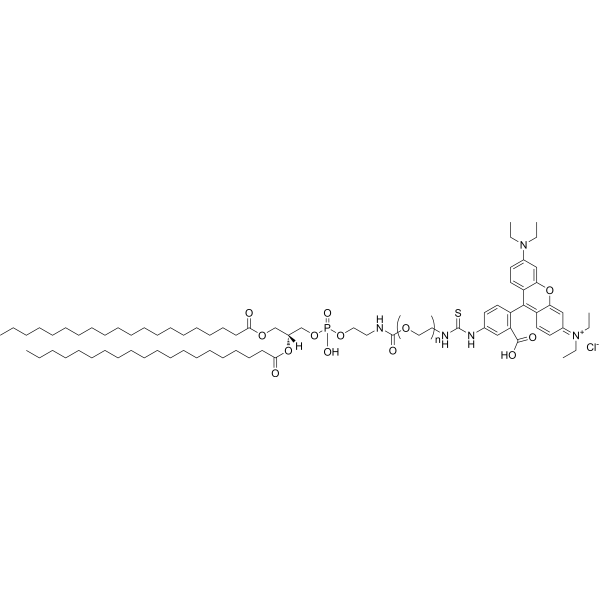 0 ImagesCat. No.: HY-W440919DSPE-PEG2000-Rhodamine is a dye functionalized phospholipid. The amphiphilic polymer can form lipid bilayer in water and be used to encapsulate therapeutic agents, such as liposomal anticancer drug or mRNA vaccine. Rhodamine has maximum absorption at 570 nm and emission around 595 nm and can be easily traced using an imaging technique.
-
VL-422
 0 ImagesCat. No.: HY-159709CAS No.: 2765519-47-7VL-422 is an ionizable cationic lipid. VL-422 delivers CRISPR complementary single-guide RNA (sgRNA) and Cas9 mRNA to enable in vitro and in vivo gene editing. LNPs containing VL-422 loaded with Cas9 mRNA and sgRNA targeting the ANGPTL3 gene induce the deletion of premature stop codons within the ANGPTL3 gene in the liver of cynomolgus monkeys. Loss-of-function of ANGPTL3 leads to decreased levels of LDL, HDL and cholesterol in plasma. The VL-422 delivery system can be used for the research of gene editing strategies targeting lipid metabolism diseases.
-
Lipid 23
 0 ImagesLipid 23 is an ionizable cationic amino lipid that can be used to generate lipid nanoparticles (LNP). Lipid 23 can be used for mRNA delivery.
-
DSPC-d4
 0 ImagesSynonyms: 1,2-Distearoyl-sn-glycero-3-PC-d4; 1,2-Distearoyl-sn-glycero-3-phosphorylcholine-d4DSPC-d4 (1,2-Distearoyl-sn-glycero-3-phosphorylcholine-d4) is the deuterium labeled DSPC (HY-W040193). DSPC is a cylindrical-shaped lipid. 1,2-Distearoyl-sn-glycero-3-phosphorylcholine is used to synthesize liposomes, and is the lipid component in the lipid nanoparticle (LNP) system.
-
Bupivacaine liposome
 0 ImagesCat. No.: HY-185388Synonyms: Liposomal bupivacaineBupivacaine liposome is a liposome-encapsulated form of Bupivacaine (HY-B0405). Bupivacaine is an NMDA receptor inhibitor. During the action potential, Bupivacaine blocks sodium channels, thereby inhibiting the generation and conduction of nerve impulses induced by painful stimuli. Bupivacaine liposome reduces the release rate of Bupivacaine, thus achieving a long-lasting pain relief effect.
-
Mitoxantrone hydrochloride liposome
 0 ImagesCat. No.: HY-185372Synonyms: Liposomal mitoxantroneMitoxantrone hydrochloride liposome is a liposome-encapsulated Mitoxantrone hydrochloride (HY-13502A) (a topoisomerase II inhibitor). Compared to regular Mitoxantrone hydrochloride, Mitoxantrone hydrochloride liposome enhances antitumor activity and prolongs drug circulation time in the body.
-
Amikacin liposome
 0 ImagesCat. No.: HY-185398Synonyms: Amikacin disulfate liposome; Liposomal amikacinAmikacin liposome is a liposome-encapsulated form of Amikacin disulfate (HY-B0509B), an aminoglycoside antibiotic with antibactericidal avtivity. Amikacin liposome prolongs the release of amikacin in the lungs and reduces systemic exposure, thereby lowering systemic toxicity.
-
Cisplatin liposome
 0 ImagesCat. No.: HY-185389Synonyms: Liposomal cisplatinCisplatin liposome is a liposome-encapsulated form of Cisplatin (HY-17394). Cisplatin (CDDP) is an anti-tumor chemotherapeutic agent that cross-links with DNA, causing DNA damage in cancer cells. Cisplatin liposome prolongs drug circulation time and slowly releases the drug, allowing it to accumulate in the tumor and exert its killing effect.
-
DSPE-PEG5000-CSTSMLKAC
 0 ImagesCat. No.: HY-172688DSPE-PEG5000-CSTSMLKAC is a PEG compound which composed of DSPE and a peptide (CSTSMLKAC). CSTSMLKAC is capable of mediating selective homing of phage to ischemic heart tissue. DSPE-PEG5000-CSTSMLKAC can be used for drug delivery.
-
Daunorubicin-Cytarabine Liposome
 0 ImagesCat. No.: HY-160952CAS No.: 1256639-86-7Synonyms: CPX 351; Cytarabine-daunorubicinCytarabine-daunorubicin (CPX 351) is a Liposomal formulation prepared from Cytarabine (HY-13605) and Daunorubicin (HY-13062A) at a fixed synergistic molar ratio of 5:1. Cytarabine-daunorubicin improves secondary acute myeloid leukemia. Cytarabine-daunorubicin can be used in research related to secondary acute myeloid leukemia, high-risk myelodysplastic syndrome, and chronic myelomonocytic leukemia.



