



Chronic Pain
-
Chronic Pain (16)

- 1
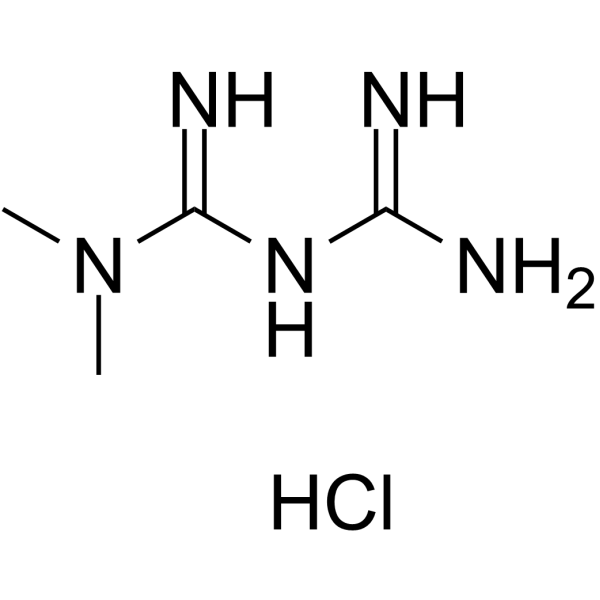
- Formula: C4H12ClN5
- Molecular Weight: 165.62
Metformin (1,1-Dimethylbiguanide) hydrochloride inhibits the mitochondrial respiratory chain in the liver, leading to AMPK activation and enhancing insulin sensitivity, and can be used in the study of type 2 diabetes. Metformin hydrochloride exerts central glucose-lowering effects by inhibiting Ras-related protein 1 (Rap1) in SF1 hypothalamic neurons. Metformin hydrochloride also inhibits liver oxidative stress, nitrosative stress, inflammation, and apoptosis caused by liver ischemia/reperfusion injury. In addition, Metformin hydrochloride regulates the expression of autophagy-related proteins by activating AMPK and inhibiting the mTOR signaling pathway, thereby inducing tumor cell autophagy and inhibiting the growth of renal cell carcinoma in vitro and in vivo.

- Formula: C16H15N5
- Molecular Weight: 277.32
DAPI (4',6-Diamidino-2-phenylindole) is a DAPI dye. DAPI is a fluorescent dye that binds strongly to DNA. It binds to the AT base pair of the double-stranded DNA minor groove, and one DAPI molecule can occupy three base pair positions. The fluorescence intensity of DAPI molecules bound to double-stranded DNA is increased by about 20 times, and it is commonly observed with fluorescence microscopy, and the amount of DNA can be determined based on the intensity of fluorescence. DAPI cannot penetrate intact cell membranes and is commonly used for staining damaged and fixed cells. DAPI (Compound 3) is an acid-sensing ion channel 3 (ASIC3) inhibitor. DAPI binds to ASIC3 and blocks the channel function. DAPI can be used in the study of chronic pain treatment (Ex/Em = 356/451 nm).
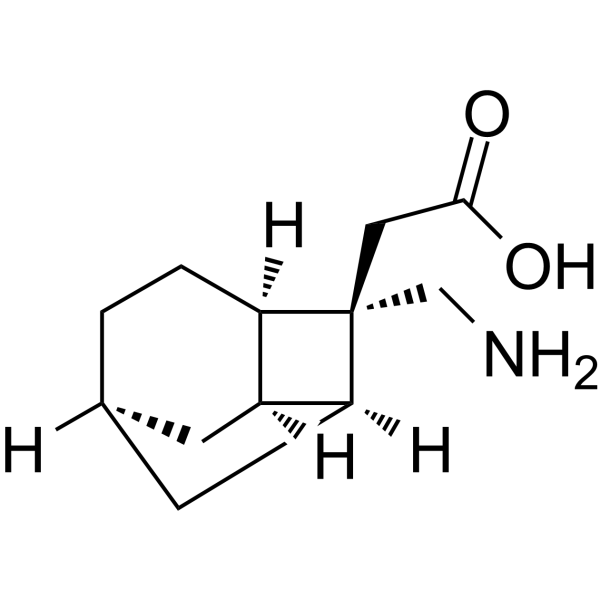
- Formula: C12H19NO2
- Molecular Weight: 209.28
Crisugabalin is an orally active, selective ligand for the α2δ subunit of voltage-gated calcium channels, with a target IC50 of 3.96 nM in rats. Crisugabalin inhibits the binding of [3H]gabapentin to the α2δ subunit, reduces calcium influx, decreases neuronal excitability, and impairs nociceptive transmission. Crisugabalin alleviates mechanical allodynia, neuropathic pain and inflammatory pain in rats, and reduces phase II pain behaviors. Crisugabalin can be used in research related to chronic pain, neuropathic pain, diabetic neuropathy, fibromyalgia, inflammatory pain, diabetic peripheral neuropathy and postherpetic neuralgia.

- Formula: C27H41N5O5
- Molecular Weight: 515.64
PAR2 modulator-1 is a biased protease-activated receptor 2 (PAR2) inhibitor. PAR2 modulator-1 blocks the PAR2-dependent MAPK signaling pathway with an IC50 value of 8.5 μM, without altering the PAR2-dependent Ca2+ signaling pathway. PAR2 modulator-1 blocks pain responses induced by PAR2 agonists. PAR2 modulator-1 can be used in the research of chronic pain.

- Formula: C20H29N3O2S2
- Molecular Weight: 407.59
ASP8062 is an orally active, blood-brain barrier-permeable selective GABAB receptor positive allosteric modulator. ASP8062 enhances GABA-mediated activation of GABAB receptors and strengthens GABAergic neurotransmission. ASP8062 reverses Reserpine (HY-N0480)-induced myalgia, regulates the sleep-wake cycle, increases delta wave power during non-REM sleep, and impairs motor coordination at high doses. ASP8062 penetrates the central nervous system with a half-life of 40-50 h. ASP8062 can be used in research related to opioid use disorder, fibromyalgia, chronic pain, and alcohol use disorder.

- Formula: C27H29ClN4O
- Molecular Weight: 461.00
Nav1.7-IN-23 is an orally active, selective NaV1.7 inhibitor. Nav1.7-IN-23 exhibits electrophysiological regulatory effects in mouse dorsal root ganglion neurons. Nav1.7-IN-23 can be used for the research of acute pain, chronic inflammatory pain and neuropathic pain.

- Formula: C19H19F3N2O2
- Molecular Weight: 364.36
NS-6740 is a silent agonist of α7 nicotinic acetylcholine receptor (α7 nAChR) with an IC50 of 3 nM. NS-6740 reduces LPS-induced TNF-α release and regulates the cholinergic anti-inflammatory pathway. NS-6740 exerts anti-inflammatory effects. NS-6740 reduces long-term potentiation in hippocampal brain slices. NS-6740 can be used in research related to neuroinflammation and schizophrenia.

- Formula: C19H20ClF3N2O2
- Molecular Weight: 400.82
NS-6740 hydrochloride is a silent agonist of α7 nicotinic acetylcholine receptor (α7 nAChR) with an IC50 of 3 nM. NS-6740 hydrochloride reduces LPS-induced TNF-α release and regulates the cholinergic anti-inflammatory pathway. NS-6740 hydrochloride exerts anti-inflammatory effects. NS-6740 hydrochloride reduces long-term potentiation in hippocampal brain slices. NS-6740 hydrochloride can be used in research related to neuroinflammation and schizophrenia.

- Formula: C26H27ClN4O2
- Molecular Weight: 462.97
KOR modulator-1 is a blood-brain barrier-permeable kappa opioid receptor (KOR) modulator. KOR modulator-1 induces antinociceptive effects without significant sedation or impairment of neuromuscular coordination. KOR modulator-1 can be used for the research of chronic pain.

- Formula: C35H46N8O3
- Molecular Weight: 626.79
Desfluoro-BMS-694153 (Compound 3) is a calcitonin gene-related peptide receptor (CGRP receptor) antagonist, with a Ki value of 0.01 nM. Desfluoro-BMS-694153 has a significantly reduced risk of CYP3A4 inhibition, and its IC50 values for CYP3A4-BFC and CYP3A4-BZR are 36 and 6 μM respectively. Desfluoro-BMS-694153 can be used for research on migraines.

- Formula: C26H42N2O2
- Molecular Weight: 414.62
O-1812 is a selective CB1 ligand. O-1812 is also a very weak AMT inhibitor. O-1812 can be used in the research of chronic pain, migraines, and inflammation.

- Formula: C23H29ClN2O
- Molecular Weight: 384.94
BL-1021 is an orally active ion channel blocker. BL-1021 significantly reduces symptoms of neuropathic pain without noticeable sedation or cardiac arrhythmias. BL-1021 can be used in the research of acute and chronic pain.

- Formula: C24H45N2NaO3
- Molecular Weight: 432.62
Oleoyl-D-lysine sodium is a selective Glycine Transporter-2 (GlyT2) inhibitor based on lipid. Oleoyl-D-lysine sodium reverses neuropathic pain in mice, shows antidrowsiness effect on chronic neuropathic pain. Oleoyl-D-lysine sodium is safe and effective without respiratory depression.

- Formula: C20H19F6NO
- Molecular Weight: 403.36
L-733060 is a selective neurokinin-1 (NK-1) receptor antagonist. L-733060 mainly regulates pain transmission and neural plasticity by blocking the binding of Substance P (P substance) to the NK-1 receptor. L-733060 blocks the promoting effect of Substance P on long-term potentiation (LTP) in the hippocampus. L-733060 reverses the orofacial hyperalgesia induced by experimental occlusal interference (EOI) in rats. L-733060 hydrochloride inhibits neurogenic plasma extravasation at a dose that does not cause adverse cardiovascular effects in rodents, and also acts as an anti-tumor agent. L-733060 can be used for the study of chronic orofacial pain.

- Formula: C169H259N49O43S8
- Molecular Weight: 3921.69
Phrixotoxin 2 is a Kv4 family potassium channel inhibitor, with Ki values in rats of 120 nM for Kv4.2, 110 nM for Kv4.3, and 230 nM for Kv4.1. Phrixotoxin 2 mediates voltage-dependent inhibition of Kv4.2 and Kv4.3 currents, and voltage-independent inhibition of Kv4.1 currents. Phrixotoxin 2 fails to inhibit A-type K+ currents in visceral dorsal root ganglion neurons. Phrixotoxin 2 induces contraction of non-pregnant uterine smooth muscle and triggers orofacial cold hyperalgesia in rats. Phrixotoxin 2 can distinguish the contribution of Kv4 subunits to A-type K+ currents in different subsets of sensory neurons. Phrixotoxin 2 can be used in research related to chronic pain and trigeminal neuropathic pain.
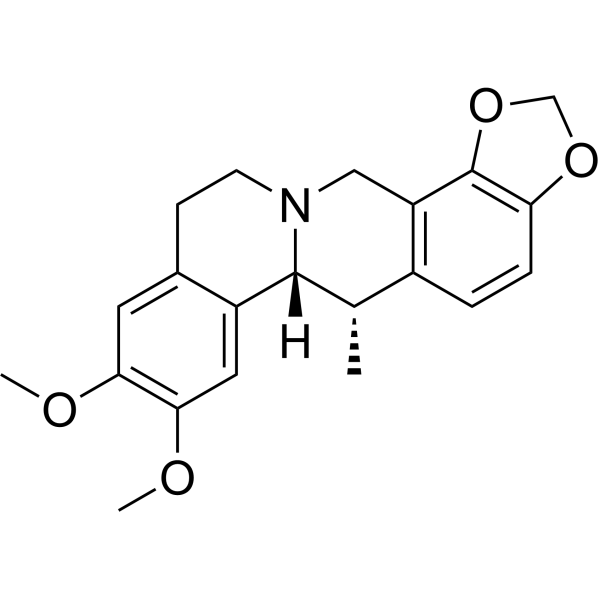
- Formula: C21H23NO4
- Molecular Weight: 353.41
Cavidine ((+)-Cavidine) is an analgesic and anti-inflammatory agent. Cavidine can be isolated from Corydalis ternata f. yanhusuo (Y.H.Chou & Chun C.Hsu) Y.C.Zhu. Cavidine reduces the expression of inflammatory factors IL-1β, IL-6 and TNF-α, and inhibits calcium ion influx. Cavidine inhibits the phosphorylation of p38 and ERK1/2. Cavidine increases mechanical and thermal pain thresholds in chronic pain models. Cavidine can be used for the research of chronic pain.
- 1



