



Phrixotoxin 2
Phrixotoxin 2 is a Kv4 family potassium channel inhibitor, with Ki values in rats of 120 nM for Kv4.2, 110 nM for Kv4.3, and 230 nM for Kv4.1. Phrixotoxin 2 mediates voltage-dependent inhibition of Kv4.2 and Kv4.3 currents, and voltage-independent inhibition of Kv4.1 currents. Phrixotoxin 2 fails to inhibit A-type K+ currents in visceral dorsal root ganglion neurons. Phrixotoxin 2 induces contraction of non-pregnant uterine smooth muscle and triggers orofacial cold hyperalgesia in rats. Phrixotoxin 2 can distinguish the contribution of Kv4 subunits to A-type K+ currents in different subsets of sensory neurons. Phrixotoxin 2 can be used in research related to chronic pain and trigeminal neuropathic pain.
For research use only. We do not sell to patients.
- CAS No.: 741738-57-8
- Formula: C169H259N49O43S8
- Molecular Weight:3921.69
-
Storage:
Please store the product under the recommended conditions in the Certificate of Analysis.

To place orders, for customer services and technical support, please contact: MedChemExpress USA
Tel: 609-228-6898 E-mail: [email protected] [email protected]


-
 Biological Activity
-
Chemical Information
- Protocols
- Purity & Documentation
- References
-
 Help & FAQs




Biological Activity
Description
IC50 & Target
[1]|
Kv4.3 110 nM (Ki) |
Kv4.2 120 nM (Ki) |
Kv4.1 230 nM (Ki) |
In Vitro
Phrixotoxin 2 (4-7 min) inhibits voltage-independently and concentration-dependently the KA currents in capsaicin-sensitive C-fiber afferent neurons among IB4-strongly stained rat L6-S1 dorsal root ganglion (DRG) somata, but exerts no effect on the KA currents in FB-positive capsaicin-sensitive C-fiber afferent neurons innervating the bladder[1].
Phrixotoxin 2 (200-500 nM; 4-7 min) inhibits the currents of heterologously expressed rat Kv4.1, Kv4.2 and Kv4.3 in CHO-K1 cells with distinct voltage dependence, which is determined by a four-amino-acid region at the carboxyl terminus of the S3 transmembrane domain; Kv4.1 exhibits voltage-independent inhibition (Ki = 230 nM at +30 mV), while Kv4.2 and Kv4.3 show voltage-dependent inhibition (Ki values of 120 nM and 110 nM, respectively, at +30 mV)[1].
MedChemExpress (MCE) has not independently confirmed the accuracy of these methods. They are for reference only.
In Vivo
MedChemExpress (MCE) has not independently confirmed the accuracy of these methods. They are for reference only.
-
Animal Model:Sprague Dawley (male, 350-500 g)[3]
-
Dosage:2 mM, 50 µL
-
Administration:i.c.; single bilateral injection in orofacial regions
-
Result:Reduced total contact time and total contact numbers compared to vehicle controls at 5°C noxious cold stimulation.
Showed no significant differences in total contact time or total contact numbers compared to vehicle controls at 24°C innocuous temperature.
Did not differ in mean contact time compared to vehicle controls at either 5°C or 24°C.


Chemical Information
-
CAS No. 741738-57-8
-
Molecular Weight 3921.69
-
Formula C169H259N49O43S8
-
Sequence
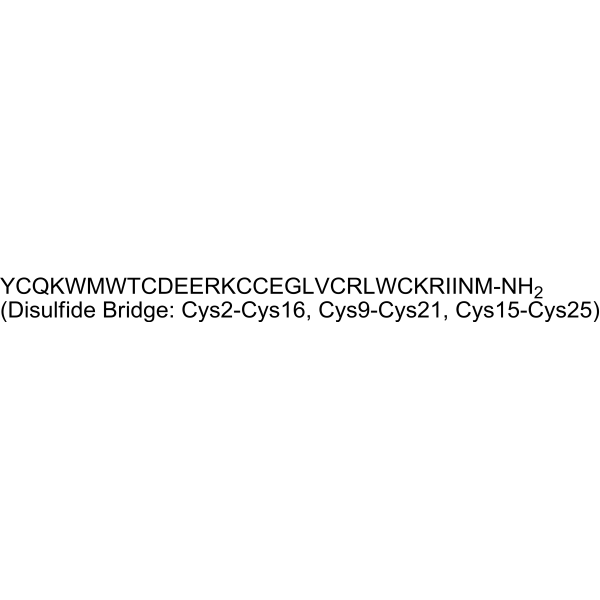
Tyr-Cys-Gln-Lys-Trp-Met-Trp-Thr-Cys-Asp-Glu-Glu-Arg-Lys-Cys-Cys-Glu-Gly-Leu-Val-Cys-Arg-Leu-Trp-Cys-Lys-Arg-Ile-Ile-Asn-Met-NH2 (Disulfide Bridge: Cys2-Cys16, Cys9-Cys21, Cys15-Cys25)
-
Sequence Shortening
YCQKWMWTCDEERKCCEGLVCRLWCKRIINM-NH2 (Disulfide Bridge: Cys2-Cys16, Cys9-Cys21, Cys15-Cys25)
-
Shipping
Room temperature in continental US; may vary elsewhere.
-
Storage
Please store the product under the recommended conditions in the Certificate of Analysis.


Purity & Documentation
References
[1]. Yunoki T, et al. Differential contribution of Kv4-containing channels to A-type, voltage-gated potassium currents in somatic and visceral dorsal root ganglion neurons. J Neurophysiol. 2014 Nov 15;112(10):2492-504. [Content Brief]
[2]. Smith RC, et al. The role of voltage-gated potassium channels in the regulation of mouse uterine contractility. Reproductive biology and endocrinology : RB&E. 2007 Nov 02;5:41. [Content Brief]
[3]. Kanda H, et al. Kv4.3 Channel Dysfunction Contributes to Trigeminal Neuropathic Pain Manifested with Orofacial Cold Hypersensitivity in Rats. The Journal of neuroscience : the official journal of the Society for Neuroscience. 2021 Mar 10;41(10):2091-2105. [Content Brief]

Calculators
Concentration (start) × Volume (start) = Concentration (final) × Volume (final)


Phrixotoxin 2 Related Classifications
HY-P2786A Related Classifications
 Powered by Bioz