



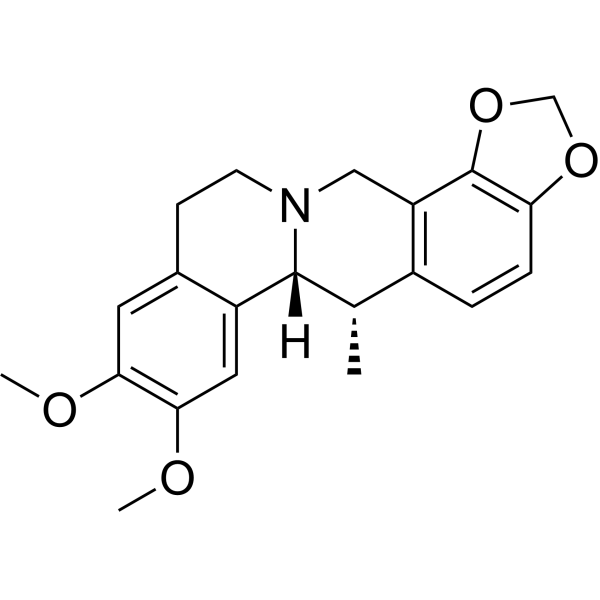
Cavidine
Cavidine ((+)-Cavidine) is an analgesic and anti-inflammatory agent. Cavidine can be isolated from Corydalis ternata f. yanhusuo (Y.H.Chou & Chun C.Hsu) Y.C.Zhu. Cavidine reduces the expression of inflammatory factors IL-1β, IL-6 and TNF-α, and inhibits calcium ion influx. Cavidine inhibits the phosphorylation of p38 and ERK1/2. Cavidine increases mechanical and thermal pain thresholds in chronic pain models. Cavidine can be used for the research of chronic pain.
Nur für Forschungszwecke. Wir verkaufen nicht an Patienten.
- CAS. Nr.: 32728-75-9
- Formel: C21H23NO4
- Molecular Weight:353.41
-
Speicherung:
Please store the product under the recommended conditions in the Certificate of Analysis.

To place orders, for customer services and technical support, please contact: MedChemExpress USA
Tel: 609-228-6898 E-mail: [email protected] [email protected]


-
 Biologische Aktivität
-
Chemical Information
- Protokoll
- Reinheit & Dokumentation
- Verweise
-
 Help & FAQs




Biologische Aktivität
Beschreibung
IC50 & Target
[1]|
p38 |
ERK1 |
ERK2 |
IL-1β |
IL-6 |
In Vitro
Cavidine (10 μg/mL) inhibits α,β-ME-ATP-induced calcium ion influx in P2X3-overexpressing U373 cells[1].
Cavidine (2.5-10 μg/mL; 24 h) inhibits LPS-induced activation of BV-2 microglial cells[1].
Cavidine (5-10 μg/mL) inhibits α,β-ME-ATP-induced phosphorylation of p38 and ERK1/2 in primary DRG neurons[1].
MedChemExpress (MCE) has not independently confirmed the accuracy of these methods. They are for reference only.
In Vivo
Cavidine (2.5-10 mg/kg; i.p.; daily) exerts dose-dependent analgesic and anti-inflammatory effects in SNI-induced neuropathic pain mice by downregulating P2X3 receptors, inhibiting microglial activation, suppressing inflammatory factor production, and reducing MAPK pathway activation[1].
MedChemExpress (MCE) has not independently confirmed the accuracy of these methods. They are for reference only.
-
Animal Model:C57BL/6 J (female, 6-9 weeks old, 20-25 g, CFA-induced)[1]
-
Dosage:2.5 mg/kg; 5 mg/kg; 10 mg/kg
-
Administration:i.p.; daily; 7 days
-
Result:Significantly increased paw withdrawal threshold (PWT) and thermal withdrawal latency (TWL) compared to untreated CFA mice (P < 0.05, P < 0.01, or P < 0.001).
Reduced paw swelling compared to untreated CFA mice after 7 days of treatment (P < 0.05 or P < 0.001).
Suppressed DRG protein expression of IL-1β and TNF-α (P < 0.001), while 5 mg/kg and 10 mg/kg suppressed DRG IL-6 protein expression (P < 0.01 or P < 0.001).
Suppressed DRG mRNA expression of IL-6 (P < 0.001); 5 mg/kg and 10 mg/kg suppressed DRG mRNA expression of IL-1β (P < 0.001), and 10 mg/kg suppressed DRG mRNA expression of TNF-α (P < 0.001).
Suppressed spinal cord protein and mRNA expression of IL-1β, TNF-α, and IL-6 (P < 0.05 or P < 0.001).
Reduced spinal cord IBA-1 expression at 5 mg/kg and 10 mg/kg compared to untreated CFA mice (P < 0.05 or P < 0.01).
Reduced inflammatory cell infiltration and attenuated neuronal atrophy in DRG, as well as reduced neuronal vacuolation and glial clusters in the spinal cord compared to untreated CFA mice.
Suppressed DRG and spinal cord P2X3 receptor protein and mRNA expression (P < 0.05, P < 0.01, or P < 0.001).
Reduced DRG p-p38 and p-ERK1/2 phosphorylation at 2.5 mg/kg; 5 mg/kg and 10 mg/kg significantly suppressed both p-p38 and p-ERK1/2 phosphorylation in DRG (P < 0.001).
-
Animal Model:C57BL/6 J (female, 6-9 weeks old, 20-25 g, SNI-induced)[1]
-
Dosage:2.5 mg/kg; 5 mg/kg; 10 mg/kg
-
Administration:i.p.; daily
-
Result:Significantly increased paw withdrawal threshold (PWT) and thermal withdrawal latency (TWL) compared to untreated SNI mice (P < 0.05, P < 0.01, or P < 0.001).
Suppressed DRG protein expression of IL-6 and IL-1β at 5 mg/kg and 10 mg/kg (P < 0.001), while 10 mg/kg suppressed DRG TNF-α protein expression (P < 0.01).
Suppressed spinal cord TNF-α protein expression at 2.5 mg/kg (P < 0.001); 5 mg/kg and 10 mg/kg suppressed spinal cord protein expression of TNF-α, IL-6, and IL-1β (P < 0.001).
Suppressed DRG mRNA expression of TNF-α (P < 0.001); 5 mg/kg and 10 mg/kg suppressed DRG mRNA expression of IL-6 and IL-1β (P < 0.01 or P < 0.001).
Suppressed spinal cord mRNA expression of IL-6 and IL-1β (P < 0.01 or P < 0.001); 5 mg/kg and 10 mg/kg suppressed spinal cord TNF-α mRNA expression (P < 0.01 or P < 0.001).
Reduced spinal cord IBA-1 expression at 5 mg/kg and 10 mg/kg compared to untreated SNI mice (P < 0.05 or P < 0.01).
Reduced inflammatory cell infiltration and attenuated neuronal atrophy in DRG, as well as reduced neuronal vacuolation and glial clusters in the spinal cord compared to untreated SNI mice.
Suppressed DRG and spinal cord P2X3 receptor protein expression at 5 mg/kg and 10 mg/kg (P < 0.05 or P < 0.01); all doses suppressed DRG and spinal cord P2X3 receptor mRNA expression (P < 0.001).
Reduced DRG p-p38 phosphorylation at 2.5 mg/kg; 5 mg/kg and 10 mg/kg significantly suppressed both p-p38 and p-ERK1/2 phosphorylation in DRG (P < 0.001).


Chemical Information
-
CAS. Nr. 32728-75-9
-
Molecular Weight 353.41
-
Formel C21H23NO4
-
SMILES
C[C@H]1C(C=C2)=C(C3=C2OCO3)CN4CCC5=CC(OC)=C(OC)C=C5[C@@]14[H]
-
Synonyms
(+)-Cavidine
-
Structure Classification
-
Initial Source
-
Versand
Room temperature in continental US; may vary elsewhere.
-
Speicherung
Please store the product under the recommended conditions in the Certificate of Analysis.


Reinheit & Dokumentation
Verweise

Calculators
Konzentration (Stammlösung) × Volumen (Stammlösung) = Konzentration (Ziellösung) × Volumen (Ziellösung)


Cavidine Related Classifications
HY-101546A Related Classifications
 Powered by Bioz