



KRAS/Ras Mutation Colorectal Cancer
-
KRAS/Ras Mutation Colorectal Cancer (13)

- 1
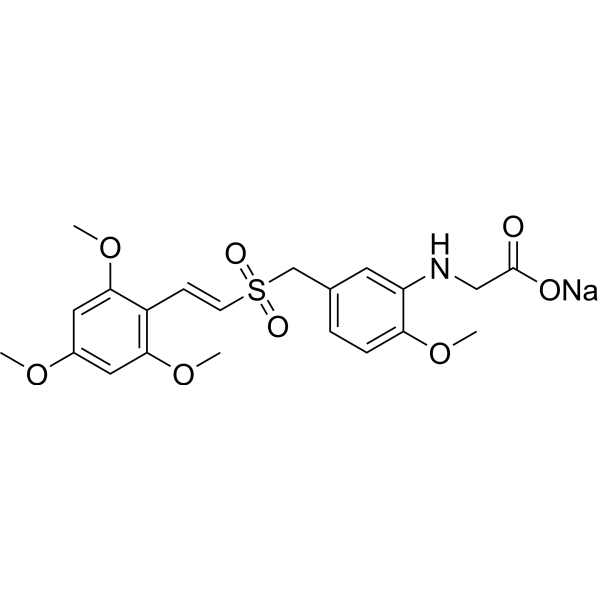
- Formula: C21H24NNaO8S
- Molecular Weight: 473.47
Rigosertib sodium (ON-01910 sodium) is a multi-kinase inhibitor and a selective anti-cancer agent, which induces apoptosis by inhibition the PI3K/Akt pathway, promotes the phosphorylation of histone H2AX and induces G2/M arrest in cell cycle. Rigosertib sodium is a selective and non-ATP-competitive inhibitor of PLK1 with an IC50 of 9 nM.

- Formula: C20H19IN2O5
- Molecular Weight: 494.28
SHOC2-RAS PPI-IN-1 is a SHOC2-NRAS interaction inhibitor with IC50 of 0.048 μM and a Kd of 0.065 μM for SHOC2. SHOC2-RAS PPI-IN-1 inhibits RAS/MAPK signalling and downregulates MEK and ERK phosphorylation. SHOC2-RAS PPI-IN-1 can inhibit cells proliferation in RAS-mutant cancer models. SHOC2-RAS PPI-IN-1 can be used for the research of RAS-mutant cancers.
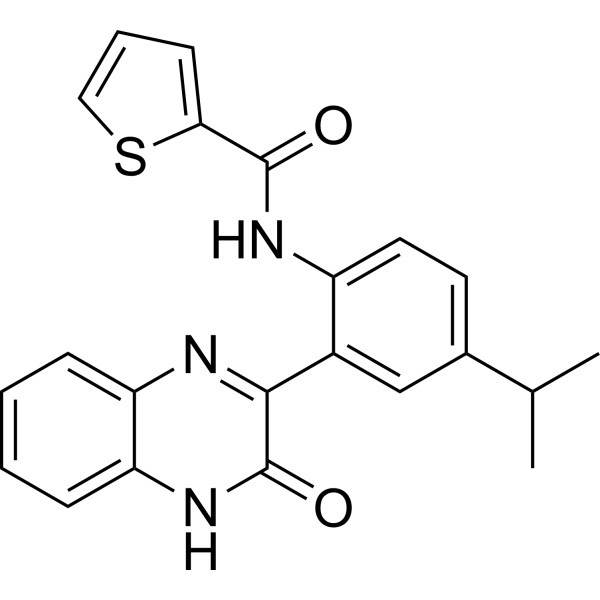
- Formula: C22H19N3O2S
- Molecular Weight: 389.47
ML281 is a highly selective inhibitor of serine/threonine kinase 33 (STK33) with an IC50 value of 14 nM. ML281 shows 700-fold selectivity over PKA and 550-fold over AurB. ML281 exerts core mechanism by inhibiting STK33: in small cell lung cancer, ML281 downregulates RPS6/BAD signaling phosphorylation, induces apoptosis, and suppresses proliferation, invasion. ML281 reduces STK33-mediated 4-hydroxyphenylpyruvate dioxygenase (HPD) phosphorylation in tyrosinemia . ML281 is suitable for research on STK33 function, KRAS mutation-related cancers (pancreatic cancer, colon cancer, lung adenocarcinoma, etc.), small cell lung cancer, and tyrosinemia-related damage
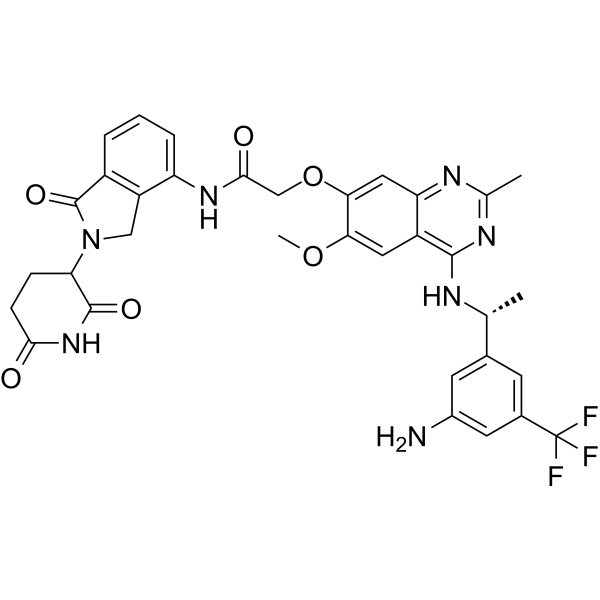
- Formula: C34H32F3N7O6
- Molecular Weight: 691.66
PROTAC SOS1 degrader-3 is a PROTAC degrader targeting SOS1, which induces the targeted degradation of SOS1 via the ubiquitin-proteasome system, with DC50 values ranging from 0.19 μM to 0.75 μM in multiple distinct colorectal cancer cell lines. PROTAC SOS1 degrader-3 inhibits the phosphorylation of AKT and ERK. PROTAC SOS1 degrader-3 induces apoptosis and morphological changes in KRAS-mutant colorectal cancer organoids. PROTAC SOS1 degrader-3 can be applied in studies related to kras-mutant colorectal cancer.

- Formula: C45H58N8O5S
- Molecular Weight: 823.06
Pan-RAS-IN-5 is a macrocyclic pan-RAS inhibitor that targets mutant RAS (including KRAS, NRAS, and HRAS). Pan-RAS-IN-5 inhibits the proliferation of various KRAS-mutant cancer cells. Pan-RAS-IN-5 is applicable to the research of KRAS mutation-related cancers such as pancreatic cancer, nephroblastoma, and colon adenocarcinoma.

- Formula: C35H34F7N9O3
- Molecular Weight: 761.69
KRAS-IN-62 is an orally effective pan-KRAS inhibitor that potently inhibits SOS1-mediated KRAS nucleotide exchange (IC50 < 10 nM for KRAS G12D/G12V/G12C/WT). KRAS-IN-62 inhibits pERK signaling and cell proliferation in KRAS-mutant tumor cells (pERK IC90 = 0.51 nM in GP2D cells). KRAS-IN-62 inhibits tumor growth in vivo, with plasma concentrations exceeding IC50 for ~20 h after oral administration in beagle dogs. KRAS-IN-62 can be used in studies of KRAS mutation-related cancers, such as colorectal cancer.

- Formula: C24H34ClFN6O3S
- Molecular Weight: 541.08
FAK-IN-32 is an orally active, selective and highly potent FAK inhibitor (IC50 = 10.87 nM). FAK-IN-32 can induce cell cycle arrest at the G2/M phase, inhibit FAK-AKT signaling pathway activity, and promote apoptosis to some extent. FAK-IN-32 can be used for research on KRAS-mutant colorectal cancer.

- Formula: C32H43N5
- Molecular Weight: 497.72
SOS1-IN-27 is a potent, selective allosteric SOS1 inhibitor with a KD of 14 nM and SOS1-KRAS binding IC50 of 1.6 nM. SOS1-IN-27 disrupts SOS1-KRAS interaction, inhibits MAPK/PI3K signaling, induces G1 arrest and tumor cell apoptosis. SOS1-IN-27 serves as a valuable tool compound for pan-KRAS-driven colorectal cancer studies.

- Formula: C31H40N4O
- Molecular Weight: 484.68
SOS1-IN-26 is a potent, orally active selective allosteric SOS1 inhibitor with a KD of 33 nM and SOS1-KRAS binding IC50 of 4.0 nM. SOS1-IN-26 disrupts SOS1-KRAS interaction, inhibits MAPK/PI3K signaling, induces G1 phase arrest and tumor cell apoptosis. SOS1-IN-26 serves as a balanced lead therapeutic candidate for pan-KRAS-driven colorectal cancer studies.

MEDI-5304 is a hedgehog antibody inhibitor with human sonic hedgehog (SHH) KD of 5.13 pmol/L, and human Indian hedgehog (IHH) KD of 34.7 pmol/L. MEDI-5304 binds and neutralizes SHH and IHH, blocks downstream target gene transcription, inhibits osteoblast differentiation. MEDI-5304 can be used for the research of colon cancer.

- Formula: C22H30N4O4
- Molecular Weight: 414.50
CDK2-IN-57 is a selective Cdk2/CycE inhibitor with an IC50 of 2.8 nM. CDK2-IN-57 inhibits Cdk1/2 kinase activity, blocks cell cycle progression, induces G0-phase cell cycle arrest, and prevents S-phase entry. CDK2-IN-57 can be used for the research of colon carcinoma.

- Formula: C25H23BrN2O2S
- Molecular Weight: 495.43
BYBC‑1 is a selective G4‑RNA‑targeting ligand with high affinity forKRAS and NRAS G4‑RNAs (Kd = 0.05-0.28 μM). BYBC‑1 stabilizes G4‑RNA structures in KRAS and NRAS mRNA, blocks thePI3K/AKT and MAPK/ERK pathways, activates the DNA damage response (DDR), suppresses energy metabolism, and induces S‑phase arrest and apoptosis. BYBC‑1 exhibits high selectivity over non‑malignant fibroblasts and significantly inhibits the growth of HCT‑116 xenograft tumors in vivo. BYBC‑1 can be used for the study of colorectal cancer.

- Formula: C25H28ClN5O
- Molecular Weight: 449.98
RAS activator compound 1 (Compound 7c) is a RAS activator targeting the guanine nucleotide exchange factor (GEF) son of sevenless homologue 1 (SOS1). RAS activator compound 1 can activate the nucleotide exchange process and increase levels of active RAS-GTP in HeLa cells. RAS activator compound 1 can be used for research of RAS-driven tumor.
- 1



