



ACKR3 Protein, Human (His-SUMO)

Based on 1 Customer Validation
ACKR3 is an atypical chemokine receptor that precisely controls chemokine levels and localization through high-affinity binding, operating independently of ligand-driven signaling. It acts as an interceptor, internalization receptor, and chemokine scavenger for CXCL11 and CXCL12/SDF1, inducing β-arrestin recruitment, ligand internalization, and MAPK pathway activation. ACKR3 Protein, Human (His-SUMO) is the recombinant human-derived ACKR3 protein, expressed by E. coli , with N-SUMO, N-6*His labeled tag.
- Species: Human
- Source: E. coli
-
Storage:Stored at -20°C for 2 years from date of receipt. After reconstitution, it is stable at 4°C for 1 week or -20°C for longer (with carrier protein). It is recommended to freeze aliquots at -20°C or -80°C for extended storage.


To place orders, for customer services and technical support, please contact: MedChemExpress USA
Tel: 609-228-6898 E-mail: [email protected] [email protected]


-
 Biological Activity
-
Technical Parameters
-
Product Properties
- Documentation
- Help & FAQs




Biological Activity
Description
ACKR3 is an atypical chemokine receptor that precisely controls chemokine levels and localization through high-affinity binding, operating independently of ligand-driven signaling. It acts as an interceptor, internalization receptor, and chemokine scavenger for CXCL11 and CXCL12/SDF1, inducing β-arrestin recruitment, ligand internalization, and MAPK pathway activation. ACKR3 Protein, Human (His-SUMO) is the recombinant human-derived ACKR3 protein, expressed by E. coli , with N-SUMO, N-6*His labeled tag.
Background
ACKR3, an atypical chemokine receptor, exerts precise control over chemokine levels and localization through high-affinity chemokine binding, which operates independently of conventional ligand-driven signal transduction cascades. Functioning as an interceptor, internalizing receptor, chemokine-scavenging receptor, or chemokine decoy receptor, ACKR3 engages with chemokines such as CXCL11 and CXCL12/SDF1 without activating G-protein-mediated signal transduction. Instead, chemokine binding induces beta-arrestin recruitment, leading to ligand internalization and the activation of the MAPK signaling pathway. In migrating interneurons, ACKR3 is essential for regulating CXCR4 protein levels, adapting their responsiveness to chemokines. In glioma cells, ACKR3 transduces signals through the MEK/ERK pathway, conferring resistance to apoptosis and promoting cell growth and survival. While not influencing the migration, adhesion, or proliferation of normal hematopoietic progenitors, ACKR3, when activated by CXCL11 in malignant hematopoietic cells, enhances cell adhesion and migration through ERK1/2 phosphorylation. Additionally, ACKR3 plays a regulatory role in CXCR4-mediated activation of cell surface integrins and is vital for heart valve development. In the oculomotor system, ACKR3 regulates axon guidance by modulating CXCL12 levels. Furthermore, as a coreceptor with CXCR4, ACKR3 collaborates with a restricted number of HIV isolates during microbial infection.
MCE Validation Data
-
Purity - SDS-PAGE
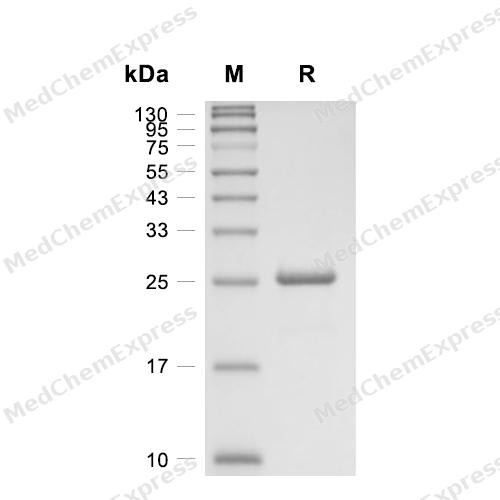
Purity - SDS-PAGE


Technical Parameters
-
Species Human
-
Source E. coli
-
Tag N-SUMO;N-6*His
-
Accession
P25106 (M1-K40)
-
Molecular Construction
-
N-term
-
6*His-SUMO
-
ACKR3 (M1-K40)
Accession # P25106 -
C-term
-
-
Protein Length
Extracellular Domain
-
Synonyms
ACKR3; Chemokine (C-X-C Motif) Receptor 7; Prev. CMKOR1; G-Protein Coupled Receptor 159; Prev. CXCR7; CXC-R7; GPR159; CXCR-7; RDC1; RDC-1; Chemokine Orphan Receptor 1; G Protein-Coupled Receptor; G-Protein Coupled Receptor RDC1 Homolog; Atypical Chemokine
-
AA Sequence
MDLHLFDYSEPGNFSDISWPCNSSDCIVVDTVMCPNMPNK
-
Molecular Weight
Approximately 27 kDa, based on SDS-PAGE under reducing conditions.
-
Purity
≥ 90%, as determined by reducing SDS-PAGE.


Product Properties
Lyophilized powder
1.Lyophilized from a 0.22 μm filtered solution of 20 mM Tris-HCl, 0.5 M NaCl, 6% trehalose, pH 8.0.
2.Lyophilized from a 0.22 μm filtered solution of PBS, pH 8.0, 6% trehalose.
Please refer to the lot-specific COA for specific buffer information.
Note: For SPR assay, please replace the buffer. Primary amine components (e.g., Tris, imidazole) can affect protein-coupled chips.
<1 EU/μg, determined by LAL method.
It is not recommended to reconstitute to a concentration less than 100 μg/mL in ddH2O.
Stored at -20°C for 2 years from date of receipt. After reconstitution, it is stable at 4°C for 1 week or -20°C for longer (with carrier protein). It is recommended to freeze aliquots at -20°C or -80°C for extended storage.
Room temperature in continental US; may vary elsewhere.


Documentation
-
Data Sheet (235 KB)
-
SDS (251 KB)
- English - EN (251 KB)
- Français - FR (251 KB)
- Deutsch - DE (251 KB)
- Norwegian - NO (251 KB)
- Español - ES (251 KB)
- Swedish - SV (251 KB)
- Italian - IT (251 KB)
- Korean - KR (251 KB)
- Portuguese - PT (251 KB)
-
Handling Instructions (2659 KB)

Calculators
Concentration (start) × Volume (start) = Concentration (final) × Volume (final)


 Powered by Bioz

