



I-309/CCL1 Protein, Human

Based on 1 Customer Validation
CCL1 Protein, Human is a cytokine that mediates inflammatory immune responses, viral infections, and tumorigenesis by interacting with the CCR8 chemokine receptor on the cell surface and attracting monocytes, natural killer cells, and immature B-cell nuclear dendritic cells. I-309/CCL1 Protein, Human is a recombinant human CCL1 (K24-K96) expressed by E. coli.
- Species: Human
- Source: E. coli
-
Storage:Stored at -20°C for 2 years from date of receipt. After reconstitution, it is stable at 4°C for 1 week or -20°C for longer (with carrier protein). It is recommended to freeze aliquots at -20°C or -80°C for extended storage.


To place orders, for customer services and technical support, please contact: MedChemExpress USA
Tel: 609-228-6898 E-mail: [email protected] [email protected]


-
 Biological Activity
-
Technical Parameters
-
Product Properties
- Documentation
- References
- Help & FAQs




Biological Activity
Description
CCL1 Protein, Human is a cytokine that mediates inflammatory immune responses, viral infections, and tumorigenesis by interacting with the CCR8 chemokine receptor on the cell surface and attracting monocytes, natural killer cells, and immature B-cell nuclear dendritic cells. I-309/CCL1 Protein, Human is a recombinant human CCL1 (K24-K96) expressed by E. coli[1].
Background
CCL1 is a small glycoprotein belonging to the CC chemokine family with a molecular weight of approximately 15-16 kDa, known as small inducible cytokine I-309 in humans and TCA-3 in mice. CCL1 is secreted by activated monocytes, macrophages, T lymphocytes and endothelial cells and is chemotactic for monocytes but not for neutrophils[1]. CCL1 can be activated by interaction with the cell surface chemokine receptor CCR8, which induces Ca2+ influx, stimulates transient increases in cytoplasmic free calcium concentration in monocytes, and inhibits apoptosis in thymocyte lines via the RAS/MAPK pathway. Among others, CCR8 is constitutively expressed in monocytes, macrophages, Th2 and regulatory T lymphocytes and is the sole receptor for the human CCL1 and for the viral chemokine, vCCL1 (viral macrophage inflammatory protein 1). CCR8 has been shown to be associated with phagocytic macrophages and activated microglia in MS lesions and is directly related to demyelinating activity[2]. CCL1 is involved in inflammatory processes through leukocyte recruitment and can play a key role in angiogenesis and other viral and neoplastic processes. A number of single nucleotide polymorphisms (SNPs) in the CCL1 gene have been associated with the progression of chronic obstructive pulmonary disease (COPD). In parallel, CCL1 plays a role in various CNS functions and diseases and may be associated with neuroinflammatory disorders[3].
In Vitro
CCL1 (100 ng/mL, 3h) stimulates a 14-fold increase in human aortic smooth muscle cells (VSMCs) migration and induces VSMC chemotaxis. Also, it stimulates VSMC secretion of pro - MMP2 and induces MMP-2 mRNA[4].
Verified Bioactivity
1. Fully biologically active when compared to standard. The biological activity determined by a chemotaxis bioassay using human T-lymphocytes is in a concentration range of 10.0-100.0 ng/mL.
2. Determined by its ability to chemoattract human monocytes population (THP-1). The ED50 for this effect is 64.65 ng/mL, corresponding to a specific activity is 1.547×10⁴ U/mg.
MCE Validation Data
-
Purity - SDS-PAGE
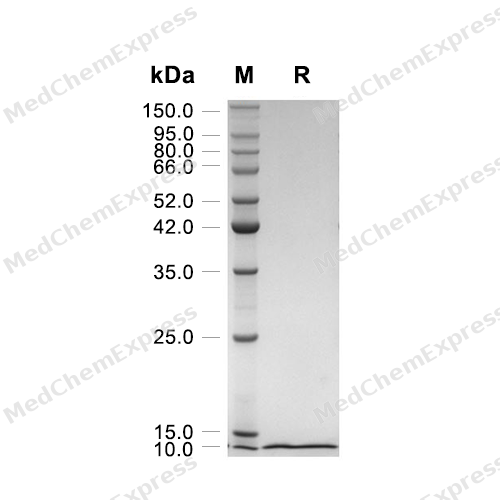
Purity - SDS-PAGE
-
Bioactivity - Cell-Based Assay
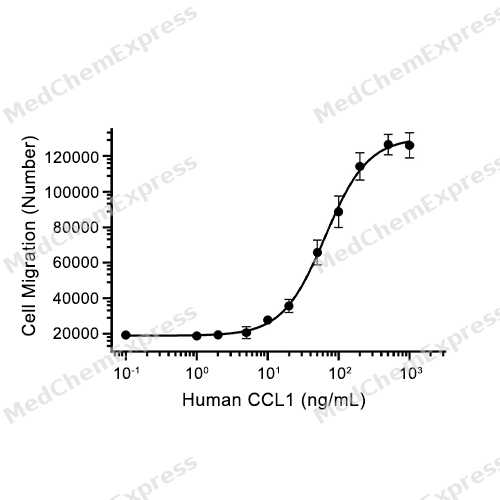
Bioactivity - Cell-Based Assay


Technical Parameters
-
Species Human
-
Source E. coli
-
Tag Tag Free
-
Accession
P22362 (K24-K96)
-
Molecular Construction
-
N-term
-
CCL1 (K24-K96)
Accession # P22362 -
C-term
-
-
Protein Length
Full Length of Mature Protein
-
Synonyms
CCL1; SISe; Prev. SCYA1; Chemokine (C-C Motif) Ligand 1; T Lymphocyte-Secreted Protein I-309; Inflammatory Cytokine I-309; I-309; C-C Motif Chemokine 1; TCA3; Small-Inducible Cytokine A1; P500; C-C Motif Chemokine Ligand 1; Small Inducible Cytokine A1 (I-
-
AA Sequence
KSMQVPFSRCCFSFAEQEIPLRAILCYRNTSSICSNEGLIFKLKRGKEACALDTVGWVQRHRKMLRHCPSKRK
-
Predicted Molecular Mass
8.6 kDa
-
Molecular Weight
Approximately 10 kDa, based on SDS-PAGE under reducing conditions.
-
Purity
≥ 95%, as determined by reducing SDS-PAGE.


Product Properties
Lyophilized powder.
Lyophilized from a 0.22 μm filtered solution of 20 mM PB, 150 mM NaCl, pH 7.4.
<1 EU/μg, determined by LAL method.
It is not recommended to reconstitute to a concentration less than 100 μg/mL in ddH2O. For long term storage it is recommended to add a carrier protein (0.1% BSA, 5% HSA, 10% FBS or 5% Trehalose).
Stored at -20°C for 2 years from date of receipt. After reconstitution, it is stable at 4°C for 1 week or -20°C for longer (with carrier protein). It is recommended to freeze aliquots at -20°C or -80°C for extended storage.
Room temperature in continental US; may vary elsewhere.


Documentation
-
Data Sheet (263 KB)
-
SDS (252 KB)
- English - EN (252 KB)
- Français - FR (252 KB)
- Deutsch - DE (252 KB)
- Norwegian - NO (252 KB)
- Español - ES (252 KB)
- Swedish - SV (252 KB)
- Italian - IT (252 KB)
- Korean - KR (252 KB)
- Portuguese - PT (252 KB)
-
Handling Instructions (2659 KB)


References
[1]. M D Miller, et al. The human cytokine I-309 is a monocyte chemoattractant. Proc Natl Acad Sci U S A. 1992 Apr 1;89(7):2950-4. [Content Brief]
[2]. A Zingoni, et al. The chemokine receptor CCR8 is preferentially expressed in Th2 but not Th1 cells. J Immunol. 1998 Jul 15;161(2):547-51. [Content Brief]
[3]. Gültekin Tamgüney, et al. Autocrine stimulation of rhadinovirus-transformed T cells by the chemokine CCL1/I-309. Oncogene. 2004 Nov 4;23(52):8475-85. [Content Brief]
[4]. Nasreen S Haque, et al. Chemokine receptor-8 (CCR8) mediates human vascular smooth muscle cell chemotaxis and metalloproteinase-2 secretion. Blood. 2004 Feb 15;103(4):1296-304. [Content Brief]

Calculators
Concentration (start) × Volume (start) = Concentration (final) × Volume (final)


 Powered by Bioz

