



Dectin-1/CLEC7A Protein, Human (HEK293, Fc)
Based on 1 publication(s) in Google Scholar
The Dectin-1/CLEC7A protein is a lectin and pattern recognition receptor that targets β-1,3- and β-1,6-linked glucans in bacterial and fungal cell walls. It triggers Toll-like receptor 2 (TLR2)-mediated inflammation by recruiting splenic tyrosine kinase (SYK) and activating the CARD domain-BCL10-MALT1 (CBM) signalosome. Dectin-1/CLEC7A Protein, Human (HEK293, Fc) is the recombinant human-derived Dectin-1/CLEC7A protein, expressed by HEK293 , with N-hFc labeled tag.
- Species: Human
- Source: HEK293
-
Storage:Stored at -20°C for 2 years from date of receipt. After reconstitution, it is stable at 4°C for 1 week or -20°C for longer (with carrier protein). It is recommended to freeze aliquots at -20°C or -80°C for extended storage.


To place orders, for customer services and technical support, please contact: MedChemExpress USA
Tel: 609-228-6898 E-mail: [email protected] [email protected]


-
 Biological Activity
-
Technical Parameters
-
Product Properties
- Documentation
- Help & FAQs




Biological Activity
Description
The Dectin-1/CLEC7A protein is a lectin and pattern recognition receptor that targets β-1,3- and β-1,6-linked glucans in bacterial and fungal cell walls. It triggers Toll-like receptor 2 (TLR2)-mediated inflammation by recruiting splenic tyrosine kinase (SYK) and activating the CARD domain-BCL10-MALT1 (CBM) signalosome. Dectin-1/CLEC7A Protein, Human (HEK293, Fc) is the recombinant human-derived Dectin-1/CLEC7A protein, expressed by HEK293 , with N-hFc labeled tag.
Background
Dectin-1/CLEC7A Protein operates as a lectin, functioning as a pattern recognition receptor (PRR) specifically designed for beta-1,3-linked and beta-1,6-linked glucans, prominent constituents of cell walls in pathogenic bacteria and fungi. Essential for the Toll-like receptor 2 (TLR2)-mediated inflammatory response, Dectin-1, upon binding to beta-glucan, recruits spleen tyrosine kinase (SYK) via its immunoreceptor tyrosine-based activation motif (ITAM) and instigates a signaling cascade. This cascade activates CARD domain-BCL10-MALT1 (CBM) signalosomes, leading to the activation of NF-kappa-B and MAP kinase p38 pathways. Consequently, the stimulation of gene expression encoding pro-inflammatory cytokines and chemokines ensues, thereby enhancing cytokine production in macrophages and dendritic cells. Beyond its role in inflammation, Dectin-1 mediates the production of reactive oxygen species and is instrumental in the phagocytosis of Candida albicans conidia. Moreover, Dectin-1 binds T-cells, playing a role in T-cell activation, inducing phosphorylation of SCIMP upon beta-glucan binding. Existing as a homodimer, Dectin-1 interacts with SYK, participating in leukocyte activation in the presence of fungal pathogens.
Verified Bioactivity
Immobilized Human CLEC7A at 2 μg/mL can bind Anti- CLEC7A antibody. The ED50 for this effect is 215.7 ng/mL.
MCE Validation Data
-
Purity - SDS-PAGE
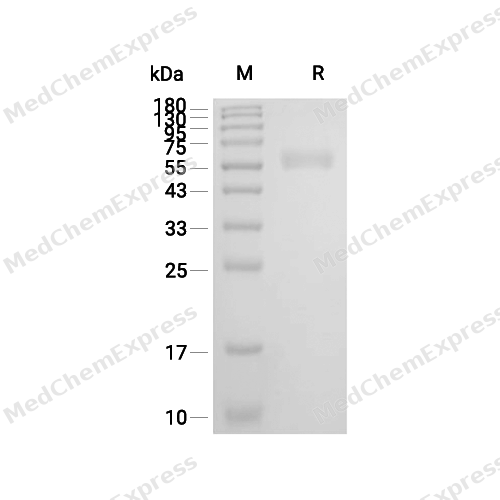
Purity - SDS-PAGE
-
Bioactivity - ELISA
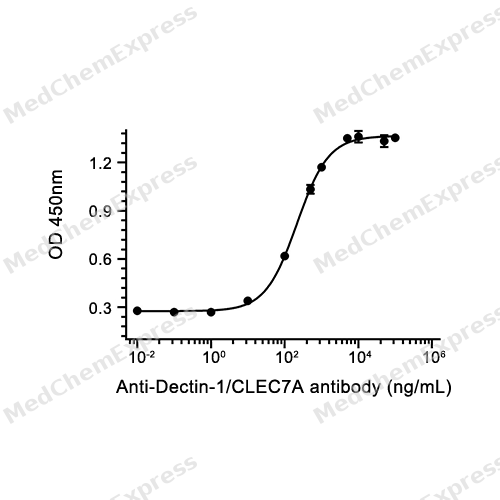
Bioactivity - ELISA


Publications (1)
-
Journal Impact Factor
-
Most Recent
-
Nat Commun
C-type lectin receptor 2d forms homodimers and heterodimers with TLR2 to negatively regulate IRF5-mediated antifungal immunity. [Abstract]2023 Oct 23;14(1):6718. PMID: 37872182


Technical Parameters
-
Species Human
-
Source HEK293
-
Tag N-hFc
-
Accession
Q9BXN2-1 (T66-M247)
-
Molecular Construction
-
N-term
-
hFc
-
CLEC7A (T66-M247)
Accession # Q9BXN2-1 -
C-term
-
-
Protein Length
Extracellular Domain
-
Synonyms
CLEC7A; CDNA FLJ59887, Moderately Similar To Homo Sapiens C-Type Lectin Domain Family 7, Member A (CLEC7A), Transcript Variant 4, MRNA; Prev. CLECSF12; C-Type Lectin Domain Containing 7A Transcript Variant 7; C-Type Lectin Domain Family 7 Member A; C-Type
-
AA Sequence
TMAIWRSNSGSNTLENGYFLSRNKENHSQPTQSSLEDSVTPTKAVKTTGVLSSPCPPNWIIYEKSCYLFSMSLNSWDGSKRQCWQLGSNLLKIDSSNELGFIVKQVSSQPDNSFWIGLSRPQTEVPWLWEDGSTFSSNLFQIRTTATQENPSPNCVWIHVSVIYDQLCSVPSYSICEKKFSM
-
Molecular Weight
Approximately 50-65 kDa, based on SDS-PAGE under reducing conditions.
-
Glycosylation
Yes
-
Purity
≥ 95%, as determined by reducing SDS-PAGE.


Product Properties
Lyophilized powder
Lyophilized from a 0.22 μm filtered solution of PBS, pH 7.4.
<1 EU/μg, determined by LAL method.
It is not recommended to reconstitute to a concentration less than 100 μg/mL in ddH2O. For long term storage it is recommended to add a carrier protein (0.1% BSA, 5% HSA, 10% FBS or 5% Trehalose).
Stored at -20°C for 2 years from date of receipt. After reconstitution, it is stable at 4°C for 1 week or -20°C for longer (with carrier protein). It is recommended to freeze aliquots at -20°C or -80°C for extended storage.
Room temperature in continental US; may vary elsewhere.


Documentation
-
Data Sheet (237 KB)
-
SDS (252 KB)
- English - EN (252 KB)
- Français - FR (252 KB)
- Deutsch - DE (252 KB)
- Norwegian - NO (252 KB)
- Español - ES (252 KB)
- Swedish - SV (252 KB)
- Italian - IT (252 KB)
- Korean - KR (252 KB)
- Portuguese - PT (252 KB)
-
Handling Instructions (2659 KB)

Calculators
Concentration (start) × Volume (start) = Concentration (final) × Volume (final)


 Powered by Bioz

