



IL-23 Protein, Rat (HEK293, His)
Based on 1 publication(s) in Google Scholar
IL-23 alpha protein has cytokine activity and binds to the interleukin 23 receptor. It regulates cytokine production, lymphocyte activation, and peptidyl tyrosine phosphorylation. IL-23 Protein, Rat (HEK293, His) is a recombinant protein dimer complex containing rat-derived IL-23 alpha & IL-12 beta Heterodimer protein, expressed by HEK293 , with C-10*His labeled tag.
- Species: Rat
- Source: HEK293
-
Storage:Stored at -20°C for 2 years from date of receipt. After reconstitution, it is stable at 4°C for 1 week or -20°C for longer (with carrier protein). It is recommended to freeze aliquots at -20°C or -80°C for extended storage.


To place orders, for customer services and technical support, please contact: MedChemExpress USA
Tel: 609-228-6898 E-mail: [email protected] [email protected]


-
 Biological Activity
-
Technical Parameters
-
Product Properties
- Documentation
- Help & FAQs




Biological Activity
Description
IL-23 alpha protein has cytokine activity and binds to the interleukin 23 receptor. It regulates cytokine production, lymphocyte activation, and peptidyl tyrosine phosphorylation. IL-23 Protein, Rat (HEK293, His) is a recombinant protein dimer complex containing rat-derived IL-23 alpha & IL-12 beta Heterodimer protein, expressed by HEK293 , with C-10*His labeled tag.
Background
The IL-23 alpha protein is predicted to possess cytokine activity and contribute to the binding of interleukin-23 receptors. It is also predicted to be involved in various processes, including the positive regulation of cytokine production, lymphocyte activation, and peptidyl-tyrosine phosphorylation. Furthermore, it is anticipated to play a role upstream of T cell proliferation and in the positive regulation of transcription by RNA polymerase II. Located in the extracellular space, this protein is also predicted to be a component of the interleukin-23 complex. In terms of expression, it demonstrates bias toward the thymus (RPKM 15.2), spleen (RPKM 11.9), and nine other tissues. It shares orthology with the human IL23A gene, which is responsible for encoding the interleukin 23 subunit alpha.
Verified Bioactivity
1. Measured by its ability to induce IL17 secretion by mouse splenocytes and the ED50 is 0.5-3 ng/mL.
2. Measured by its ability to induce IL17 secretion by mouse CTLL-2 cells. The ED50 for this effect is 4.136 ng/mL, corresponding to a specific activity is 2.41×10⁵ U/mg.
3. Measured by its binding ability in a functional ELISA. Immobilized Rat IL-23R at 10 μg/mL (100 μL/well) on the plate can bind Rat IL-23 Protein. The ED50 for this effect is 0.08-0.3 μg/mL.
MCE Validation Data
-
Purity - SDS-PAGE
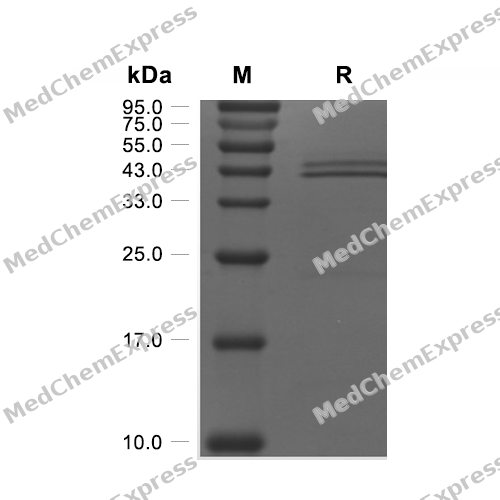
Purity - SDS-PAGE
-
Bioactivity - Cell-Based Assay
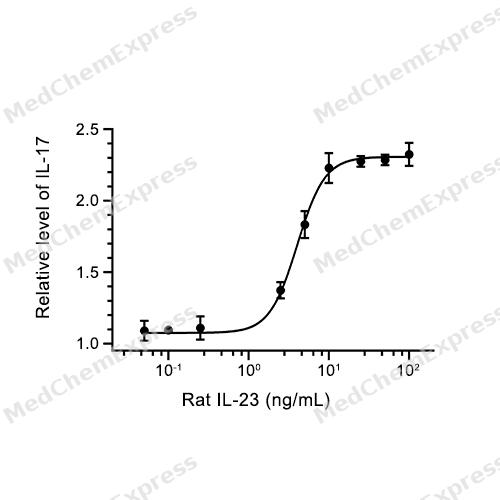
Bioactivity - Cell-Based Assay


Publications (1)
-
Journal Impact Factor
-
Most Recent
-
Heliyon
Astragalus regulates the intestinal immune response during sepsis by mediating ILC3 proliferation through RORγt. [Abstract]2023 Jun 28;9(7):e17766. PMID: 37539221


Technical Parameters
-
Species Rat
-
Source HEK293
-
Tag C-10*His
-
Accession
NP_569094.1 (V22-A196) & EDM04146.1 (M23-S335)
-
Synonyms
IL23A; Interleukin 23, Alpha Subunit P19; Interleukin 23 Subunit Alpha; Interleukin-23 Subunit Alpha; SGRF; Interleukin-23 Subunit P19; IL23P19; IL-23 Subunit Alpha; IL-23A; IL-23p19; IL-23; IL-23-A; P19; JKA3 Induced Upon T-Cell Activation; Interleukin-S
-
AA Sequence
IL-23alpha:
VPRSSSPDWAQCQQLSRNLCTLAWSAHTPVGQMDLLREEGEEETKSDVPRIQCGDGCDPQGLKDNSQFCLQRIRQGLVFYKHLLDSDIFTGEPSLLPDSPVDQLHTSLLGLSQLLQPEDHHWETQQMPRLSPSQQWQRSLLRSKILRSLQAFLAIAARVFAHGAATLTEPLVPTA
IL-12beta:
MWELEKDVYVVEVDWRPDAPGETVTLTCDSPEEDDITWTSDQRRGVIGSGKTLTITVREFLDAGQYTCHRGGETLSHSHLLLHKKENGIWSTEILKNFKNKTFLKCEAPNYSGRFTCSWLVHRNTDLKFNIKSSSSSPESRAVTCGAASLSAEKVTLNQRDYEKYSVACQEDVTCPTAEETLPIELVVEAQQQNKYENYSTSFFIRDIIKPDPPKNLQVKPLKNSQVEVSWEYPDSWSTPHSYFSLKFFVRIQRKKEKTKETEEECNQKGAFLVEKTSAEVQCKGANICVQAQDRYYNSSCSKWTCVPCRGRS -
Molecular Weight
Approximately 47 kDa & 43 kDa & 28 kDa & 25 kDa, based on SDS-PAGE under reducing conditions.
-
Purity
≥ 90%, as determined by reducing SDS-PAGE.


Product Properties
Lyophilized powder
Lyophilized from a 0.2 μm filtered solution of PBS, pH 7.4.
<1 EU/μg, determined by LAL method.
It is not recommended to reconstitute to a concentration less than 100 μg/mL in ddH2O. For long term storage it is recommended to add a carrier protein (0.1% BSA, 5% HSA, 10% FBS or 5% Trehalose).
Stored at -20°C for 2 years from date of receipt. After reconstitution, it is stable at 4°C for 1 week or -20°C for longer (with carrier protein). It is recommended to freeze aliquots at -20°C or -80°C for extended storage.
Room temperature in continental US; may vary elsewhere.


Documentation
-
Data Sheet (239 KB)
-
SDS (254 KB)
- English - EN (254 KB)
- Français - FR (254 KB)
- Deutsch - DE (254 KB)
- Norwegian - NO (254 KB)
- Español - ES (254 KB)
- Swedish - SV (254 KB)
- Italian - IT (254 KB)
- Korean - KR (254 KB)
- Portuguese - PT (254 KB)
-
Handling Instructions (2659 KB)

Calculators
Concentration (start) × Volume (start) = Concentration (final) × Volume (final)


 Powered by Bioz

