



MMP-9 Protein, Human (HEK293)
Based on 2 publication(s) in Google Scholar
MMP-9 is an important member of the MMP protein family and regulates the extracellular matrix during physiological processes such as development and tissue remodeling. It involves arthritis and metastasis. MMP-9 Protein, Human (HEK293) is the recombinant human-derived MMP-9 protein, expressed by HEK293 , with tag free.
- Species: Human
- Source: HEK293
-
Storage:Stored at -20°C for 2 years from date of receipt. After reconstitution, it is stable at 4°C for 1 week or -20°C for longer (with carrier protein). It is recommended to freeze aliquots at -20°C or -80°C for extended storage.


To place orders, for customer services and technical support, please contact: MedChemExpress USA
Tel: 609-228-6898 E-mail: [email protected] [email protected]


-
 Biological Activity
-
Technical Parameters
-
Product Properties
- Documentation
- Help & FAQs


-
HY-148905
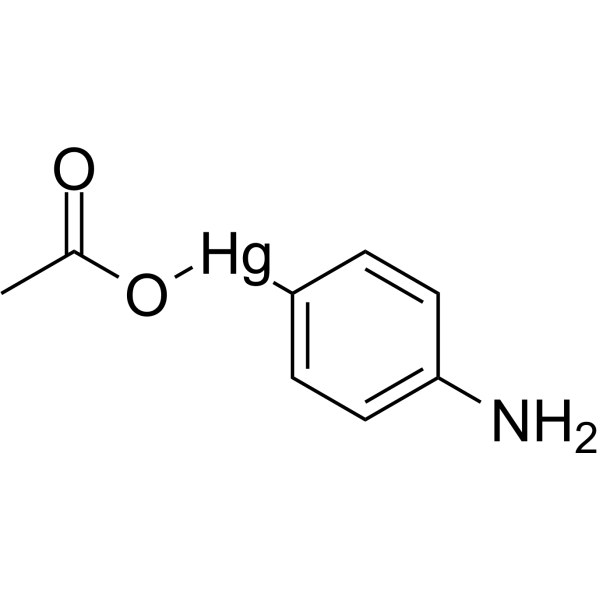
p-Aminophenylmercuric acetate -

HY-P73296
MMP-2 Protein, Human (HEK293) -
HY-P72507
MMP-8 Protein, Human (HEK293, His) -
HY-P70250
MMP-1 Protein, Human (HEK293, His, solution) -
HY-Y0873
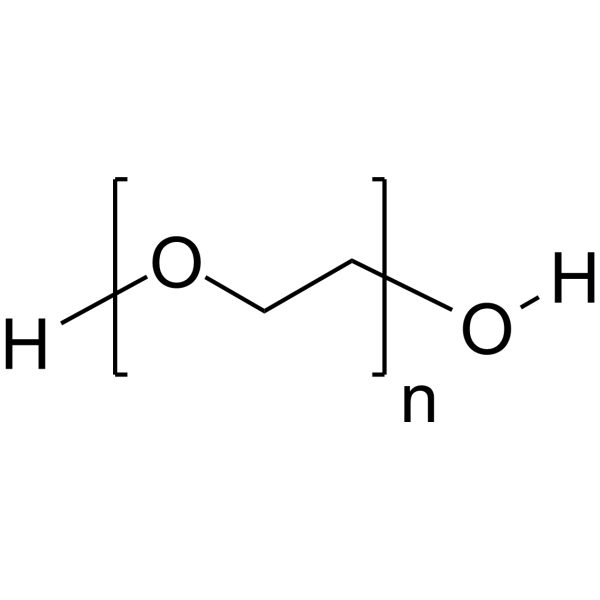
PEG300 -
HY-18739
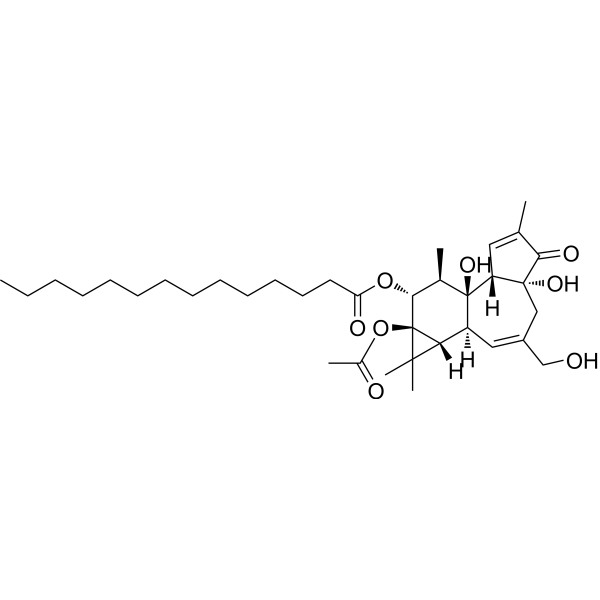
Phorbol 12-myristate 13-acetate -
HY-12318
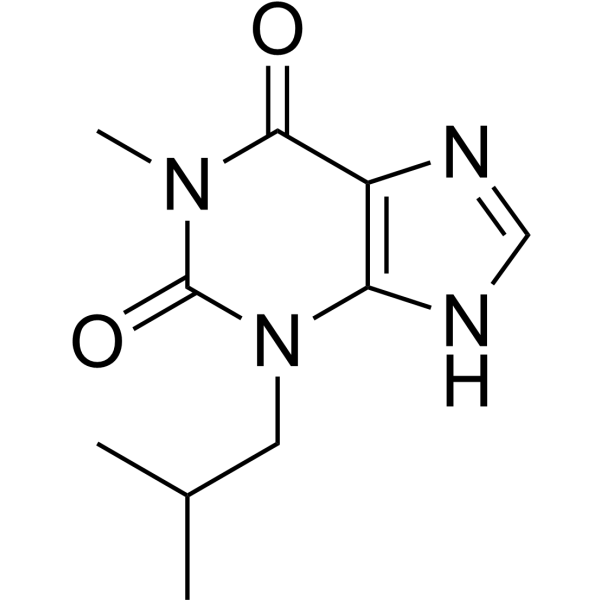
IBMX -
HY-A0281
4-Phenylbutyric acid -
HY-10071
Y-27632 -

HY-P0014
Liraglutide -
HY-P7044
IL-6 Protein, Human -
HY-15768
Ilomastat


Biological Activity
Description
MMP-9 is an important member of the MMP protein family and regulates the extracellular matrix during physiological processes such as development and tissue remodeling. It involves arthritis and metastasis. MMP-9 Protein, Human (HEK293) is the recombinant human-derived MMP-9 protein, expressed by HEK293 , with tag free.
Background
MMP-9, a member of the matrix metalloproteinase (MMP) family, plays a crucial role in modulating the extracellular matrix during various physiological processes, including embryonic development, reproduction, and tissue remodeling. These proteins are pivotal in both normal and pathological conditions, such as arthritis and metastasis. Typically secreted as inactive proproteins, MMPs are activated through cleavage by extracellular proteinases. The enzyme encoded by the MMP-9 gene specifically targets type IV and V collagens. Research in rhesus monkeys suggests its involvement in IL-8-induced mobilization of hematopoietic progenitor cells from the bone marrow, while murine studies propose a role in tumor-associated tissue remodeling. With biased expression observed in bone marrow (RPKM 144.9), lymph node (RPKM 49.8), and other tissues, MMP-9 emerges as a key player in the dynamic regulation of tissue architecture and cellular processes.
Verified Bioactivity
Measured by its ability to cleave the fluorogenic peptide substrate, Mca-PLGL-Dpa-AR-NH2 and the specific activity is >1300 pmol/min/μg. (Activation description: The proenzyme needs to be activated by APMA (HY-148905) for an activated form.)
MCE Validation Data
-
Purity - SDS-PAGE
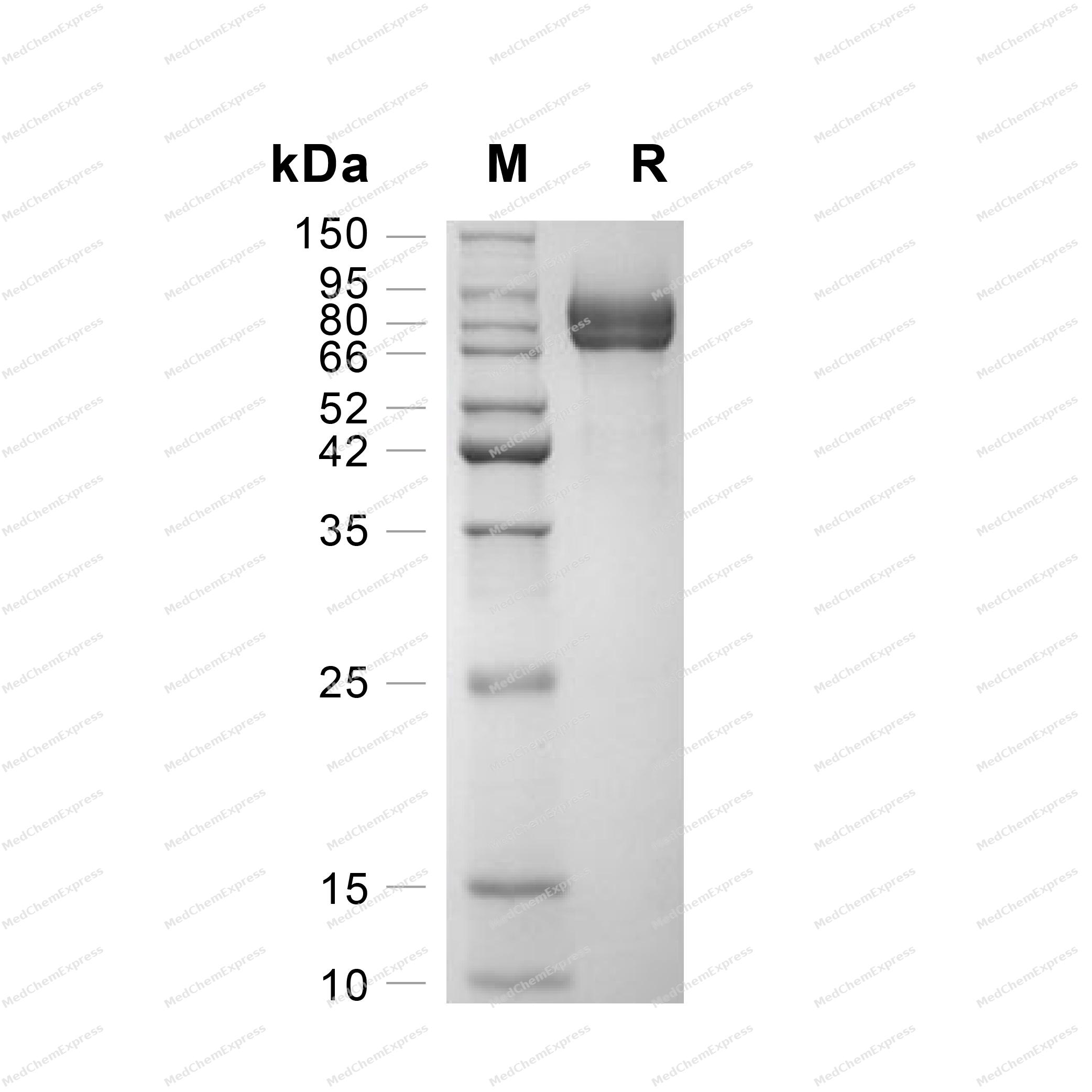
Purity - SDS-PAGE
-
Bioactivity - Enzymatic Activity Assay
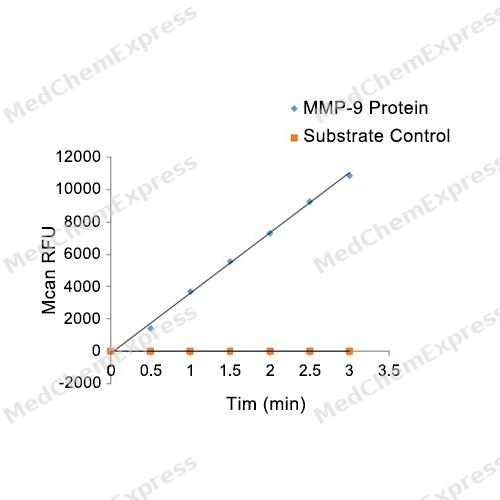
Bioactivity - Enzymatic Activity Assay

Assay Procedure
Materials
Assay buffer:50 mM Tris,10 mM CaCl2, 150 mM NaCl, 0.05% Brij-35(w/v), pH 7.5(TCNB)
Test protein: MMP-9 Protein, Human (HEK293) (HY-P73300)
Activator: p-aminophenylmercuric acetate (APMA, HY-148905), stored as a 100 mM solution diluted in DMSO.
Substrate:MCA-Pro-Leu-Gly-Leu-DPA-Ala-Arg-NH2 (HY-131498)
Standard: MCA-Pro-Leu-OH
Procedure
1. Standard Curve:Dilute standard in assay buffer to concentrations of 0, 1.5625, 3.125, 6.25, 12.5, 25, 50, and 100 μM. Add 100 μL of each dilution to a black microplate well. Measure fluorescence in kinetic mode for 5 minutes at excitation and emission wavelengths of 320 nm and 405 nm, respectively. Plot the measured RFU values on the y-axis and the standard concentrations on the x-axis to generate a standard curve and obtain the curve equation.
2. Dilute Human MMP-9 to 100 μg/mL in assay buffer.
3. Activate Human MMP-9 by adding APMA to a final concentration of 1 mM.
4. Incubate at 37°C for 24 hours.
5. Dilute the activated Human MMP-9 to 0.4 μg/mL in assay buffer.
6. Dilute the substrate to 20 μM in assay buffer.
7. Experimental group: Add 50 μL of 0.4 μg/mL Human MMP-9 to the plate and initiate the reaction by adding 50 μL of 20 μM substrate.
Control group: 50 μL of assay buffer and 50 μL of 20 μM substrate.
8. Read in kinetic mode for 5 minutes at excitation and emission wavelengths of 320 nm and 405 nm, respectively.
9. Calculate the specific activity.
Specific Activity (pmol/min/μg) = | Adjusted Vmax* (RFU/min) x Conversion Factor ** (pmol/RFU) |
| amount of enzyme (μg) |
*Adjusted for Control
**Derived using calibration standard


Publications (2)
-
Journal Impact Factor
-
Most Recent
-
Food Funct
The potential anti-caries activity of theaflavins (TFs): investigation of their inhibitory effect on matrix metalloproteinase-9 (MMP-9) and the underlying mechanism. [Abstract]2026 Feb 23;17(4):2050-2067. PMID: 41661095 -
Biomedicines
Environmental Lead Promotes Breast Cancer Migration and Invasion via the AKR1C3-NF-κB-MMP Axis. [Abstract]2026 Jan 27;14(2):286. PMID: 41751184


Technical Parameters
-
Species Human
-
Source HEK293
-
Tag Tag Free
-
Accession
NP_004985.2 (A20-D707)
-
Molecular Construction
-
N-term
-
MMP-9 (A20-D707)
Accession # NP_004985.2 -
C-term
-
-
Protein Length
Full Length of Mature Protein (with Propeptide)
-
Synonyms
MMP9; Matrix Metallopeptidase 9 (Gelatinase B, 92kDa Gelatinase, 92kDa Type IV Collagenase); Prev. CLG4B; Macrophage Gelatinase; Matrix Metalloproteinase 9 (Gelatinase B, 92kDa Gelatinase, 92kDa Type IV Collagenase); Type V Collagenase; Matrix Metalloproteinase-9; 92 KDa Gelatinase; MMP-9; Gelatinase B; GELB; MANDP2; Matrix Metallopeptidase 9; 92 KDa Type IV Collagenase
-
AA Sequence
APRQRQSTLVLFPGDLRTNLTDRQLAEEYLYRYGYTRVAEMRGESKSLGPALLLLQKQLSLPETGELDSATLKAMRTPRCGVPDLGRFQTFEGDLKWHHHNITYWIQNYSEDLPRAVIDDAFARAFALWSAVTPLTFTRVYSRDADIVIQFGVAEHGDGYPFDGKDGLLAHAFPPGPGIQGDAHFDDDELWSLGKGVVVPTRFGNADGAACHFPFIFEGRSYSACTTDGRSDGLPWCSTTANYDTDDRFGFCPSERLYTQDGNADGKPCQFPFIFQGQSYSACTTDGRSDGYRWCATTANYDRDKLFGFCPTRADSTVMGGNSAGELCVFPFTFLGKEYSTCTSEGRGDGRLWCATTSNFDSDKKWGFCPDQGYSLFLVAAHEFGHALGLDHSSVPEALMYPMYRFTEGPPLHKDDVNGIRHLYGPRPEPEPRPPTTTTPQPTAPPTVCPTGPPTVHPSERPTAGPTGPPSAGPTGPPTAGPSTATTVPLSPVDDACNVNIFDAIAEIGNQLYLFKDGKYWRFSEGRGSRPQGPFLIADKWPALPRKLDSVFEERLSKKLFFFSGRQVWVYTGASVLGPRRLDKLGLGADVAQVTGALRSGRGKMLLFSGRRLWRFDVKAQMVDPRSASEVDRMFPGVPLDTHDVFQYREKAYFCQDRFYWRVSSRSELNQVDQVGYVTYDILQCPED
-
Molecular Weight
Approximately 80-95 kDa, based on SDS-PAGE under reducing conditions, due to the glycosylation.
-
Glycosylation
Yes
-
Purity
≥ 90%, as determined by reducing SDS-PAGE.


Product Properties
Lyophilized powder
1.Lyophilized from a 0.22 μm filtered solution of 50 mM Tris, 150 mM NaCl, 10 mM CaCl2, 0.05% Brij35, pH 7.5, 5% trehalose, 5% mannitol, 0.01% Tween 80.
2.Lyophilized from a 0.22 μm filtered solution of 50 mM Tris, 150 mM NaCl, pH 7.5.
3.Lyophilized from a 0.22 μm filtered solution of 50 mM Tris-HCl, 150 mM NaCl, pH 7.5.
4.Lyophilized from a 0.22 μm filtered solution of 50 mM Tris-HCl, 150 mM NaCl, pH 7.5, 8% trehalose.
Please refer to the lot-specific COA for specific buffer information.
Note: For SPR assay, please replace the buffer. Primary amine components (e.g., Tris, imidazole) can affect protein-coupled chips.
<1 EU/μg, determined by LAL method.
It is not recommended to reconstitute to a concentration less than 100 μg/mL in ddH2O. For long term storage it is recommended to add a carrier protein (0.1% BSA, 5% HSA, 10% FBS or 5% Trehalose).
Stored at -20°C for 2 years from date of receipt. After reconstitution, it is stable at 4°C for 1 week or -20°C for longer (with carrier protein). It is recommended to freeze aliquots at -20°C or -80°C for extended storage.
Room temperature in continental US; may vary elsewhere.


Documentation
-
Data Sheet (240 KB)
-
SDS (254 KB)
- English - EN (254 KB)
- Français - FR (254 KB)
- Deutsch - DE (254 KB)
- Norwegian - NO (254 KB)
- Español - ES (254 KB)
- Swedish - SV (254 KB)
- Italian - IT (254 KB)
- Korean - KR (254 KB)
- Portuguese - PT (254 KB)
-
Handling Instructions (2659 KB)

Calculators
Concentration (start) × Volume (start) = Concentration (final) × Volume (final)


 Powered by Bioz

