



MMP-9 Protein, Mouse (HEK293)
Based on 4 publication(s) in Google Scholar
The MMP-9 protein is a matrix metalloproteinase that is critical for local extracellular matrix proteolysis and leukocyte migration.It is suggested that it may be involved in bone osteoclastic resorption.MMP-9 Protein, Mouse (HEK293) is the recombinant mouse-derived MMP-9 protein, expressed by HEK293 , with tag free.
- Species: Mouse
- Source: HEK293
-
Storage:Stored at -20°C for 2 years from date of receipt. After reconstitution, it is stable at 4°C for 1 week or -20°C for longer (with carrier protein). It is recommended to freeze aliquots at -20°C or -80°C for extended storage.


To place orders, for customer services and technical support, please contact: MedChemExpress USA
Tel: 609-228-6898 E-mail: [email protected] [email protected]


-
 Biological Activity
-
Technical Parameters
-
Product Properties
- Documentation
- Help & FAQs


-
HY-148905
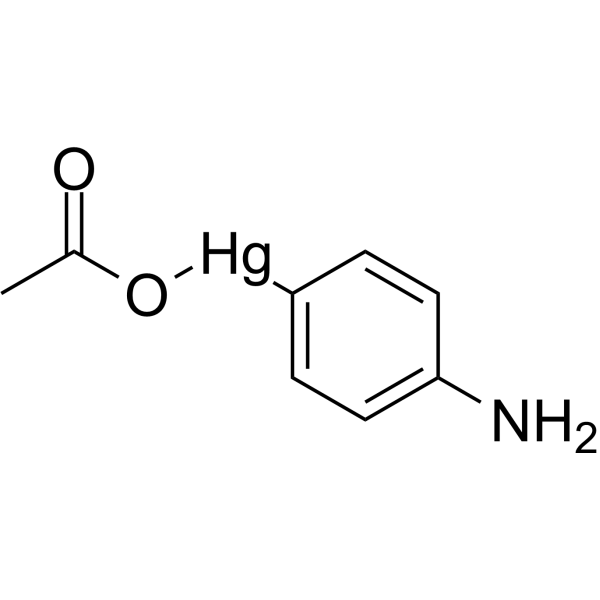
p-Aminophenylmercuric acetate -

HY-P73810
MMP-2 Protein, Mouse (HEK293, His) -
HY-P73296
MMP-2 Protein, Human (HEK293) -
HY-13259
MG-132 -
HY-P73300
MMP-9 Protein, Human (HEK293) -
HY-P70282
Myeloperoxidase/MPO Protein, Mouse (HEK293, His) -
HY-P70469
SDF-1 alpha/CXCL12 Protein, Human -
HY-P78328
MMP-8 Protein, Mouse (HEK293, His) -
HY-P7747
Cathepsin B Protein, Mouse (HEK293, His) -
HY-P70139
Stromelysin-1/MMP-3 Protein, Human (HEK293, His)


Biological Activity
Description
The MMP-9 protein is a matrix metalloproteinase that is critical for local extracellular matrix proteolysis and leukocyte migration.It is suggested that it may be involved in bone osteoclastic resorption.MMP-9 Protein, Mouse (HEK293) is the recombinant mouse-derived MMP-9 protein, expressed by HEK293 , with tag free.
Background
MMP-9 Protein, a matrix metalloproteinase, plays a crucial role in local proteolysis of the extracellular matrix and facilitates leukocyte migration. It could be involved in bone osteoclastic resorption and cleaves KiSS1 at a specific Gly-|-Leu bond. Additionally, MMP-9 cleaves NINJ1 to generate the Secreted ninjurin-1 form and processes type IV and type V collagen into large C-terminal three-quarter fragments and shorter N-terminal one-quarter fragments. While degrading fibronectin, MMP-9 does not impact laminin or Pz-peptide, showcasing its selectivity in substrate cleavage.
Verified Bioactivity
Measured by its ability to cleave the fluorogenic peptide substrate, Mca-PLGL-Dpa-AR-NH2. The specific activity is >1,500 pmol/min/µg, as measured under the described conditions. (Activation description: The proenzyme needs to be activated by APMA (HY-148905) for an activated form.)
MCE Validation Data
-
Purity - SDS-PAGE
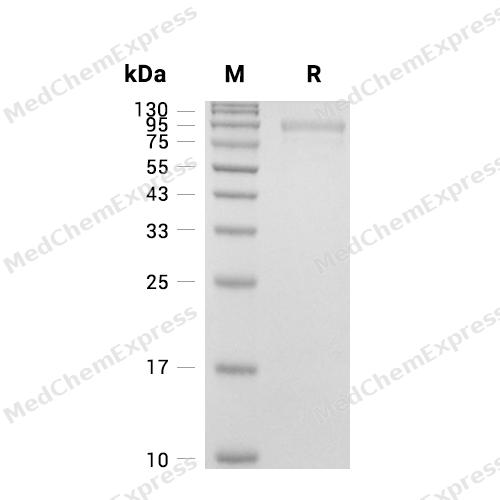
Purity - SDS-PAGE

Assay Procedure
Materials
Assay buffer: 50 mM Tris, 10 mM CaCl2, 150 mM NaCl, 0.05% Brij-35 (w/v) , pH 7.5 (TCNB)
MMP-9 Protein, Mouse (HEK293) (HY-P73807)
p-aminophenylmercuric acetate (APMA, HY-148905), diluted with DMSO to 100 mM for storage
Substrate: MCA-Pro-Leu-Gly-Leu-DPA-Ala-Arg-NH2 (HY-131498)
Standard: MCA-Pro-Leu-OH
Procedure
1. Standard curve: Dilute MCA-Pro-Leu-OH (standard) to 0, 1.5625, 3.125, 6.25, 12.5, 25, 50, 100 μM with assay buffer, and add 100 μL of each into black enzyme-labeled wells. The excitation and emission wavelengths were 320 nm and 405 nm, respectively, and read in kinetic mode for 5 min. The measured RFU was used as the horizontal coordinate, and the amount of standard substance was used as the horizontal coordinate to make the standard curve and obtain the standard curve formula.
2. Proteins were solubilized to 1 mg/mL with ddH2O and subsequently diluted to 100 μg/mL in assay buffer.
3. Mouse MMP-9 was activated by addition of APMA to a final concentration of 1 mM APMA .
4. Incubate at 37°C for 2 hours.
5. Dilute the activated MMP-9 to 0.4 μg/mL in the assay buffer.
6. The substrate was diluted to 20 μM in the assay buffer.
7. Experimental group: 50 μL of 0.4 μg/mL Mouse MMP-9 was added to the plate and the reaction was started by adding 50 μL of 20 μM substrate.
Control: 50 μL of assay buffer and 50 μL of 20 μM substrate.
8. Readings were taken in kinetic mode for 5 min at excitation and emission wavelengths of 320 nm and 405 nm, respectively.
9. Calculate specific activity:
Specific Activity (pmol/min/μg) = | Adjusted Vmax* (RFU/min) x Conversion Factor ** (pmol/RFU) |
| amount of enzyme (μg) |
*Adjusted for Control
**Derived using calibration standard
Per Well:
Mouse MMP-9: 0.02 μg
Substrate: 10 μM


Publications (4)
-
Journal Impact Factor
-
Most Recent
-
Nat Commun
Engineered exosome nanovesicles for delivery of antibodies to treat inflammatory bowel disease. [Abstract]2026 Feb 13;17(1):2737. PMID: 41688436 -
ACS Nano
Enzyme-Responsive DNA Origami-Antibody Conjugates for Targeted and Combined Therapy of Choroidal Neovascularization. [Abstract]2024 Aug 20;18(33):22194-22207. PMID: 39116033 -
Adv Sci (Weinh)
A Brain-Penetrant Nanobody Reveals GSK3β-Driven Proline-Directed Phosphorylation as a Master Regulator of Ischemic Neurodegeneration. [Abstract]2026 Jun 9:e76004. PMID: 42261803 -
Adv Sci (Weinh)
A Dual-Responsive Versatile Nanohybrid Orchestrating Tumor Elimination and Tumor-Associated Osteolysis Restoration via Sequential Release. [Abstract]2026 Mar 18:e18962. PMID: 41847914


Technical Parameters
-
Species Mouse
-
Source HEK293
-
Tag Tag Free
-
Accession
P41245 (P21-P730, P514A, H639P, L711P)
-
Molecular Construction
-
N-term
-
MMP-9 (P21-P730, P514A, H639P, L711P)
Accession # P41245 -
C-term
-
-
Protein Length
Partial
-
Synonyms
MMP9; Matrix Metallopeptidase 9 (Gelatinase B, 92kDa Gelatinase, 92kDa Type IV Collagenase); Prev. CLG4B; Macrophage Gelatinase; Matrix Metalloproteinase 9 (Gelatinase B, 92kDa Gelatinase, 92kDa Type IV Collagenase); Type V Collagenase; Matrix Metalloprot
-
AA Sequence
PYQRQPTFVVFPKDLKTSNLTDTQLAEAYLYRYGYTRAAQMMGEKQSLRPALLMLQKQLSLPQTGELDSQTLKAIRTPRCGVPDVGRFQTFKGLKWDHHNITYWIQNYSEDLPRDMIDDAFARAFAVWGEVAPLTFTRVYGPEADIVIQFGVAEHGDGYPFDGKDGLLAHAFPPGAGVQGDAHFDDDELWSLGKGVVIPTYYGNSNGAPCHFPFTFEGRSYSACTTDGRNDGTPWCSTTADYDKDGKFGFCPSERLYTEHGNGEGKPCVFPFIFEGRSYSACTTKGRSDGYRWCATTANYDQDKLYGFCPTRVDATVVGGNSAGELCVFPFVFLGKQYSSCTSDGRRDGRLWCATTSNFDTDKKWGFCPDQGYSLFLVAAHEFGHALGLDHSSVPEALMYPLYSYLEGFPLNKDDIDGIQYLYGRGSKPDPRPPATTTTEPQPTAPPTMCPTIPPTAYPTVGPTVGPTGAPSPGPTSSPSPGPTGAPSPGPTAAPTAGSSEASTESLSPADNPCNVDVFDAIAEIQGALHFFKDGWYWKFLNHRGSPLQGPFLTARTWPALPATLDSAFEDPQTKRVFFFSGRQMWVYTGKTVLGPRSLDKLGLGPEVTHVSGLLPRRPGKALLFSKGRVWRFDLKSQKVDPQSVIRVDKEFSGVPWNSHDIFQYQDKAYFCHGKFFWRVSFQNEVNKVDPEVNQVDDVGYVTYDLLQCP
-
Molecular Weight
Approximately 100 kDa, based on SDS-PAGE under reducing conditions, due to the glycosylation.
-
Glycosylation
Yes
-
Purity
≥ 90%, as determined by reducing SDS-PAGE.


Product Properties
Lyophilized powder
1.Lyophilized from a 0.22 μm filtered solution of PBS, pH 7.4, 5% trehalose, 5% mannitol, 0.01% Tween 80.
2.Lyophilized from a 0.22 μm filtered solution of 20 mM PB, 150 mM NaCl, pH 7.4.
3.Lyophilized from a 0.22 μm filtered solution of PBS, pH 7.4, 8% trehalose.
Please refer to the lot-specific COA for specific buffer information.
<1 EU/μg, determined by LAL method.
It is not recommended to reconstitute to a concentration less than 100 μg/mL in ddH2O.
Stored at -20°C for 2 years from date of receipt. After reconstitution, it is stable at 4°C for 1 week or -20°C for longer (with carrier protein). It is recommended to freeze aliquots at -20°C or -80°C for extended storage.
Room temperature in continental US; may vary elsewhere.


Documentation
-
Data Sheet (240 KB)
-
SDS (254 KB)
- English - EN (254 KB)
- Français - FR (254 KB)
- Deutsch - DE (254 KB)
- Norwegian - NO (254 KB)
- Español - ES (254 KB)
- Swedish - SV (254 KB)
- Italian - IT (254 KB)
- Korean - KR (254 KB)
- Portuguese - PT (254 KB)
-
Handling Instructions (2659 KB)

Calculators
Concentration (start) × Volume (start) = Concentration (final) × Volume (final)


 Powered by Bioz

