



MMP-2 Protein, Mouse (HEK293, His)
Based on 2 publication(s) in Google Scholar
MMP-2 protein is a ubiquitous metalloprotease that contributes to vasculature remodeling, angiogenesis, tissue repair, tumor invasion, inflammation, and atherosclerotic plaque rupture. In addition to extracellular matrix degradation, it also targets non-matrix proteins and promotes vasoconstriction. MMP-2 Protein, Mouse (HEK293, His) is the recombinant mouse-derived MMP-2 protein, expressed by HEK293 , with N-His labeled tag.
- Species: Mouse
- Source: HEK293
-
Storage:Stored at -20°C for 2 years from date of receipt. After reconstitution, it is stable at 4°C for 1 week or -20°C for longer (with carrier protein). It is recommended to freeze aliquots at -20°C or -80°C for extended storage.


To place orders, for customer services and technical support, please contact: MedChemExpress USA
Tel: 609-228-6898 E-mail: [email protected] [email protected]


-
 Biological Activity
-
Technical Parameters
-
Product Properties
- Documentation
- Help & FAQs




Biological Activity
Description
MMP-2 protein is a ubiquitous metalloprotease that contributes to vasculature remodeling, angiogenesis, tissue repair, tumor invasion, inflammation, and atherosclerotic plaque rupture. In addition to extracellular matrix degradation, it also targets non-matrix proteins and promotes vasoconstriction. MMP-2 Protein, Mouse (HEK293, His) is the recombinant mouse-derived MMP-2 protein, expressed by HEK293 , with N-His labeled tag.
Background
MMP-2 protein is a versatile ubiquitinous metalloproteinase with involvement in various functions, including vasculature remodeling, angiogenesis, tissue repair, tumor invasion, inflammation, and atherosclerotic plaque rupture. Apart from its role in degrading extracellular matrix proteins, it also acts on nonmatrix proteins such as big endothelial 1 and beta-type CGRP, promoting vasoconstriction. Furthermore, it cleaves KISS at a Gly-|-Leu bond and appears to play a role in myocardial cell death pathways and myocardial oxidative stress regulation by influencing GSK3beta activity. Additionally, MMP-2 is implicated in the formation of fibrovascular tissues and its C-terminal non-catalytic fragment, PEX, exhibits anti-angiogenic and anti-tumor properties while inhibiting cell migration and adhesion to FGF2 and vitronectin. Furthermore, MMP-2 serves as a ligand for integrin alpha-v/beta-3 on the surface of blood vessels.
Verified Bioactivity
1. No Enzyme Activity.
2. Measured by its binding ability in a functional ELISA. Immobilized Mouse MMP-2 at 2 μg/mL (100 μL/well) can bind MMP-2 Polyclonal antibody, The ED50 for this effect is 0.04792 μg/mL.
MCE Validation Data
-
Purity - SDS-PAGE
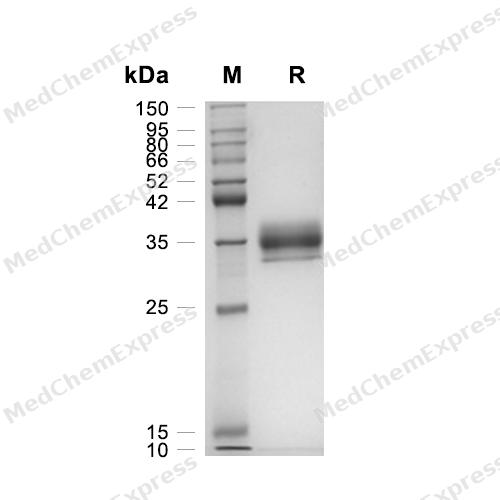
Purity - SDS-PAGE
-
Bioactivity - ELISA
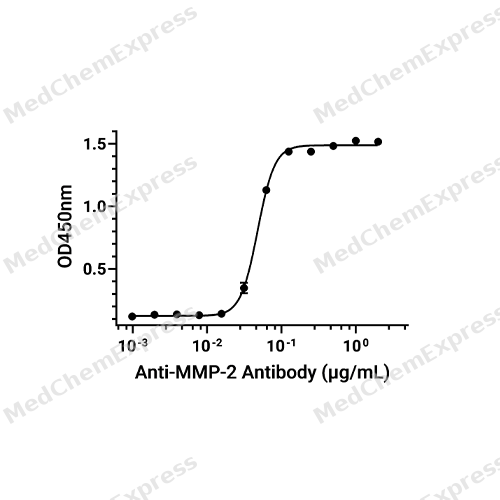
Bioactivity - ELISA


Publications (2)
-
Journal Impact Factor
-
Most Recent
-
Transl Neurodegener
Persistent PirB cleavage drives Golgi-directed trafficking deficits underlying neurodegeneration. [Abstract]2026 Jun 3;15(1):26. PMID: 42231420 -
PLoS One
MMP-2 associated imbalance of VEGF/Endostatin is linked to suppression of the PI3K/AKT/HIF-1α pathway in steroid-induced osteonecrosis of femoral head. [Abstract]2026 Apr 17;21(4):e0346880. PMID: 41996352


Technical Parameters
-
Species Mouse
-
Source HEK293
-
Tag N-His
-
Accession
NP_032636.1 (M409-C662)
-
Molecular Construction
-
N-term
-
His
-
MMP-2 (M409-C662)
Accession # NP_032636.1 -
C-term
-
-
Protein Length
Partial Extracellular Domain
-
Synonyms
MMP2; Matrix Metallopeptidase 2 (Gelatinase A, 72kDa Gelatinase, 72kDa Type IV Collagenase); Prev. CLG4A; Collagenase Type IV-A; Prev. CLG4; Neutrophil Gelatinase; TBE-1; 72 KDa Gelatinase; MMP-2; Gelatinase A; 72 KDa Type IV Collagenase; MMP-II; Matrix M
-
AA Sequence
MGLEHSQDPGALMAPIYTYTKNFRLSHDDIKGIQELYGPSPDADTDTGTGPTPTLGPVTPEICKQDIVFDGIAQIRGEIFFFKDRFIWRTVTPRDKPTGPLLVATFWPELPEKIDAVYEAPQEEKAVFFAGNEYWVYSASTLERGYPKPLTSLGLPPDVQQVDAAFNWSKNKKTYIFAGDKFWRYNEVKKKMDPGFPKLIADSWNAIPDNLDAVVDLQGGGHSYFFKGAYYLKLENQSLKSVKFGSIKSDWLGC
-
Molecular Weight
Approximately 30-40 kDa, based on SDS-PAGE under reducing conditions.
-
Glycosylation
Yes
-
Purity
≥ 95%, as determined by reducing SDS-PAGE.


Product Properties
Lyophilized powder
1.Lyophilized from a 0.22 μm filtered solution of PBS, pH 7.4, 5% trehalose, 5% mannitol, 0.01% Tween 80.
2.Lyophilized from a 0.22 μm filtered solution of 20 mM PB, 150 mM NaCl, pH 7.4.
Please refer to the lot-specific COA for specific buffer information.
<1 EU/μg, determined by LAL method.
It is not recommended to reconstitute to a concentration less than 100 μg/mL in ddH2O.
Stored at -20°C for 2 years from date of receipt. After reconstitution, it is stable at 4°C for 1 week or -20°C for longer (with carrier protein). It is recommended to freeze aliquots at -20°C or -80°C for extended storage.
Room temperature in continental US; may vary elsewhere.


Documentation
-
Data Sheet (237 KB)
-
SDS (254 KB)
- English - EN (254 KB)
- Français - FR (254 KB)
- Deutsch - DE (254 KB)
- Norwegian - NO (254 KB)
- Español - ES (254 KB)
- Swedish - SV (254 KB)
- Italian - IT (254 KB)
- Korean - KR (254 KB)
- Portuguese - PT (254 KB)
-
Handling Instructions (2659 KB)

Calculators
Concentration (start) × Volume (start) = Concentration (final) × Volume (final)


 Powered by Bioz

