



MMP-9 Protein, Mouse (HEK293, C-His)
Based on 2 publication(s) in Google Scholar
The MMP-9 protein is a matrix metalloproteinase that is critical for local extracellular matrix proteolysis and leukocyte migration.It is suggested that it may be involved in bone osteoclastic resorption.MMP-9 Protein, Mouse (HEK293, C-His) is the recombinant mouse-derived MMP-9 protein, expressed by HEK293 , with C-10*His labeled tag.
- Species: Mouse
- Source: HEK293
-
Storage:Stored at -20°C for 2 years from date of receipt. After reconstitution, it is stable at 4°C for 1 week or -20°C for longer (with carrier protein). It is recommended to freeze aliquots at -20°C or -80°C for extended storage.


To place orders, for customer services and technical support, please contact: MedChemExpress USA
Tel: 609-228-6898 E-mail: [email protected] [email protected]


-
 Biological Activity
-
Technical Parameters
-
Product Properties
- Documentation
- Help & FAQs




Biological Activity
Description
The MMP-9 protein is a matrix metalloproteinase that is critical for local extracellular matrix proteolysis and leukocyte migration.It is suggested that it may be involved in bone osteoclastic resorption.MMP-9 Protein, Mouse (HEK293, C-His) is the recombinant mouse-derived MMP-9 protein, expressed by HEK293 , with C-10*His labeled tag.
Background
MMP-9 Protein, a matrix metalloproteinase, plays a crucial role in local proteolysis of the extracellular matrix and facilitates leukocyte migration. It could be involved in bone osteoclastic resorption and cleaves KiSS1 at a specific Gly-|-Leu bond. Additionally, MMP-9 cleaves NINJ1 to generate the Secreted ninjurin-1 form and processes type IV and type V collagen into large C-terminal three-quarter fragments and shorter N-terminal one-quarter fragments. While degrading fibronectin, MMP-9 does not impact laminin or Pz-peptide, showcasing its selectivity in substrate cleavage.
Verified Bioactivity
Measured by its ability to cleave the fluorogenic peptide substrate, Mca-PLGL-Dpa-AR-NH2. The specific activity is 4658.992 pmol/min/µg, as measured under the described conditions. (Activation description: The proenzyme needs to be activated by APMA (HY-148905) for an activated form.)
MCE Validation Data
-
Purity - SDS-PAGE
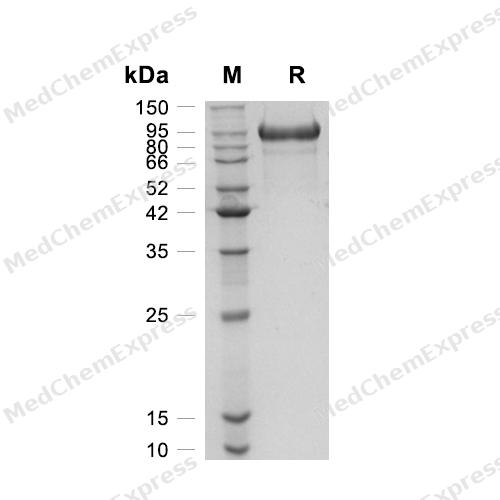
Purity - SDS-PAGE


Publications (2)
-
Journal Impact Factor
-
Most Recent
-
Transl Neurodegener
Persistent PirB cleavage drives Golgi-directed trafficking deficits underlying neurodegeneration. [Abstract]2026 Jun 3;15(1):26. PMID: 42231420 -
Brain Behav Immun
Dorsal root ganglion macrophages mediate osteoarthritis pain via disruption of sensory neuron perineuronal nets. [Abstract]2026 Aug:136:106567. PMID: 41905490


Technical Parameters
-
Species Mouse
-
Source HEK293
-
Tag C-10*His
-
Accession
P41245 (A20-P730)
-
Molecular Construction
-
N-term
-
MMP-9 (A20-P730)
Accession # P41245 -
10*His
-
C-term
-
-
Protein Length
Full Length of Mature Protein (with Propeptide)
-
Synonyms
MMP9; Matrix Metallopeptidase 9 (Gelatinase B, 92kDa Gelatinase, 92kDa Type IV Collagenase); Prev. CLG4B; Macrophage Gelatinase; Matrix Metalloproteinase 9 (Gelatinase B, 92kDa Gelatinase, 92kDa Type IV Collagenase); Type V Collagenase; Matrix Metalloprot
-
AA Sequence
APYQRQPTFVVFPKDLKTSNLTDTQLAEAYLYRYGYTRAAQMMGEKQSLRPALLMLQKQLSLPQTGELDSQTLKAIRTPRCGVPDVGRFQTFKGLKWDHHNITYWIQNYSEDLPRDMIDDAFARAFAVWGEVAPLTFTRVYGPEADIVIQFGVAEHGDGYPFDGKDGLLAHAFPPGAGVQGDAHFDDDELWSLGKGVVIPTYYGNSNGAPCHFPFTFEGRSYSACTTDGRNDGTPWCSTTADYDKDGKFGFCPSERLYTEHGNGEGKPCVFPFIFEGRSYSACTTKGRSDGYRWCATTANYDQDKLYGFCPTRVDATVVGGNSAGELCVFPFVFLGKQYSSCTSDGRRDGRLWCATTSNFDTDKKWGFCPDQGYSLFLVAAHEFGHALGLDHSSVPEALMYPLYSYLEGFPLNKDDIDGIQYLYGRGSKPDPRPPATTTTEPQPTAPPTMCPTIPPTAYPTVGPTVGPTGAPSPGPTSSPSPGPTGAPSPGPTAPPTAGSSEASTESLSPADNPCNVDVFDAIAEIQGALHFFKDGWYWKFLNHRGSPLQGPFLTARTWPALPATLDSAFEDPQTKRVFFFSGRQMWVYTGKTVLGPRSLDKLGLGPEVTHVSGLLPRRLGKALLFSKGRVWRFDLKSQKVDPQSVIRVDKEFSGVPWNSHDIFQYQDKAYFCHGKFFWRVSFQNEVNKVDHEVNQVDDVGYVTYDLLQCP
-
Predicted Molecular Mass
79.9 kDa
-
Molecular Weight
Approximately 94 kDa, based on SDS-PAGE under reducing conditions.
-
Glycosylation
Yes
-
Purity
≥ 95%, as determined by reducing SDS-PAGE.


Product Properties
Lyophilized powder.
Lyophilized from a 0.22 μm filtered solution of 20 mM Tris, 150 mM NaCl, pH 7.5.
Note: For SPR assay, please replace the buffer. Primary amine components (e.g., Tris, imidazole) can affect protein-coupled chips.
<1 EU/μg, determined by LAL method.
It is not recommended to reconstitute to a concentration less than 100 μg/mL in ddH2O. For long term storage it is recommended to add a carrier protein (0.1% BSA, 5% HSA, 10% FBS or 5% Trehalose).
Stored at -20°C for 2 years from date of receipt. After reconstitution, it is stable at 4°C for 1 week or -20°C for longer (with carrier protein). It is recommended to freeze aliquots at -20°C or -80°C for extended storage.
Room temperature in continental US; may vary elsewhere.


Documentation
-
Data Sheet (240 KB)
-
SDS (254 KB)
- English - EN (254 KB)
- Français - FR (254 KB)
- Deutsch - DE (254 KB)
- Norwegian - NO (254 KB)
- Español - ES (254 KB)
- Swedish - SV (254 KB)
- Italian - IT (254 KB)
- Korean - KR (254 KB)
- Portuguese - PT (254 KB)
-
Handling Instructions (2659 KB)

Calculators
Concentration (start) × Volume (start) = Concentration (final) × Volume (final)


 Powered by Bioz

