



Cathepsin B Protein, Mouse (HEK293, His)
Based on 2 publication(s) in Google Scholar
Cathepsin B Protein, Mouse (HEK293, His) is an approximately 32-50 kDa Cathepsin B protein with a His-flag. Cathepsin B is an enzymatic protein belonging to the peptidase C1 family.
- Species: Mouse
- Source: HEK293
-
Storage:Stored at -20°C for 2 years from date of receipt. After reconstitution, it is stable at 4°C for 1 week or -20°C for longer (with carrier protein). It is recommended to freeze aliquots at -20°C or -80°C for extended storage.


To place orders, for customer services and technical support, please contact: MedChemExpress USA
Tel: 609-228-6898 E-mail: [email protected] [email protected]


-
 Biological Activity
-
Technical Parameters
-
Product Properties
- Documentation
- References
- Help & FAQs


-

HY-P7753
Cathepsin L1 Protein, Mouse (HEK293, His) -
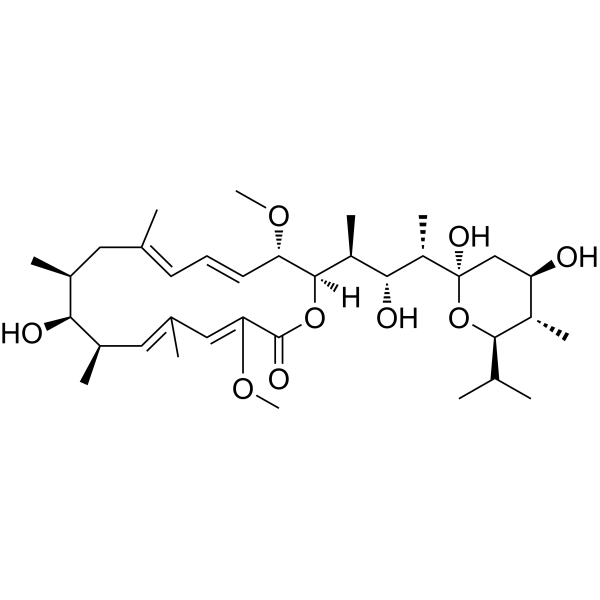
HY-100558
Bafilomycin A1 -
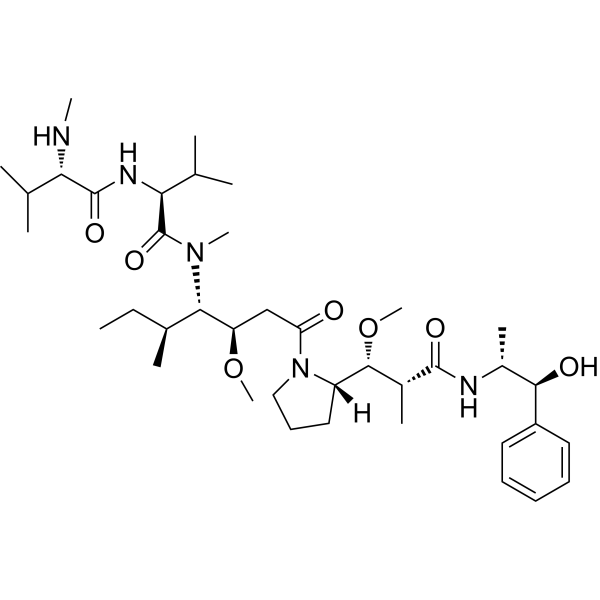
HY-15162
Monomethyl auristatin E -
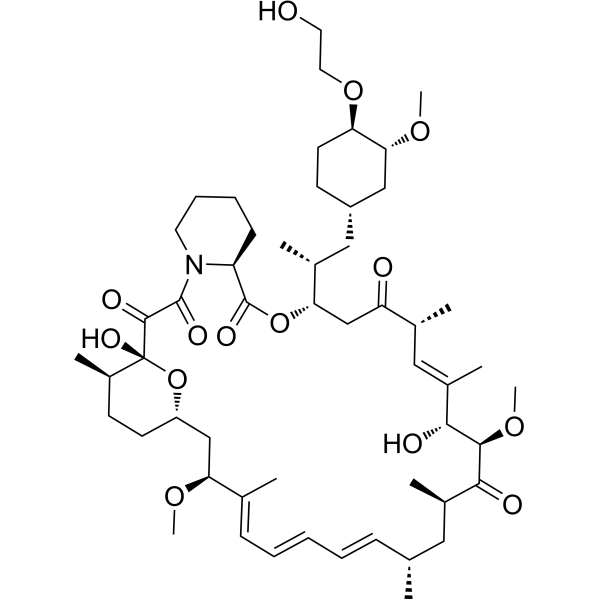
HY-10218
Everolimus -
HY-P7993A
Cathepsin B Protein, Human (HEK293, His) -
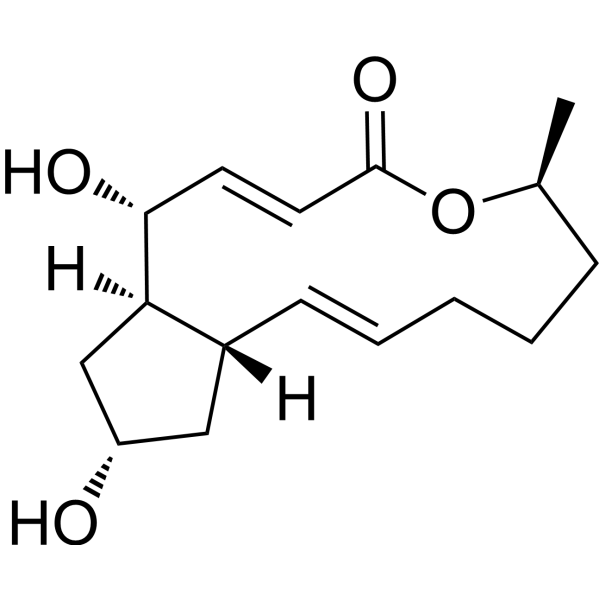
HY-16592
Brefeldin A -
HY-P7756
Cathepsin S Protein, Human (HEK293, His) -

HY-137367
Z-Val-Val-Arg-AMC -
HY-P7754A
Cathepsin L1 Protein, Human (HEK293, His) -
HY-P7749
Cathepsin D Protein, Mouse (HEK293, His) -
HY-P73807
MMP-9 Protein, Mouse (HEK293)


Biological Activity
Description
Cathepsin B Protein, Mouse (HEK293, His) is an approximately 32-50 kDa Cathepsin B protein with a His-flag. Cathepsin B is an enzymatic protein belonging to the peptidase C1 family[1].
Background
Cathepsin B (CTSB) is also known as APP secretase (APPS) and CPSB, is an enzymatic protein belonging to the peptidase C1 family[1].Cathepsin B/CTSB is synthesized as a preproenzyme and is activated in prelysosomal acidic vesicles (late endosomes) prior to its delivery to lysosomes. After removal of the signal peptide, the inactive proenzyme undergoes modifications including removal of the pro region to result in the active enzyme[1].Several lysosomal proteinases including the cathepsin B have been implicated in malignant progression of tumors. Many researchers have demonstrated correlations between increased activity of cathepsin B and increased metastatic capability of animal tumors or malignancy of human tumors[2].
Verified Bioactivity
Measured by its ability to cleave 10 μM fluorogenic peptide 10 μM substrate Z-LR-AMC (HY-142021). The specific activity is >2000 pmol/min/µg, as measured under the described conditions. (Activation description: The proenzyme needs to be activated in acid reducing buffer for an activated form.)
MCE Validation Data
-
Purity - SDS-PAGE
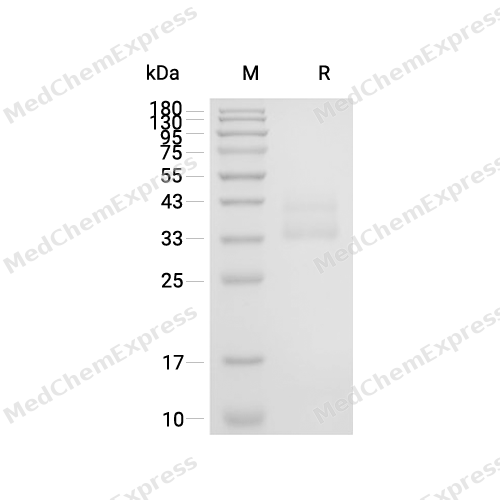
Purity - SDS-PAGE

Assay Procedure
Materials
Activation Buffer: 25 mM MES, 5 mM DTT, pH 5.0.
Assay Buffer: 25 mM MES, pH 5.0.
Test protein: Cathepsin B Protein, Mouse (HEK293, His) (HY-P7747)
Standard: 7-Amino, 4-Methyl Coumarin (AMC, HY-D0027)
Substrate: Z-Leu-Arg-AMC (Z-LR-AMC, HY-142021)
Procedure
1. Standard curve: Dilute 7-Amino, 4-Methyl Coumarin (AMC) (standard) to 0, 0.78125, 1.5625, 3.125, 6.25, 12.5, 25, 50, 100 μmol/L with assay buffer, and add 100 μL into the black enzyme-labeled wells. The excitation and emission wavelengths were 380 nm and 460 nm, respectively, and the standard curve was made with the measured RFU as the horizontal coordinate and the amount of standard substance as the vertical coordinate to obtain the standard curve formula.
2. Dilute the measured proteins to 10μg/mL with activation buffer.
3. Incubate for 15 minutes at room temperature.
4. Dilute Mouse Cathepsin B to 0.2 μg/mL in Assay Buffer.
5. Dilute substrate to 20 μM in assay buffer.
6. Add 50 μL of each concentration of the measured protein to the assay wells and add 50 μL of 20 μM substrate to start the reaction. Blank wells were spiked with 50 μL of assay buffer and 50 μL of 20μM protein-free substrate.
7. The excitation and emission wavelengths were 380 nm and 460 nm, respectively, and read in kinetic mode for 5 minutes.
8. Calculate the specific activity:
Specific Activity (pmol/min/μg) = | Adjusted Vmax* (RFU/min) x Conversion Factor ** (pmol/RFU) |
| amount of enzyme (μg) |
*Adjusted for Control
**Derived using calibration standard
Per Well:
Mouse Cathepsin B: 0.01 μg
Substrate: 10 μM


Publications (2)
-
Journal Impact Factor
-
Most Recent
-
-
J Control Release
Nanoprodrug targeting tumor-associated intracellular bacteria enhances colorectal cancer immunotherapy. [Abstract]2026 Feb 10:390:114512. PMID: 41360332


Technical Parameters
-
Species Mouse
-
Source HEK293
-
Tag C-6*His
-
Accession
P10605 (H18-F339)
-
Molecular Construction
-
N-term
-
Cathepsin B (H18-F339)
Accession # P10605 -
6*His
-
C-term
-
-
Protein Length
Full Length of Mature Protein
-
Synonyms
CTSB; Keratolytic Winter Erythema (Oudtshoorn Skin Disease); Cathepsin B; Epididymis Secretory Sperm Binding Protein; APP Secretase; Amyloid Precursor Protein Secretase; Cathepsin B1; Cysteine Protease; APPS; RECEUP; CPSB; KWE
-
AA Sequence
HDKPSFHPLSDDLINYINKQNTTWQAGRNFYNVDISYLKKLCGTVLGGPKLPGRVAFGEDIDLPETFDAREQWSNCPTIGQIRDQGSCGSCWAFGAVEAISDRTCIHTNGRVNVEVSAEDLLTCCGIQCGDGCNGGYPSGAWSFWTKKGLVSGGVYNSHVGCLPYTIPPCEHHVNGSRPPCTGEGDTPRCNKSCEAGYSPSYKEDKHFGYTSYSVSNSVKEIMAEIYKNGPVEGAFTVFSDFLTYKSGVYKHEAGDMMGGHAIRILGWGVENGVPYWLAANSWNLDWGDNGFFKILRGENHCGIESEIVAGIPRTDQYWGRF
-
Molecular Weight
Approximately 43-47 kDa & 32-35 kDa, based on SDS-PAGE under reducing conditions, due to the glycosylation.
-
Glycosylation
Yes
-
Purity
≥ 95%, as determined by reducing SDS-PAGE.


Product Properties
Lyophilized powder
Lyophilized from a 0.22 μm filtered solution of PBS, pH 7.4.
<1 EU/μg, determined by LAL method.
It is not recommended to reconstitute to a concentration less than 100 μg/mL in ddH2O. For long term storage it is recommended to add a carrier protein (0.1% BSA, 5% HSA, 10% FBS or 5% Trehalose).
Stored at -20°C for 2 years from date of receipt. After reconstitution, it is stable at 4°C for 1 week or -20°C for longer (with carrier protein). It is recommended to freeze aliquots at -20°C or -80°C for extended storage.
Room temperature in continental US; may vary elsewhere.


Documentation
-
Data Sheet (264 KB)
-
SDS (252 KB)
- English - EN (252 KB)
- Français - FR (252 KB)
- Deutsch - DE (252 KB)
- Norwegian - NO (252 KB)
- Español - ES (252 KB)
- Swedish - SV (252 KB)
- Italian - IT (252 KB)
- Korean - KR (252 KB)
- Portuguese - PT (252 KB)
-
Handling Instructions (2659 KB)


References

Calculators
Concentration (start) × Volume (start) = Concentration (final) × Volume (final)


 Powered by Bioz

