



Cathepsin L1 Protein, Mouse (HEK293, His)

Based on 1 Customer Validation
Cathepsin L Protein, Mouse (HEK293, His) is a lysosomal acid cysteine protease, which is associated with tumor occurrence, development, and metastasis.
- Species: Mouse
- Source: HEK293
-
Storage:Stored at -20°C for 2 years from date of receipt. After reconstitution, it is stable at 4°C for 1 week or -20°C for longer (with carrier protein). It is recommended to freeze aliquots at -20°C or -80°C for extended storage.


To place orders, for customer services and technical support, please contact: MedChemExpress USA
Tel: 609-228-6898 E-mail: [email protected] [email protected]


-
 Biological Activity
-
Technical Parameters
-
Product Properties
- Documentation
- References
- Help & FAQs


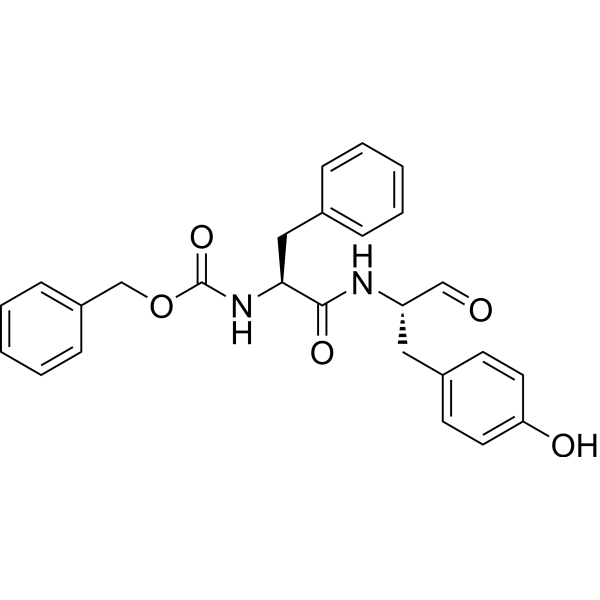


Biological Activity
Description
Cathepsin L Protein, Mouse (HEK293, His) is a lysosomal acid cysteine protease, which is associated with tumor occurrence, development, and metastasis.
Background
Cathepsin L (CTSL) is a cysteine protease that belongs to the papain-like family (peptidase C1A), which is associated with tumor occurrence, development, and metastasis. Cathepsin L is implicated in invasion and metastasis of tumors, inflammatory status, atherosclerosis, renal disease, diabetes, bone diseases, viral infection and other diseases. Functions of Cathepsin L depend on their subcellular localization: Cathepsin L is involved in cell death and inflammation in the cytoplasm, and it also regulates cell cycle in the nucleus and exert degradative roles in the extracellular environment. Cathepsin L is expressed in all tissues and cell types and the primary function of cysteine cathepsins is proteolysis of protein antigens generated by pathogen endocytosis[1][2].
Verified Bioactivity
Measured by its ability to cleave the fluorogenic peptide substrate Z-LR-AMC. The specific activity is 26159.6 pmol/min/µg, as measured under the described conditions. (Activation description: The proenzyme needs to be activated in acid reducing buffer for an activated form.)
MCE Validation Data
-
Purity - SDS-PAGE
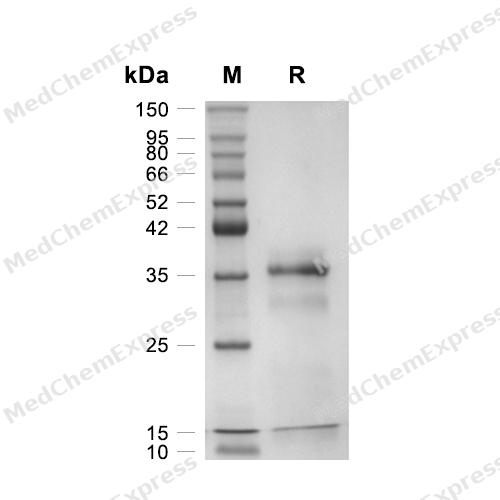
Purity - SDS-PAGE


Technical Parameters
-
Species Mouse
-
Source HEK293
-
Tag C-His
-
Accession
P06797 (T18-N334)
-
Molecular Construction
-
N-term
-
Cathepsin L1 (T18-N334)
Accession # P06797 -
His
-
C-term
-
-
Protein Length
Full Length of Mature Protein (with Propeptide)
-
Synonyms
CTSL; Procathepsin L; Prev. CTSL1; MEP; Cathepsin L1; Cathepsin L, Isoform CRA_b; Major Excreted Protein; CATL; Cathepsin L; FLJ31037
-
AA Sequence
TPKFDQTFSAEWHQWKSTHRRLYGTNEEEWRRAIWEKNMRMIQLHNGEYSNGQHGFSMEMNAFGDMTNEEFRQVVNGYRHQKHKKGRLFQEPLMLKIPKSVDWREKGCVTPVKNQGQCGSCWAFSASGCLEGQMFLKTGKLISLSEQNLVDCSHAQGNQGCNGGLMDFAFQYIKENGGLDSEESYPYEAKDGSCKYRAEFAVANDTGFVDIPQQEKALMKAVATVGPISVAMDASHPSLQFYSSGIYYEPNCSSKNLDHGVLLVGYGYEGTDSNKNKYWLVKNSWGSEWGMEGYIKIAKDRDNHCGLATAASYPVVN
-
Molecular Weight
Approximately 36 kDa, based on SDS-PAGE under reducing conditions.
-
Glycosylation
Yes
-
Purity
≥ 90%, as determined by reducing SDS-PAGE.


Product Properties
Lyophilized powder.
Lyophilized from a 0.22 μm filtered solution of 20mM Tris, 150mM NaCl, pH 7.5-8.0. Normally 5 % - 8 % trehalose, mannitol and 0.01% Tween 80 are added as protectants before lyophilization.
Note: For SPR assay, please replace the buffer. Primary amine components (e.g., Tris, imidazole) can affect protein-coupled chips.
<1 EU/μg, determined by LAL method.
It is not recommended to reconstitute to a concentration less than 100 μg/mL in ddH2O.
Stored at -20°C for 2 years from date of receipt. After reconstitution, it is stable at 4°C for 1 week or -20°C for longer (with carrier protein). It is recommended to freeze aliquots at -20°C or -80°C for extended storage.
Room temperature in continental US; may vary elsewhere.


Documentation
-
Data Sheet (264 KB)
-
SDS (251 KB)
- English - EN (251 KB)
- Français - FR (251 KB)
- Deutsch - DE (251 KB)
- Norwegian - NO (251 KB)
- Español - ES (251 KB)
- Swedish - SV (251 KB)
- Italian - IT (251 KB)
- Korean - KR (251 KB)
- Portuguese - PT (251 KB)
-
Handling Instructions (2659 KB)


References
[1]. Mei-Ling Han, et al. Cathepsin L upregulation-induced EMT phenotype is associated with the acquisition of cisplatin or paclitaxel resistance in A549 cells. Acta Pharmacol Sin. 2016 Dec;37(12):1606-1622. [Content Brief]
[2]. Caio P Gomes, et al. Cathepsin L in COVID-19: From Pharmacological Evidences to Genetics. Front Cell Infect Microbiol. 2020 Dec 8;10:589505. [Content Brief]

Calculators
Concentration (start) × Volume (start) = Concentration (final) × Volume (final)


 Powered by Bioz

