



MMP-9 Protein, Rat (HEK293, His)
Based on 1 Customer Validation
Matrix metalloproteinase-9 (Mmp9) is a member of the matrix metalloproteinase (MMP) family. Mmp9 is secreted as inactive proproteins which are activated when cleaved by extracellular proteinases to generate a mature, zinc-dependent endopeptidase enzyme that degrades collagens of type IV, V and XI, and elastin. Mmp9 is also involved in IL-8-induced mobilization of hematopoietic progenitor cells from bone marrow. MMP-9 Protein, Rat (HEK293, His) is the recombinant rat-derived MMP-9 protein, expressed by HEK293 , with C-10*His labeled tag.
- Species: Rat
- Source: HEK293
-
Storage:Stored at -20°C for 2 years from date of receipt. After reconstitution, it is stable at 4°C for 1 week or -20°C for longer (with carrier protein). It is recommended to freeze aliquots at -20°C or -80°C for extended storage.


To place orders, for customer services and technical support, please contact: MedChemExpress USA
Tel: 609-228-6898 E-mail: [email protected] [email protected]


-
 Biological Activity
-
Technical Parameters
-
Product Properties
- Documentation
- Help & FAQs




Biological Activity
Description
Matrix metalloproteinase-9 (Mmp9) is a member of the matrix metalloproteinase (MMP) family. Mmp9 is secreted as inactive proproteins which are activated when cleaved by extracellular proteinases to generate a mature, zinc-dependent endopeptidase enzyme that degrades collagens of type IV, V and XI, and elastin. Mmp9 is also involved in IL-8-induced mobilization of hematopoietic progenitor cells from bone marrow. MMP-9 Protein, Rat (HEK293, His) is the recombinant rat-derived MMP-9 protein, expressed by HEK293 , with C-10*His labeled tag.
Background
Matrix metalloproteinase-9 (Mmp9) is a member of the matrix metalloproteinase (MMP) family, which are involved in the breakdown of extracellular matrix in normal physiological processes, such as embryonic development, reproduction, wound repair, and tissue remodeling, as well as in disease processes, such as arthritis, progression of atherosclerosis and tumor invasion. Mmp9 is secreted as inactive proproteins which are activated when cleaved by extracellular proteinases to generate a mature, zinc-dependent endopeptidase enzyme that degrades collagens of type IV, V and XI, and elastin. Mmp9 is also involved in IL-8-induced mobilization of hematopoietic progenitor cells from bone marrow. Mmp9 implicates in several diseases, including Down syndrome; anodontia; artery disease; autoimmune disease; and chronic obstructive pulmonary disease[1][2].
Verified Bioactivity
Measured by its ability to cleave a fluorogenic peptide substrate Mca-PLGL-Dpa-AR-NH2 and the specific activity is >1000 pmoles/min/μg. (Activation description: The proenzyme needs to be activated by APMA (HY-148905) for an activated form.)
MCE Validation Data
-
Purity - SDS-PAGE
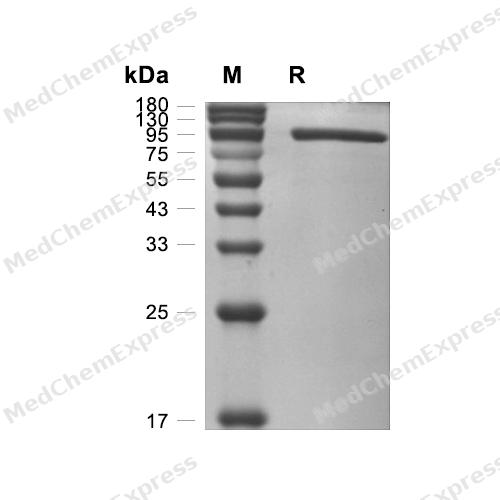
Purity - SDS-PAGE


Technical Parameters
-
Species Rat
-
Source HEK293
-
Tag C-10*His
-
Accession
EDL96479.1 (A20-P708)
-
Molecular Construction
-
N-term
-
MMP-9 (A20-P708)
Accession # EDL96479.1 -
10*His
-
C-term
-
-
Protein Length
Partial
-
Synonyms
MMP9; Matrix Metallopeptidase 9 (Gelatinase B, 92kDa Gelatinase, 92kDa Type IV Collagenase); Prev. CLG4B; Macrophage Gelatinase; Matrix Metalloproteinase 9 (Gelatinase B, 92kDa Gelatinase, 92kDa Type IV Collagenase); Type V Collagenase; Matrix Metalloprot
-
AA Sequence
APHQRQPTYVVFPRDLKTSNLTDTQLAEDYLYRYGYTRAAQMMGEKQSLRPALLMLQKQLSLPQTGELDSETLKAIRSPRCGVPDVGKFQTFEGDLKWHHHNITYWIQSYTEDLPRDVIDDSFARAFAVWSAVTPLTFTRVYGLEADIVIQFGVAEHGDGYPFDGKDGLLAHAFPPGPGIQGDAHFDDDELWSLGKGAVVPTYFGNANGAPCHFPFTFEGRSYLSCTTDGRNDGKPWCGTTADYDTDRKYGFCPSENLYTEHGNGDGKPCVFPFIFEGHSYSACTTKGRSDGYRWCATTANYDQDKLYGFCPTRADVTVTGGNSAGEMCVFPFVFLGKQYSTCTGEGRSDGRLWCATTSNFDADKKWGFCPDQGYSLFLVAAHEFGHALGLDHSSVPEALMYPMYHYHEDSPLHEDDIKGIQHLYGRGSKPDPRPPATTAAEPQPTAPPTMCPTAPPMAYPTGGPTVAPTGAPSPGPTGPPTAGPSEAPTESSTPVDNPCNVDVFDAIADIQGALHFFKDGRYWKFSNHGGSQLQGPFLIARTWPALPAKLNSAFEDPQSKKIFFFSGRKMWVYTGQSVLGPRSLDKLGLGSEVTLVTGLLPRRGGKALLISRERIWKFDLKSQKVDPQSVTRLDNEFSGVPWNSHNVFHYQDKAYFCHDKYFWRVSFHNRVNQVDHVAYVTYDLLQCP
-
Molecular Weight
Approximately 100-110 kDa, based on SDS-PAGE under reducing conditions, due to the glycosylation.
-
Purity
≥ 95%, as determined by reducing SDS-PAGE.


Product Properties
Lyophilized powder.
1.Lyophilized from a 0.22 μm filtered solution of 50 mM MES, 100 mM NaCl, 1 mM CaCl2, 10% glycerol, pH 7.4, 5% trehalose, 5% mannitol, 0.01% Tween 80.
2.Lyophilized from a 0.22 μm filtered solution of 50 mM MES, 100 mM NaCl, 1 mM CaCl2, pH 7.4.
Please refer to the lot-specific COA for specific buffer information.
<1 EU/μg, determined by LAL method.
It is not recommended to reconstitute to a concentration less than 100 μg/mL in ddH2O.
Stored at -20°C for 2 years from date of receipt. After reconstitution, it is stable at 4°C for 1 week or -20°C for longer (with carrier protein). It is recommended to freeze aliquots at -20°C or -80°C for extended storage.
Room temperature in continental US; may vary elsewhere.


Documentation
-
Data Sheet (240 KB)
-
SDS (254 KB)
- English - EN (254 KB)
- Français - FR (254 KB)
- Deutsch - DE (254 KB)
- Norwegian - NO (254 KB)
- Español - ES (254 KB)
- Swedish - SV (254 KB)
- Italian - IT (254 KB)
- Korean - KR (254 KB)
- Portuguese - PT (254 KB)
-
Handling Instructions (2659 KB)

Calculators
Concentration (start) × Volume (start) = Concentration (final) × Volume (final)


 Powered by Bioz

