



TROY/TNFRSF19 Protein, Mouse (HEK293, His)

Based on 1 Customer Validation
TROY Protein also known as TAJ, TNFRSF19, a type I transmembrane receptor, is a member of the TNF receptor superfamily. TROY Protein is involved in embryonic development and the development of skin and hair follicles. TROY Protein inhibits cell proliferation in vitro and shows antitumor activity in xenografted models. TROY/TNFRSF19 Protein, Mouse (HEK293, His) is a recombinant protein with a C-Terminal His label, It consists of 170 amino acids (M1-L170) and is produced in HEK293 cells.
- Species: Mouse
- Source: HEK293
-
Storage:Stored at -20°C for 2 years from date of receipt. After reconstitution, it is stable at 4°C for 1 week or -20°C for longer (with carrier protein). It is recommended to freeze aliquots at -20°C or -80°C for extended storage.


To place orders, for customer services and technical support, please contact: MedChemExpress USA
Tel: 609-228-6898 E-mail: [email protected] [email protected]


-
 Biological Activity
-
Technical Parameters
-
Product Properties
- Documentation
- References
- Help & FAQs




Biological Activity
Description
TROY Protein also known as TAJ, TNFRSF19, a type I transmembrane receptor, is a member of the TNF receptor superfamily. TROY Protein is involved in embryonic development and the development of skin and hair follicles[1]. TROY Protein inhibits cell proliferation in vitro and shows antitumor activity in xenografted models[2]. TROY/TNFRSF19 Protein, Mouse (HEK293, His) is a recombinant protein with a C-Terminal His label, It consists of 170 amino acids (M1-L170) and is produced in HEK293 cells.
Background
TROY Protein shows a unique tissue distribution in the embryo as well as after birth; in the embryo, TROY is exclusively expressed in the epithelium including the neuroepithelium, skin, bronchiolar epithelium, conjunctiva, and so forth, whereas after birth, TROY Protein is strongly expressed in hair follicles like Edar as well as in neurons[1]. TROY Protein is expressed in several invasive cancers, including colorectal cancer, lung cancer, melanoma, nasopharyngeal carcinoma, prostate cancer and GBM[3].
The amino acid sequence of human TROY protein has low homology for mouse TROY protein.
TROY Protein is a growth-promoting signaling molecule that also regulates the NF-κB pathway via interacting with RKIP[2]. In addition, increased TROY expression promotes STAT3 phosphorylation and STAT3 transcriptional activity that is dependent upon JAK1[3]. TROY interacts with LGR5 and inhibits Wnt signaling[4].
Knock-down of TROY suppresses the growth of glioma cells and induces cell cycle arrest at the G1-S phase in U87 cells, significantly decreasing NF-kB luciferase activity[2]. Increased TROY expression increases JAK1 phosphorylation, and silencing TROY expression inhibits GBM cell invasion, and increases sensitivity to temozolomide in glioblastoma[3].
Verified Bioactivity
Measured by its binding ability in a functional ELISA. Immobilized Human Lgr5/GPR49, at 2 μg/mL (100 μL/well) can bind TNFRSF19. The KD for this effect is 173.6 nM.
MCE Validation Data
-
Purity - SDS-PAGE
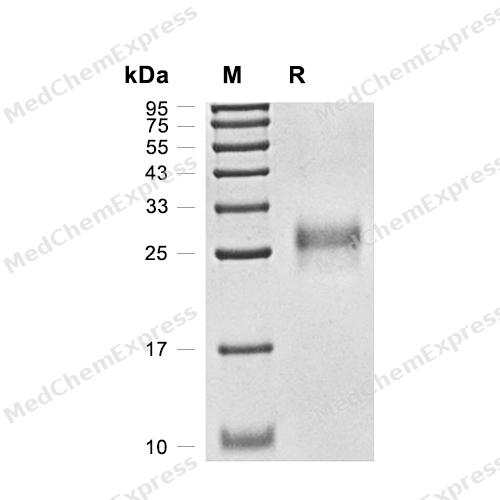
Purity - SDS-PAGE
-
Bioactivity - ELISA
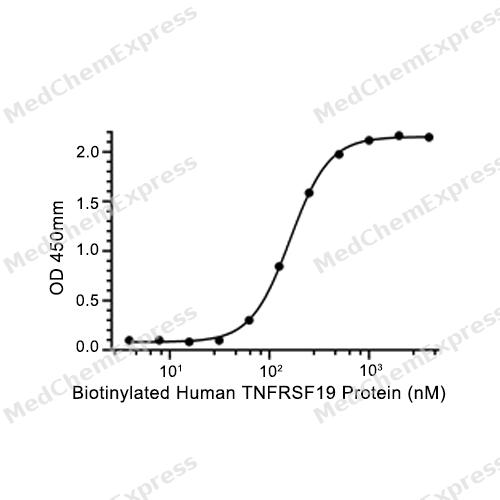
Bioactivity - ELISA


Technical Parameters
-
Species Mouse
-
Source HEK293
-
Tag C-His
-
Accession
Q9JLL3-1 (E30-L170)
-
Molecular Construction
-
N-term
-
TROY (E30-L170)
Accession # Q9JLL3-1 -
His
-
C-term
-
-
Protein Length
Extracellular Domain
-
Synonyms
TNFRSF19; Toxicity And JNK Inducer; TNF Receptor Superfamily Member 19; TAJ-Alpha; TRADE; Tumor Necrosis Factor Receptor Superfamily Member 19; TROY; Tumor Necrosis Factor Receptor Superfamily, Member 19; TAJ
-
AA Sequence
ETGDCRQQEFKDRSGNCVLCKQCGPGMELSKECGFGYGEDAQCVPCRPHRFKEDWGFQKCKPCADCALVNRFQRANCSHTSDAVCGDCLPGFYRKTKLVGFQDMECVPCGDPPPPYEPHCTSKVNLVKISSTVSSPRDTAL
-
Predicted Molecular Mass
15.6 kDa
-
Molecular Weight
Approximately 25-30 kDa, based on SDS-PAGE under reducing conditions, due to the glycosylation.
-
Glycosylation
Yes
-
Purity
≥ 95%, as determined by reducing SDS-PAGE.


Product Properties
Lyophilized powder.
Lyophilized from a 0.22 μm filtered solution of PBS, pH 7.4.
<1 EU/μg, determined by LAL method.
It is not recommended to reconstitute to a concentration less than 100 μg/mL in ddH2O. For long term storage it is recommended to add a carrier protein (0.1% BSA, 5% HSA, 10% FBS or 5% Trehalose).
Stored at -20°C for 2 years from date of receipt. After reconstitution, it is stable at 4°C for 1 week or -20°C for longer (with carrier protein). It is recommended to freeze aliquots at -20°C or -80°C for extended storage.
Room temperature in continental US; may vary elsewhere.


Documentation
-
Data Sheet (264 KB)
-
SDS (251 KB)
- English - EN (251 KB)
- Français - FR (251 KB)
- Deutsch - DE (251 KB)
- Norwegian - NO (251 KB)
- Español - ES (251 KB)
- Swedish - SV (251 KB)
- Italian - IT (251 KB)
- Korean - KR (251 KB)
- Portuguese - PT (251 KB)
-
Handling Instructions (2659 KB)


References
[1]. Kojima T, et al. TROY, a newly identified member of the tumor necrosis factor receptor superfamily, exhibits a homology with Edar and is expressed in embryonic skin and hair follicles. J Biol Chem. 2000 Jul 7;275(27):20742-7. [Content Brief]
[2]. Liu X, et al. TROY interacts with RKIP to promote glioma development. Oncogene. 2019 Feb;38(9):1544-1559. [Content Brief]
[3]. Ding Z, et al. TROY signals through JAK1-STAT3 to promote glioblastoma cell migration and resistance. Neoplasia. 2020 Sep;22(9):352-364. [Content Brief]
[4]. Fafilek B, et al. Troy, a tumor necrosis factor receptor family member, interacts with lgr5 to inhibit wnt signaling in intestinal stem cells. Gastroenterology. 2013 Feb;144(2):381-391. [Content Brief]

Calculators
Concentration (start) × Volume (start) = Concentration (final) × Volume (final)


 Powered by Bioz

