1. Search Result
Search Result
Results for "

Catalytic lysine

" in MedChemExpress (MCE) Product Catalog:

12

Inhibitors & Agonists

1

Biochemical Assay Reagents

2

Peptides

1

Click Chemistry

Targets Recommended:
Cat. No. Product Name Target Research Areas Chemical Structure
  • HY-78035

    Methylmaleic anhydride

    Biochemical Assay Reagents Others
    Citraconic anhydride (Methylmaleic anhydride) is a derivative of maleic anhydride (HY-Z0060) and novel antigen retrieval solution. Citraconic anhydride reversibly blocks protein amino groups, stabilizing specific enzymes and improving their catalytic performance. Citraconic anhydride reacts with free amino groups on proteins (especially lysine residues), converting positively charged NH3 + into carboxyl groups, thereby disrupting methylene bridge crosslinks caused by Formaldehyde during antigen retrieval. Citraconic anhydride functionalizes Isotactic polypropylene. Citraconic anhydride precisely responds to pH changes to achieve reversible modification. Citraconic anhydride is irritating to skin and eyes .
    Citraconic anhydride
  • HY-176556

    EGFR Cancer
    EGFR-IN-1671 is a selective EGFR inhibitor with an IC50 of 0.19 nM. EGFR-IN-167 exhibits good potency against various EGFR mutants (IC50 = 0.109 nM, 0.75 nM and <0.05 nM against EGFR (L858R), EGFR (C797S) and EGFR (del19), respectively). EGFR-IN-1671 covalently engages the catalytically conserved lysine of EGFR in live mammalian cells. EGFR-IN-1671 demonstrates excellent anti-proliferative activity by inhibiting EGFR autophosphorylation. EGFR-IN-1671 can be used for the study of non-small-cell lung carcinomas (NSCLC), glioblastoma and many solid tumors .
    EGFR-IN-167
  • HY-P10463

    Histone Methyltransferase Cancer
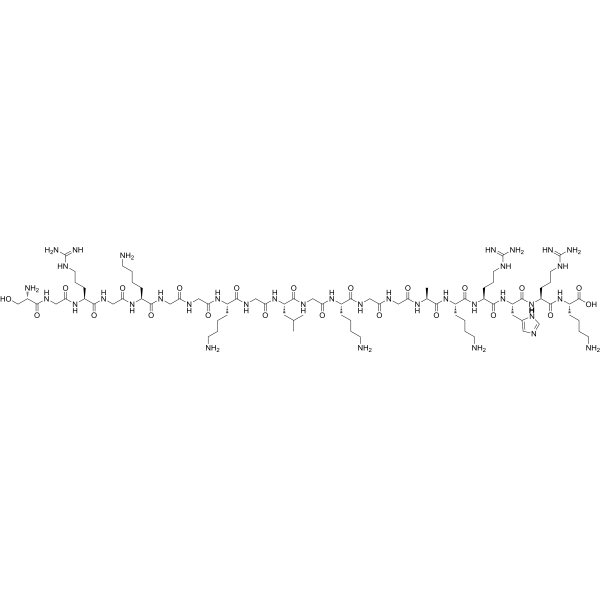
    ssK36 is a supersubstrate peptide of the histone methyltransferase (SET) domain protein 2 (SETD2), and ssK36 is designed for the SETD2 protein, a specific PKMT. ssK36 is responsible in human cells for adding methyl groups to the 36th lysine residue of histone H3 (H3K36) to form H3K36me3. ssK36 can be methylated by SETD2 at a rate more than 100 times faster than the natural substrate H3K36. ssK36 can be used to study the catalytic mechanism of PKMTs, especially substrate specificity and catalytic efficiency .
    ssK36
  • HY-171995

    Rotor NO.4 TFA

    Fluorescent Dye Bacterial Infection
    Rf470 (Rotor NO.4) TFA is a FMR-probe-D-lysine conjugate (Max Ex: 470 nM; Max Em: 640 nM) that can be covalently incorporated into peptidoglycan by bacteria. Rf470 TFA has extremely weak fluorescence in the free state, but its fluorescence is significantly enhanced when it is catalytically incorporated into peptidoglycan by transpeptidases. Through fluorescence changes, Rf470 TFA can be used for real-time monitoring of peptidoglycan biosynthesis, detection of transpeptidase activity, and screening of antibiotics, etc .
    Rf470 TFA
  • HY-179237

    MAPKAPK2 (MK2) Others
    MK2-IN-8 (Compound 42) is a covalent MK2 kinase inhibitor. MK2-IN-8 forms a unique covalent bond with the catalytic lysine, thereby demonstrating that the fluorosulfonate can effectively target the catalytic lysine in kinases.
    MK2-IN-8
  • HY-P10463A

    Histone Methyltransferase Cancer
    ssK36 TFA is a supersubstrate peptide of the histone methyltransferase (SET) domain protein 2 (SETD2) , and ssK36 TFA is designed for the SETD2 protein, a specific PKMT. ssK36 TFA is responsible in human cells for adding methyl groups to the 36th lysine residue of histone H3 (H3K36) to form H3K36me3. ssK36 TFA can be methylated by SETD2 at a rate more than 100 times faster than the natural substrate H3K36. ssK36 TFA can be used to study the catalytic mechanism of PKMTs, especially substrate specificity and catalytic efficiency .
    ssK36 TFA
  • HY-164144

    Histone Methyltransferase Cancer
    EPZ033294 is an inhibitor of SYMD2 (IC50 is 3.9 nM). SYMD2 itself has catalytic activity and can methylate the lysine residue of BTF3 to BTF3me1, which was experimentally demonstrated by detecting an IC50 of 2.9 nM for inhibition of BTF3ME1 by SYMD2, indicating an active inhibition of SYMD2 by EPZ033294. EPZ033294 (0-50 µM) has an inhibitory effect on SYMD2 and a concentration-dependent inhibitory effect in 293T .
    EPZ033294
  • HY-110196

    Histone Methyltransferase Others
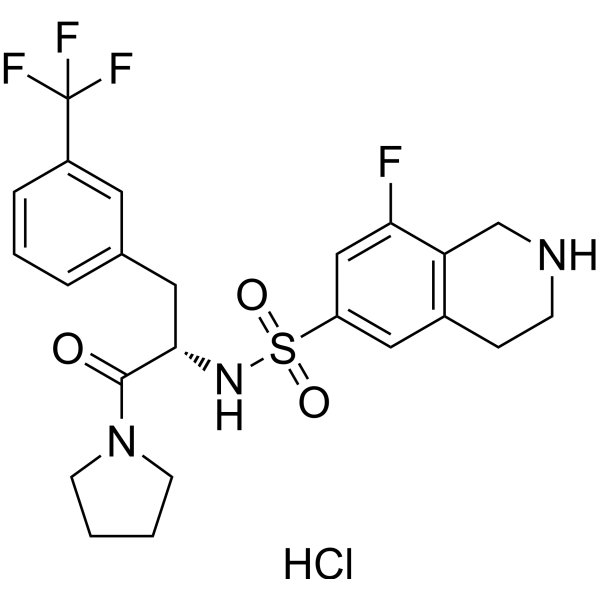
    (S)-PFI-2 hydrochloride is an inhibitor of lysine methyltransferase SETD7 and is approximately 500-fold more active than its enantiomer (R)-PFI-2. (R)-PFI-2 is a cofactor-dependent and substrate-competitive inhibitor. (R)-PFI-2 can occupy the substrate peptide binding groove of SETD7 (including the catalytic lysine binding channel) and interact with the cofactor The donor methyl group is in direct contact. However, (S)-PFI-2 was not observed to have the same interaction as (R)-PFI-2 .
    (S)-PFI-2 hydrochloride
  • HY-123564

    Bcl-2 Family Others
    Mcl1-IN-7 (compound 11) is a reversible covalent inhibitor of Mcl-1 with the activity of inhibiting Mcl-1. By covalently targeting the non-catalytic lysine side chain of Mcl-1, it has higher potency than non-covalent counterparts and can be used to develop Mcl-1 inhibitory compounds and study related biological phenomena.
    Mcl1-IN-7
  • HY-116220

    Others Others
    Mcl1-IN-14 (compound 5) is a reversible covalent inhibitor of Mcl-1 with the activity of inhibiting Mcl-1. Mcl1-IN-14 covalently targets the non-catalytic lysine side chain of Mcl-1 and has higher potency than non-covalent counterparts, which can be used to develop Mcl-1 inhibitory compounds and study related biological phenomena.
    Mcl1-IN-14
  • HY-W141446

    Eukaryotic Initiation Factor (eIF) Others
    VT00065 is a covalent DHS inhibitor. VT00065 forms a redox-dependent covalent bond with the catalytic lysine K329 of DHS, locking the enzyme in an inactive state .
    VT00065
  • HY-186091

    Amino Acid Derivatives Others
    AcdK is a non-natural amino acid and a precursor of allysine. AcdK allows site-specific incorporation into target proteins in E. coli via the amber suppression strategy. AcdK enables site-specific lysine dimethylation or monomethylation modification of target proteins. AcdK can synthesize site-specific lysine-methylated variants of histone H3 and p53, which is applicable for investigating the substrate specificity and catalytic function of epigenetic enzymes .
    AcdK

Inquiry Online

Your information is safe with us. * Required Fields.

Salutation


Country or Region *

Applicant Name *


Organization Name *

Department *


Email Address *


Product Name *

Cat. No.


Requested quantity *

Phone Number *


Remarks

Inquiry Online

Inquiry Information

Product Name:
Cat. No.:
Quantity:
MCE Japan Authorized Agent:

