1. Search Result
Search Result
Results for "

Free radical initiator

" in MedChemExpress (MCE) Product Catalog:

7

Inhibitors & Agonists

1

Screening Libraries

2

Biochemical Assay Reagents

1

Natural
Products

Cat. No. Product Name Target Research Areas Chemical Structure
  • HY-44076
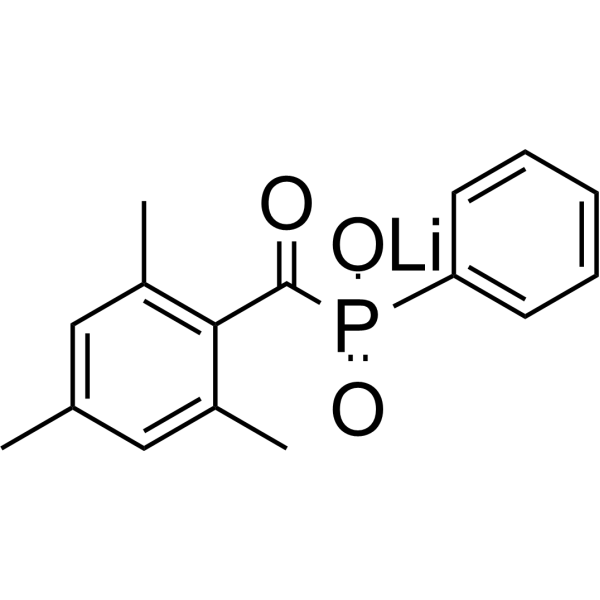
    LAP
    4 Publications Verification

    Lithium phenyl-2,4,6-trimethylbenzoylphosphinate

    Biochemical Assay Reagents Others Cancer
    LAP (Lithium phenyl-2,4,6-trimethylbenzoylphosphinate) is a free radical initiator. The free radicals produced by LAP under bioprinting conditions are potentially cytotoxic and mutagenic. In addition, the concentration of LAP affects the mechanical strength of 3D printed scaffolds. Generally, the concentration range of LAP used for curing is 0.05%-1%. The elastic modulus produced at a concentration of 0.1% is the highest, with enhanced mechanical properties and excellent biocompatibility .
    LAP
  • HY-W004761

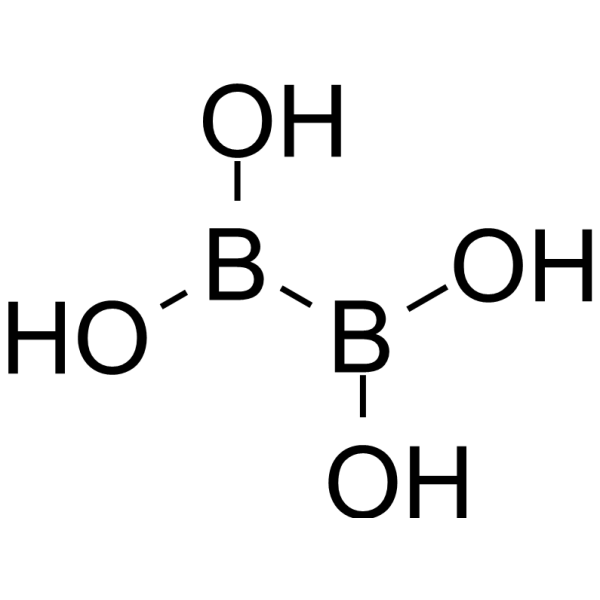
    Hypodiboric acid

    Bacterial Reactive Oxygen Species (ROS) Infection Inflammation/Immunology
    Tetrahydroxydiboron (Hypodiboric acid) acts as a hydrogel initiator and bioadhesion promoter, with broad-spectrum antibacterial activity, ROS scavenging capacity, and osteogenic induction properties. Tetrahydroxydiboron initiates rapid gelation by generating free radicals through reactions with vinyl monomers and dissolved oxygen, overcoming oxygen inhibition without deoxygenation or external triggers. Tetrahydroxydiboron achieves strong bioadhesion via interaction with carboxymethyl chitosan. Tetrahydroxydiboron can be used in the research of periodontitis and related inflammatory diseases .
    Tetrahydroxydiboron
  • HY-W087905

    Biochemical Assay Reagents Others
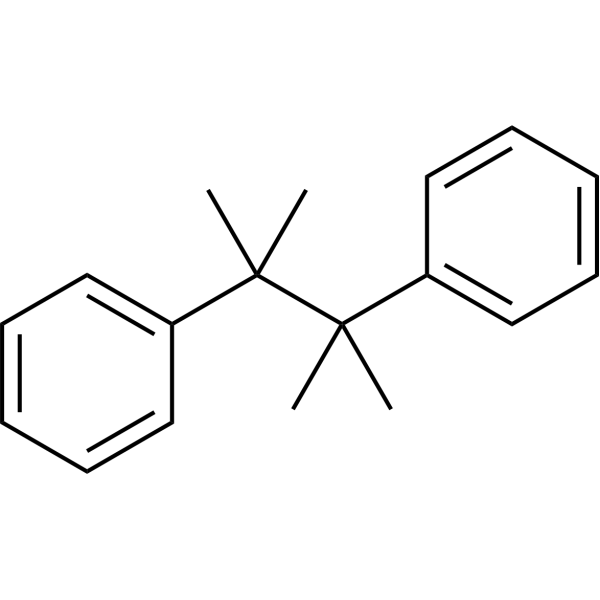
    2,3-Dimethyl-2,3-diphenylbutane is a minor product formed during the thermal decomposition of dicumyl peroxide (DCP) in cumene, generated through radical coupling reactions. As an initiator capable of producing free radicals, 2,3-dimethyl-2,3-diphenylbutane promotes cross-linking or decomposition processes via initiating free radical reactions in fields such as polymer polymerization (e.g., modification of polyphenylene oxide processing), organic synthesis (e.g., DCP decomposition reactions), and coal processing (e.g., oxidation stabilization of coal tar pitch), thereby enhancing material properties or reaction efficiency .
    2,3-Dimethyl-2,3-diphenylbutane
  • HY-W098021

    Photoinitiator-651

    Biochemical Assay Reagents Others
    2,2-Dimethoxy-2-phenylacetophenone is a hydrophobic benzoin ether-based free radical photoinitiator. 2,2-Dimethoxy-2-phenylacetophenone undergoes α-cleavage upon UV irradiation to generate benzoyl and substituted benzyl free radicals, thereby initiating photopolymerization reactions. 2,2-Dimethoxy-2-phenylacetophenone serves as a hydrophobic free radical photoinitiator for the photopolymerization of acrylamide and trimethylolpropane triacrylate in specific systems .
    2,2-Dimethoxy-2-phenylacetophenone
  • HY-124426

    Biochemical Assay Reagents Others
    Triethyl aconitate can undergo copolymerization with butadiene and styrene. Triethyl aconitate is reactive in free radical initiated copolymerizations .
    Triethyl aconitate
  • HY-N17673

    Biochemical Assay Reagents Others
    Avenanthramide 1c is a free radical scavenger and antioxidant. Avenanthramide 1c scavenges DPPH free radicals. Avenanthramide 1c inhibits azo-initiated linoleic acid peroxidation. Avenanthramide 1c exerts antioxidant effects. Avenanthramide 1c exhibits an antagonistic interaction with Avenanthramide 2f in the DPPH free radical scavenging system .
    Avenanthramide 1c
  • HY-79587

    Biochemical Assay Reagents Others
    Benzil is a 1,2-diketone compound with multiple functions including photo-peroxidation initiator, crosslinking initiator and pattern-forming agent, and is commonly used as a precursor for photodegradable network crosslinkers. In oxygen-purged polymer films or glassy matrices, Benzil reacts with molecular oxygen under illumination at wavelengths greater than 370 nm or 400 nm, and converts to benzoyl peroxide in nearly quantitative yield. Subsequently, the generated benzoyl peroxide groups produce free radicals via thermal or photochemical decomposition, thereby enabling crosslinking of polymer chains, grafting of new monomers, and preparation of patterned polymers on solid surfaces using mask irradiation. Benzil also induces crosslinking of photodegradable poly (phenyl vinyl ketone) to form a stable photodegradable polymer network .
    Benzil

Inquiry Online

Your information is safe with us. * Required Fields.

Salutation


Country or Region *

Applicant Name *


Organization Name *

Department *


Email Address *


Product Name *

Cat. No.


Requested quantity *

Phone Number *


Remarks

Inquiry Online

Inquiry Information

Product Name:
Cat. No.:
Quantity:
MCE Japan Authorized Agent:

