1. Search Result
Search Result
Pathways Recommended: Stem Cell/Wnt Cell Cycle/DNA Damage
Results for "

MCF-10A breast epithelial cells

" in MedChemExpress (MCE) Product Catalog:

9

Inhibitors & Agonists

1

Natural
Products

Cat. No. Product Name Target Research Areas Chemical Structure
  • HY-158045

    PROTACs PARP Cancer
    PROTAC PARP1 degrader-1 is a PARP1 PROTAC degrader with a DC50 value of 252.5 nM. PROTAC PARP1 degrader-1, combined with Daunorubicin (HY-13062A), induces the accumulation of cytoplasmic DNA fragments, activates the cGAS/STING innate immune pathway, and remodels the tumor microenvironment. PROTAC PARP1 degrader-1 can be used in research related to breast cancer .
    PROTAC PARP1 degrader-1
  • HY-138071

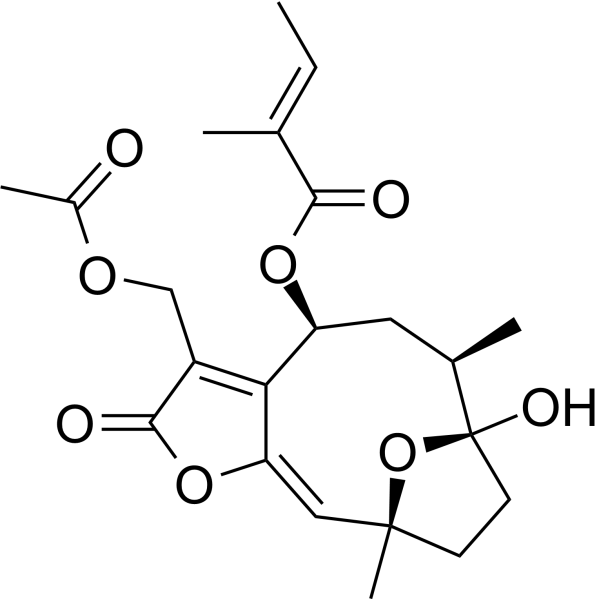
    8αTGH

    STAT Pyroptosis Apoptosis Reactive Oxygen Species (ROS) c-Myc Bcl-2 Family TrxR Cancer
    8α-Tigloyloxyhirsutinolide 13-O-acetate (8αTGH) is a potent and orally active STAT3 inhibitor. 8α-Tigloyloxyhirsutinolide 13-O-acetate induces early oxidative stress and pyroptosis, and late DNA damage, cell cycle arrest, apoptosis in the TNBC cells. 8α-Tigloyloxyhirsutinolide 13-O-acetate suppresses tumor cell growth in vitro and tumor growth in vivo .
    8α-Tigloyloxyhirsutinolide 13-O-acetate
  • HY-144638

    Apoptosis Cancer
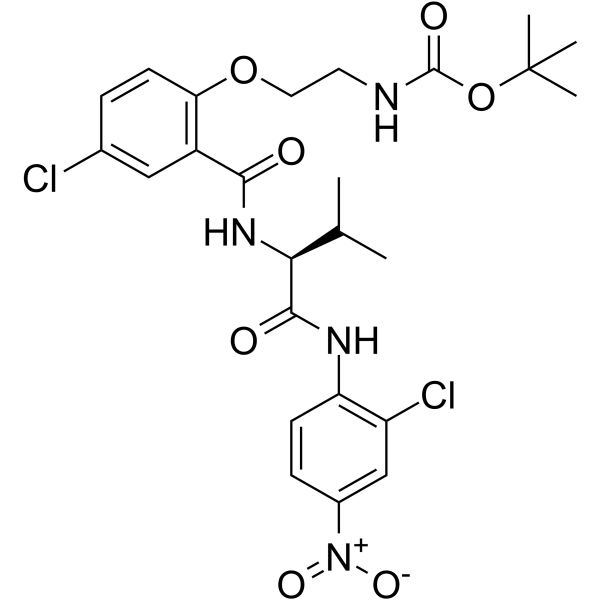
    JMX0293 is an O-alkylamino-tethered salicylamide derivative compound. JMX0293 maintains good potency against MDA-MB-231 cell line (IC50 = 3.38 μM) while exhibiting very low toxicity against human non-tumorigenic breast epithelial cell line MCF-10A (IC50> 60 μM). JMX0293 inhibits STAT3 phosphorylation and contribute to apoptosis in TNBC MDA-MB-231 cells. JMX0293 significantly suppresses MDA-MB-231 xenograft tumor growth in vivo without significant toxicity .
    JMX0293
  • HY-W010713

    Fimaporfin free base

    Photosensitizer Cancer
    Meso-tetraphenylchlorin (TPCS2a) is a photosensitizer with poor water solubility, which limits its use in the blood circulation. However, TPCS2a@NPs nanoparticles can be prepared based on polylactic-co-polyethylene glycol acid (PLGA) polymer core loaded with TPCS2. Such nanoparticles can be coated with mesenchymal stem cell-derived plasma membranes (mMSCs) to form mMSC-TPCS2a@NPs, which prolongs blood circulation time and improves tumor targeting ability. Compared with uncoated TPCS2a@NPs, mMSC-TPCS2a@NPs can reduce macrophage uptake by 54% to 70% under different conditions. Both nanoparticle forms are effectively accumulated in MCF7 and MDA-MB-231 breast cancer cells, while uptake in normal breast epithelial cells MCF10A is significantly lower .
    Meso-tetraphenylchlorin
  • HY-174854

    HDAC Reactive Oxygen Species (ROS) Apoptosis Cancer
    PySAHA is a multifunctional HDAC inhibitor. PySAHA can degrade intracellular HDAC via a hydrophobic tagging mechanism. PySAHA also possesses photodynamic therapeutic activity and can generate reactive oxygen species under light irradiation. PySAHA can inhibit the proliferation, migration and induce cell apoptosis of breast cancer cells. PySAHA has antitumor activity and can be used in breast cancer research .
    PySAHA
  • HY-178822

    Drug Derivative Cancer
    AQ-13 (Compound 7) is a Chloroquine (HY-17589A) analogue with anti-breast cancer property. AQ-13 shows antiproliferative activities against MDA-MB231 and MCF7 with GI50 of 27.81 and 17.85 μM. AQ-13 shows low cytotoxicity against non-cancerous breast epithelial cells MCF10A (GI50 = 65.26 μM). AQ-13 can be used for the research of breast cancer .
    AQ-13
  • HY-182032

    VEGFR Apoptosis Reactive Oxygen Species (ROS) Cancer
    VEGFR-2-IN-83 is a VEGFR-2 kinase inhibitor with an IC50 of 0.037 μM. VEGFR-2-IN-83 induces G0/G1 cell cycle arrest and apoptosis in breast cancer cells, and increases the production of reactive oxygen species (ROS). VEGFR-2-IN-83 is applicable to relevant research on breast cancer .
    VEGFR-2-IN-83
  • HY-181060

    Apoptosis DNA/RNA Synthesis Caspase Bcl-2 Family MDM-2/p53 Cancer
    Apoptosis inducer 56 is an apoptosis inducer. Apoptosis inducer 56 induces DNA damage (upregulation of γH2AX and p-ATM expression) by minor groove binding. Apoptosis inducer 56 induces intrinsic apoptosis (upregulation of p53 and Bax/Bcl-2 ratio, cleaved caspase-7) via S-phase cell cycle arrest. Apoptosis inducer 56 shows selectivity for cancer cells over normal breast epithelial cells. Apoptosis inducer 56 can be used for the research of breast cancer .
    Apoptosis inducer 56
  • HY-183804

    PROTACs Estrogen Receptor/ERR Cancer
    PROTAC ER Degrader-16 is an orally active ERα PROTAC degrader with a DC50 of 1.4 nM and an IC50 of 1.9 nM. PROTAC ER Degrader-16 inhibits ER-dependent breast cancer cell proliferation and exerts anti-tumor effects in mouse models. PROTAC ER Degrader-16 can be used for breast cancer research .
    PROTAC ER Degrader-16

Inquiry Online

Your information is safe with us. * Required Fields.

Salutation


Country or Region *

Applicant Name *


Organization Name *

Department *


Email Address *


Product Name *

Cat. No.


Requested quantity *

Phone Number *


Remarks

Inquiry Online

Inquiry Information

Product Name:
Cat. No.:
Quantity:
MCE Japan Authorized Agent:

