1. Search Result
Search Result
Results for "

bilirubin oxidase

" in MedChemExpress (MCE) Product Catalog:

9

Inhibitors & Agonists

1

Biochemical Assay Reagents

3

Natural
Products

Cat. No. Product Name Target Research Areas Chemical Structure
  • HY-135005A
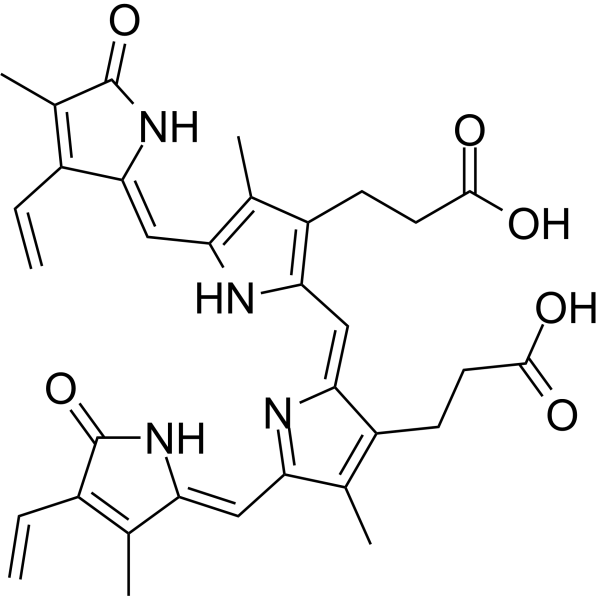
    Biliverdin
    1 Publications Verification

    Endogenous Metabolite Inflammation/Immunology
    Biliverdin, a tetrapyrrolic pigment, is a product of heme catabolism. Heme is broken down into Biliverdin and carbon monoxide and iron by heme oxidase. Biliverdin is then quickly broken down to bilirubin by Biliverdin reductase. Biliverdin can mediate the protective effects of HO-1 in many disease models including IRI and organ transplantation. Biliverdin exhibits anti-mutagenic, an antioxidant, anti-inflammatory, and immunosuppressant properties .
    Biliverdin
  • HY-135005
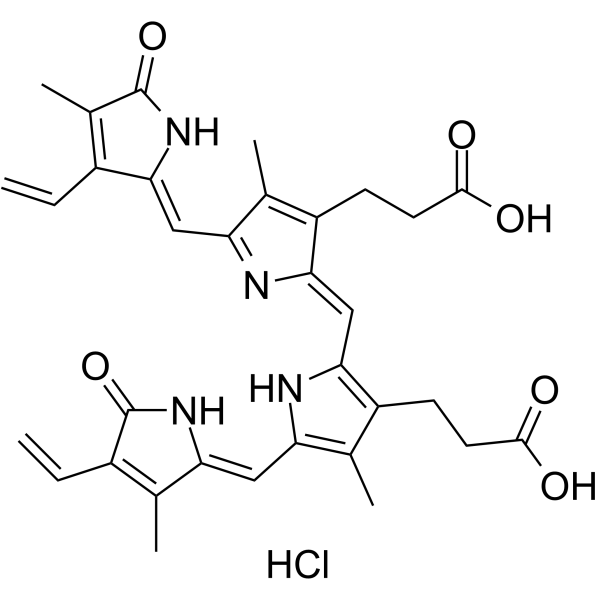
    Biliverdin hydrochloride
    1 Publications Verification

    Endogenous Metabolite Inflammation/Immunology
    Biliverdin hydrochloride, a tetrapyrrolic pigment, is a product of heme catabolism. Heme is broken down into Biliverdin and carbon monoxide and iron by heme oxidase. Biliverdin hydrochloride is then quickly broken down to bilirubin by Biliverdin reductase. Biliverdin hydrochloride is anti-mutagenic, an antioxidant, anti-inflammatory, and immunosuppressant .
    Biliverdin hydrochloride
  • HY-P2888

    BOD

    Biochemical Assay Reagents Metabolic Disease
    Bilirubin oxidase (BOD) is an electrocatalyst with oxygen removal activity. Bilirubin oxidase can catalyze the oxidation of bilirubin to biliverdin. Bilirubin oxidase participates in the metabolism of porphyrins and chlorophyll, and acts as a catalyst for oxygen reduction. Bilirubin oxidase can serve as a component of a single-enzyme oxygen removal system for reductase-based voltammetric biosensors .
    Bilirubin oxidase
  • HY-P2888A

    BOD, bacillus cereus

    Endogenous Metabolite Metabolic Disease
    Bilirubin oxidase, bacillus cereus is a multi-copper oxidase that catalyzes the oxidation of bilirubin into biliverdin, as well as other tetrapyrroles, phenols, and aryl diamines. Bilirubin oxidase, bacillus cereus can serve as a single-enzyme deoxygenator, catalyzing the direct reduction of oxygen to water in the presence of electron donor substrates, without releasing hydrogen peroxide. Bilirubin oxidase, bacillus cereus can be used to develop enzyme-based biosensors .
    Bilirubin oxidase, bacillus cereus
  • HY-P2888C

    BOD, Bacillus pumilus

    Endogenous Metabolite Metabolic Disease
    Bilirubin oxidase (BOD), Bacillus pumilus is a multicopper oxidase that catalyzes the oxidation of bilirubin to biliverdin, as well as other tetrapyrrole, phenols, and aryl diamines. Bilirubin oxidase, Bacillus pumilus can serve as a single-enzyme deoxygenator, catalyzing the direct reduction of oxygen to water in the presence of electron donor substrates, without releasing hydrogen peroxide. Bilirubin oxidase, Bacillus pumilus can be used to develop enzyme-based biosensors .
    Bilirubin oxidase, Bacillus pumilus
  • HY-P2888B

    BOD, Magnaporthe oryzae

    Endogenous Metabolite Metabolic Disease
    Bilirubin oxidase (BOD), Magnaporthe oryza is a multi-copper oxidase that catalyzes the oxidation of bilirubin to biliverdin and reduces molecular oxygen to water. Bilirubin oxidase, Magnaporthe oryzae can participate in the metabolism of porphyrin and chlorophyll, and is widely used in biochemical research as a catalyst for oxygen reduction .
    Bilirubin oxidase, Magnaporthe oryzae
  • HY-P2888D

    Biochemical Assay Reagents Metabolic Disease
    Bilirubin Oxidase, Myrothecium verrucaria (EC 1.3.3.5) is a family of oxidoreductases that act on the CH-CH group as a donor and use oxygen as an acceptor. Bilirubin Oxidase, Myrothecium verrucaria (EC 1.3.3.5) is involved in the metabolism of porphyrins and chlorophyll. The two substrates of Bilirubin Oxidase, Myrothecium verrucaria (EC 1.3.3.5) are bilirubin and O2, while its two products are biliverdin and H2O.
    Bilirubin Oxidase, Myrothecium verrucaria
  • HY-136973

    Biochemical Assay Reagents Inflammation/Immunology
    Biliverdin dihydrochloride, a tetrapyrrolic pigment, is a product of heme catabolism. Heme is broken down into Biliverdin dihydrochloride and carbon monoxide and iron by heme oxidase. Biliverdin dihydrochloride is then quickly broken down to bilirubin by Biliverdin hydrochloride reductase. Biliverdin hydrochloride is anti-mutagenic, an antioxidant, anti-inflammatory, and immunosuppressant .
    Biliverdin dihydrochloride
  • HY-135005R

    Endogenous Metabolite Inflammation/Immunology
    Biliverdin (hydrochloride) (Standard) is the analytical standard of Biliverdin (hydrochloride). This product is intended for research and analytical applications. Biliverdin hydrochloride, a tetrapyrrolic pigment, is a product of heme catabolism. Heme is broken down into Biliverdin and carbon monoxide and iron by heme oxidase. Biliverdin hydrochloride is then quickly broken down to bilirubin by Biliverdin reductase. Biliverdin hydrochloride is anti-mutagenic, an antioxidant, anti-inflammatory, and immunosuppressant .
    Biliverdin hydrochloride (Standard)

Inquiry Online

Your information is safe with us. * Required Fields.

Salutation


Country or Region *

Applicant Name *


Organization Name *

Department *


Email Address *


Product Name *

Cat. No.


Requested quantity *

Phone Number *


Remarks

Inquiry Online

Inquiry Information

Product Name:
Cat. No.:
Quantity:
MCE Japan Authorized Agent:

